AI generated photo for representation purposeWhy the switch from Google Assistant to Gemini is a 'big change'The ‘Overthinking’ problemWhat happens next?
Whether setting a reminder, calling a contact on speakerphone while cooking or turning off the living room lights, Google Assistant functioned as a workhorse.
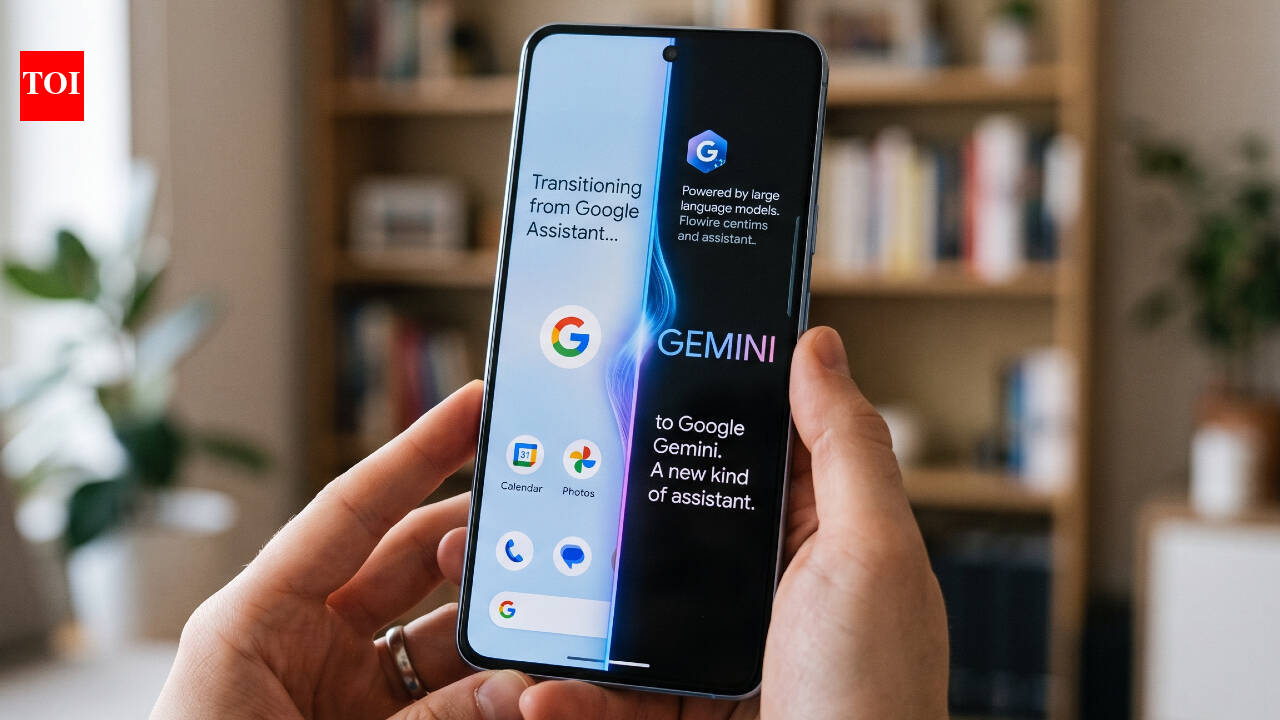
Google has officially confirmed that it will begin systematically removing Google Assistant from Android phones, tablets, Wear OS smartwatches, wireless headphones and phone-projected Android Auto systems starting September 4, 2026.
While Google previously allowed users to switch back to Assistant if the newer AI stumbled, the tech giant is now closing that exit door.
When you ask Google Assistant to turn off a light, it does not evaluate context, but it executes a hardcoded script.
AI generated photo for representation purpose
Why the switch from Google Assistant to Gemini is a 'big change'
The ‘Overthinking’ problem
What happens next?
For nearly a decade, a simple “Hey Google” or “Okay Google” were the reliable digital spoken bridge between millions of users and their smartphones as well as other Android-powered devices. Whether setting a reminder, calling a contact on speakerphone while cooking or turning off the living room lights, Google Assistant functioned as a workhorse. It was not meant to be conversational or creative; it was built to obey narrow, explicit instructions without overthinking them.That personal digital assistant is going, or rather being replaced by a better-equipped skillset, including predictability. Google has officially confirmed that it will begin systematically removing Google Assistant from Android phones, tablets, Wear OS smartwatches, wireless headphones and phone-projected Android Auto systems starting September 4, 2026. In its place, users are being pushed into the warm, chatty embrace of Gemini, Google’s flagship generative artificial intelligence (AI).The rollout will happen gradually over several weeks depending on device and region. While Google previously allowed users to switch back to Assistant if the newer AI stumbled, the tech giant is now closing that exit door. Once the phaseout reaches a device, the choice is gone for good.The transition marks one of the most significant shifts in mobile software history—probably bigger than Google Assistant coming to mobile devices. Notably, Google’s decision to sunset Assistant is not entirely unexpected. Since launching Gemini, the company has positioned generative AI as the future of human-computer interaction.One of the biggest reasons for this change is the numbers. Google said that Gemini reached 950 million monthly active users in recent months, more than doubling its footprint within a single year while daily interactions tripled. By comparison, Google Assistant served roughly 500 million monthly active users at its peak in 2020.Google Gemini has already made its way to other consumer-centric offerings such as Docs and Gmail, and as a standalone app that is capable of summarising complex documents, drafting emails, analysing images and holding fluid, human-like conversations. Mobiles are naturally next line, and moving nearly a billion users from a rigid command-and-control utility to a complex large language model introduces a fundamental transformation.People got used to getting straightforward answers and undertook tasks with simpler commands that they learned. The central challenge facing holdouts is that generative AI, by its very nature, operates differently than traditional voice software. When you ask Google Assistant to turn off a light, it does not evaluate context, but it executes a hardcoded script. Generative AI models like Gemini, on the other hand, are designed to interpret, synthesize, and generate language.They train themselves, strike a conversation as if you are talking to an assistant this is because generative models are exponentially more capable than traditional assistants, they are often less suited to simple, predictable tasks. When a user issues a basic home automation command, they need a reliable switch. Adding generative layers risks overcomplicating requests that previously produced an instant action.A real-world example is: Ask Google Assistant to turn the light off; it will do it. Ask Gemini to turn off the light; it will undertake the task but also asks, "Do you want me to do any other task?" You can stay quiet, but the human impulse pushes you to reply to the question. So, for some, this conversational style may be ‘too much,' while others may like it, as the responses are more human and 'caring.'Furthermore, Gemini still suffers from noticeable feature gaps compared to its predecessor. This transition, much like Google Assistant’s own evolution before it, remains very much a work in progress. Some users had found a comfort zone with Assistant over the years, and now, having to switch gears to Gemini all over again may take some getting used to.This means that for the average smartphone user, an occasional voice command hiccup is a minor annoyance. For individuals who depend on voice access due to visual impairments or motor disabilities, a failed command carries far higher stakes.At the same time, the transition is not without major benefits. Gemini’s advanced vision capabilities have delivered significant upgrades when integrated into accessibility tools like TalkBack, Android’s screen reader. The AI can analyse app layouts and web photos in real time, offering rich, highly detailed verbal descriptions of images that traditional software could never interpret.The challenge for Google lies in bridging this divide: ensuring that as Gemini learns to analyze the world, it does not forget how to set a five-minute alarm. Users on older or lower-spec devices aren't being left behind entirely: Google has already rolled out Gemini Go, a lightweight version built for phones with as little as 2GB of RAM, while devices that don't meet even that bar will keep the legacy Assistant for now.With this move, Google Assistant is set to join the crowded "Killed by Google" graveyard alongside past casualties like Google Podcasts and Stadia. The rollout begins September 4, 2026, and Google says it will take several weeks to reach all eligible devices worldwide. Until then, users who want a head start can manually switch to Gemini through the Google app or their device settings — but for the millions who'd rather wait, the countdown to that irreversible switch has now officially begun.