Gaurav Gupta’s latest collection, Light Song, unveiled at the Jio World Convention Centre in Mumbai on 17 July, is nominally a fashion show.
Light Song builds on Gupta’s Paris outing earlier this year, The Divine Androgyne, extending its meditation on masculine and feminine energy into a lunar-solar cosmology borrowed from Indian philosophy.
But the sheer density of logos at Light Song is a useful data point on how Indian couture houses are choosing to fund six-thousand-hour production runs in an era when the customer base for genuine haute couture, even in a market as large as India’s, remains vanishingly small.
They get one anyway, because MG Motor is buying not horsepower but heritage-by-association, and Gupta, entirely rationally, is selling it.
Light Song’s craftsmanship suggests the House still knows exactly what it is doing with a needle and thread.
MUMBAI: Seventy couture looks. Two hundred artisans. Six thousand hours of hand-craftsmanship stretched over nine months. And, somewhere in the middle of it all, a limited-edition Mahjong set for HSBC cardholders. Gaurav Gupta’s latest collection, Light Song, unveiled at the Jio World Convention Centre in Mumbai on 17 July, is nominally a fashion show. In practice it is closer to a trade fair with better lighting, and the distinction says a great deal about where Indian couture’s economics have quietly relocated.
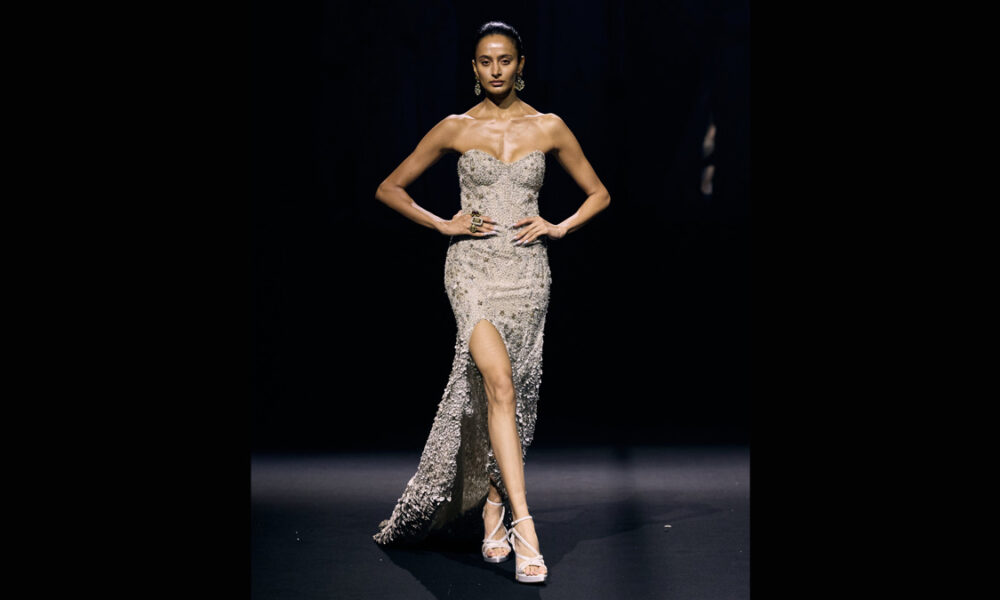
Start with the clothes, because they remain, in fairness, the point. Light Song builds on Gupta’s Paris outing earlier this year, The Divine Androgyne, extending its meditation on masculine and feminine energy into a lunar-solar cosmology borrowed from Indian philosophy. Lunar, the first act, deploys crater-inspired textures and over 20,000 crystals in powder blue and midnight tones; Solar, drawing on the Konark Sun Temple, answers with metallic brocades and five new bridal lehengas; Cosmic Union closes the loop in ivory and pearl, its chikankari revival nodding to a saree first worn by Deepika Padukone two decades ago. Ananya Panday closed the show in a bridal creation built from more than 5,000 hand-cut Camellia petals, 1,500 artisan-hours condensed into a single walk down the ramp. Whatever one makes of the cosmic framing, the craftsmanship figures are not marketing inflation; Indian couture houses genuinely do employ small armies of embroiderers for months at a stretch, and Gupta’s numbers sit comfortably within that tradition.
What has changed is everything wrapped around the clothes. Light Song’s guest list of brand partners reads less like a couture show’s credits and more like a diversified conglomerate’s annual report: JSW MG Motor India unveiled bespoke couture editions of two cars, the M9 and the Cyberster, dressed in Gupta’s signature Serpent Infinity motif; Huda Beauty signed on as official beauty partner and used the runway to push its new Liquid Matte Mousse; Kolkata’s Nemichand Bamalwa & Sons supplied the Polki and Jadau jewellery; Kérastase brought its Gloss Absolu range to the hairstyling; Favre Leuba and its Indian retail partner Ethos announced a forthcoming co-created timepiece; and HSBC, apparently unwilling to be left out of a room this photogenic, unveiled a Mahjong set. Six sponsor quotes made it into the official release, each dutifully invoking words like “philosophy,” “heritage” and “dream partnership.”
None of this is unique to Gupta, and none of it is dishonest exactly — automakers and beauty brands have chased the emotional halo of couture for years, and Favre Leuba’s claim to an 1865 Indian lineage is genuine enough. But the sheer density of logos at Light Song is a useful data point on how Indian couture houses are choosing to fund six-thousand-hour production runs in an era when the customer base for genuine haute couture, even in a market as large as India’s, remains vanishingly small. A 70-look, 200-artisan collection is not paid for by bridal commissions alone; it is paid for by turning the runway into rentable real estate for brands that want proximity to craftsmanship they cannot manufacture themselves. Cars do not usually need a Serpent Infinity motif. They get one anyway, because MG Motor is buying not horsepower but heritage-by-association, and Gupta, entirely rationally, is selling it.
The interesting question is not whether this is a betrayal of couture’s supposed purity — that ship, globally, sailed with the first perfume licensing deal decades ago — but whether the sponsorship sprawl eventually dilutes the very scarcity that makes the collaboration valuable in the first place. When a single show simultaneously narrates lunar philosophy, launches a car trim, debuts a hair range and unveils a board game, the emotional through-line Gupta describes — reflection, radiance, intuition, vitality — has to compete for attention with rather more prosaic messaging about Liquid Matte Mousse. Light Song’s craftsmanship suggests the House still knows exactly what it is doing with a needle and thread. Its guest list suggests it has become equally fluent in something rather less poetic: monetising the halo before the dresses have even reached a client’s wardrobe.