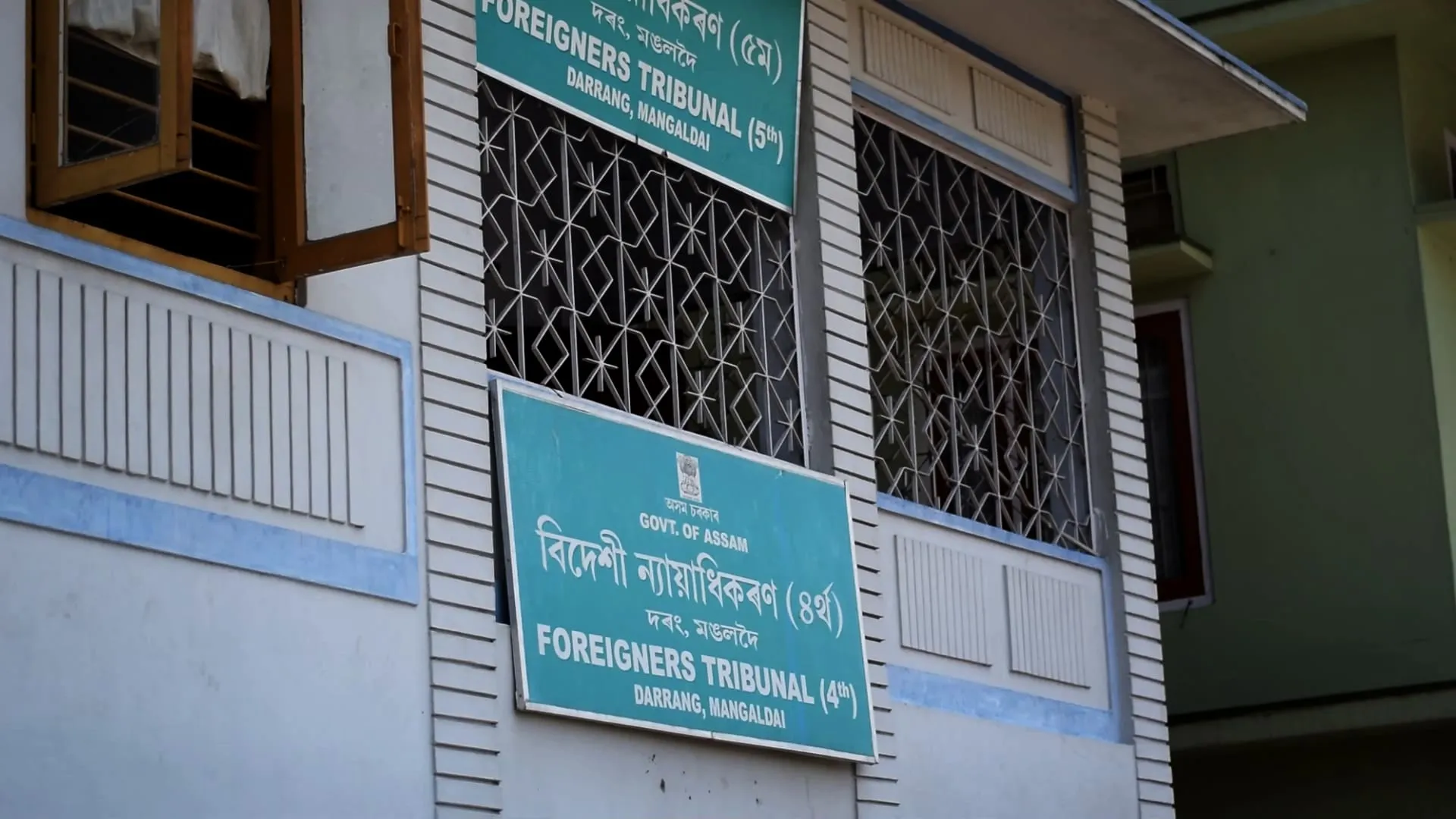
The petitioner,Aminul Hoque, a daily-wage labourer residing in a rented house, challenged a February 28, 2019 order of the Foreigners' Tribunal after alleging that an investigating officer had submitted an unfair inquiry report, leading to his being declared a foreigner.
However, the Foreigners' Tribunal found several inconsistencies in the documentary evidence.
It stated that the documents failed to establish the petitioner's linkage with ancestors whose presence in India before January 1, 1966 had been established.
Notably, in July 2025, a report by the National Law School of India University (NLSIU) and Queen Mary University of London alleged widespread arbitrariness and due process violations in the functioning of Assam's Foreigners Tribunals.
It alleged that Foreigners Tribunals routinely rejected documentary and oral evidence, lacked adequate legal safeguards against wrongful targeting, and had become routine instruments of exclusion.
Despite producing 15 documents, including records from the 1951 National Register of Citizens (NRC), multiple electoral rolls, a school certificate, PAN card and Elector's Photo Identity Card (EPIC), the Gauhati High Court has upheld a Foreigners' Tribunal order declaring an Assam resident a foreigner, holding that he failed to establish his Indian citizenship.
A Bench of Justices Kalyan Rai Surana and Shamima Jahan on Tuesday observed that the petitioner had failed to discharge the burden cast upon him under Section 9 of the Foreigners Act, 1946, which requires a person to prove that they are not a foreigner.
The court also held that oral testimony alone was insufficient to establish that the petitioner was the same individual whose name appeared in electoral rolls from the 1990s and later years.
"Though the petitioner had exhibited 15 documents as exhibits, the same does not appear to help the petitioner to establish that he has been able to discharge his burden as required under Section 9 of the Foreigners Act, 1946 to prove that he is not a foreigner but an Indian citizen," the court said.
The petitioner,Aminul Hoque, a daily-wage labourer residing in a rented house, challenged a February 28, 2019 order of the Foreigners' Tribunal after alleging that an investigating officer had submitted an unfair inquiry report, leading to his being declared a foreigner.
The petitioner argued that he is an Indian citizen by birth and traced his family's lineage through official records dating back to the 1951 National Register of Citizens (NRC).
He claimed his father's name, along with those of his grandparents and other family members, appeared in the 1951 NRC in Charai Khasara village in Goalpara district.
According to him, the family later moved to Dhobakura due to erosion caused by the Brahmaputra River, and their names continued to appear in electoral rolls from 1966 onwards.
He further contended that his grandfather purchased land in Ghugudoba in 1973, following which the family shifted there after a partition, and later moved to Hashdoba for better livelihood.
Born on May 1, 1988, the petitioner said he was raised in Ghugudoba and Hashdoba and relied on 16 documents, including the 1951 NRC, electoral rolls from 1966 to 2017, a 1973 land deed, his school certificate, PAN card, and Elector's Photo Identity Card (EPIC) to establish his citizenship.
The petitioner argued that variations in the spelling of his father, mother and grandfather's names across different documents referred to the same individuals and were the result of minor clerical inconsistencies that should not invalidate his citizenship claim.
He also examined himself and his father before the tribunal, both of whom testified that the family had continuously resided in Assam and that he was an Indian citizen by birth.
Before the High Court, the petitioner's counsel argued that he had been wrongly declared a foreigner merely because of minor discrepancies in the spelling of his father and grandfather's names across various records.
Relying on Supreme Court precedent, counsel submitted that such variations are common and cannot be treated as a valid ground for denying citizenship.
Counsel further contended that the computer-generated NRC records were admissible and reliable evidence and could not be rejected on technical grounds.
However, the Foreigners' Tribunal found several inconsistencies in the documentary evidence. It noted that the 1979 electoral roll contained nine names, of which two were not proved to be members of the petitioner's family. It also found discrepancies in the recorded ages, observing that one individual shown as 25 years old in 1979 was recorded as 29 years old in the 1989 electoral roll.
https://youtu.be/S2MDhbXJfIo?si=sudpf6v0JGYkS3U2
The tribunal further observed that the names appeared across three different villages, Dhobakura, Ghugudoba and Hashdoba, suggesting the existence of three distinct family units rather than a continuous family lineage. It stated that the documents failed to establish the petitioner's linkage with ancestors whose presence in India before January 1, 1966 had been established.
Upholding the tribunal's findings, the High Court held that the petitioner had failed to demonstrate any legal error in the appreciation of evidence or show that the tribunal had relied on irrelevant material or ignored applicable law.
Finding no perversity or illegality in the tribunal's order, the court dismissed the petition and held that the consequences flowing from the tribunal's opinion declaring the petitioner a foreigner would follow in accordance with law.
Notably, in July 2025, a report by the National Law School of India University (NLSIU) and Queen Mary University of London alleged widespread arbitrariness and due process violations in the functioning of Assam's Foreigners Tribunals.
Titled "Unmaking Citizens: The Architecture of Rights Violations and Exclusion in India's Citizenship Trials," the study analysed more than 1,200 Gauhati High Court orders, key Supreme Court judgments, and interviews with lawyers and litigants. It alleged that Foreigners Tribunals routinely rejected documentary and oral evidence, lacked adequate legal safeguards against wrongful targeting, and had become routine instruments of exclusion.
The report argued that the Foreigners Tribunal system was "a legally unsustainable regime that violates the most basic tenets of constitutional democracy and international human rights," calling for it to be dismantled and replaced with "a framework grounded in law, fairness, and justice."