The launch highlights Xiaomi's broader strategy of developing in-house silicon across smartphones, AI, intelligent driving and its wider human-car-home ecosystem.
The launch of the XRING O1 in 2025 marked Xiaomi's return to in-house smartphone silicon.
Just over a year later, Xiaomi is expanding beyond smartphone SoCs into AI acceleration and intelligent driving.
XRING O100 is designed for on-device edge AI applications for devices including smartphones, PCs, robots, EVs, AI Cube.
AI CubeXiaomi also showcased the AI Cube, an NPU-based engineering prototype mini-PC that combines the XRING O3, XRING O100 and XRING D100.
Xiaomi Technology’s latest XRING entails more than just a new smartphone chip. The launch highlights Xiaomi's broader strategy of developing in-house silicon across smartphones, AI, intelligent driving and its wider human-car-home ecosystem.
Xiaomi's first attempt at developing smartphone SoCs dates back to the Surge S1 in 2017, but the effort did not scale into a sustained smartphone chipset business. The launch of the XRING O1 in 2025 marked Xiaomi's return to in-house smartphone silicon. Just over a year later, Xiaomi is expanding beyond smartphone SoCs into AI acceleration and intelligent driving.
XRING O3
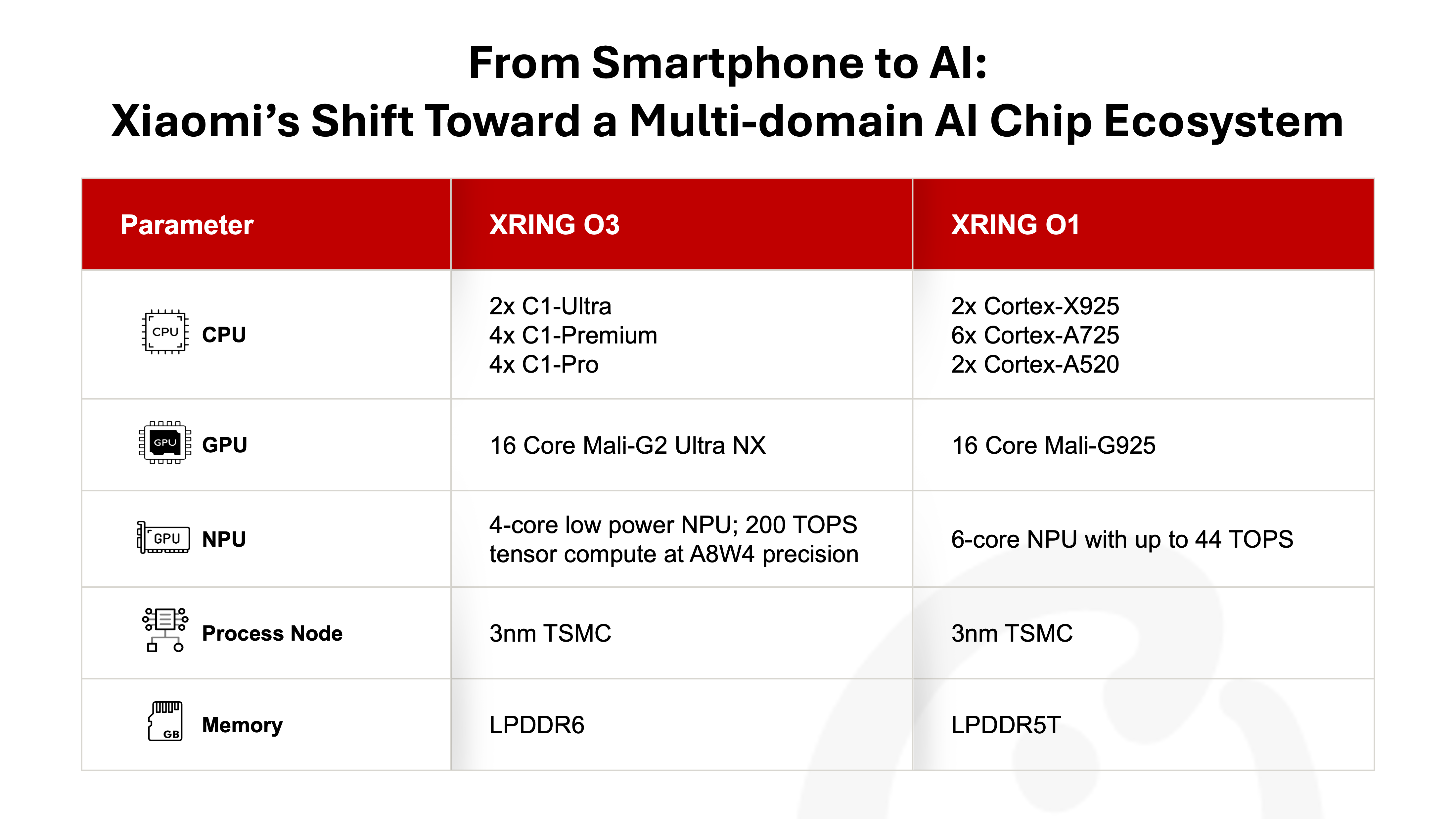
XRING O3 features some breakthroughs, with 10-core all-big-core CPU architecture featuring 2x C1-Ultra + 4x C1-Premium + 4x C1-Pro and is built on TSMC’s 3nm node. Another major improvement is that it features 16-core G2-Ultra NX GPU delivering major GPU performance enhancement as compared to its competitors. The world's first smartphone SoC to support LPDDR6, with 10667 Mbps memory speed and 113.8GB/s memory bandwidth.
Key Parameters:
Process Node: 3nm TSMC
CPU: 10-core all-big-core
GPU: 16-core G2-Ultra NX – 85% peak performance, 182% ray tracing improvement, and up to 64% lower power as compared to previous generation; 8 integrated NX neural accelerators (3.2K/120fps hardware frame interpolation).
NPU: 4-core low-power architecture; 200 TOPS tensor at A8W4 precision; 3.13 TFLOPS vector.
Memory: First SoC to support LPDDR6 with 10,667 Mbps speed and 113.8 GB/s; 60 MB system-level cache.
Comparison Between XRING O3 and XRING O1
Source: Xiaomi, Counterpoint Research
Expected Timeline: The XRING O3 will feature in the Xiaomi 18-Fold, which is likely to launch in September, and the Xiaomi Pad 9 Pro Max, which is likely to launch in Q4 2026.
Source: Xiaomi
XRING O100
The XRING O100 is the first AI-accelerator from Xiaomi. It vertically stacks a 6nm NPU compute wafer with dual high-speed DRAM memory wafers (Wafer-to-Wafer 3D Stacking), and uses advanced hybrid bonding, it is paired with Xiaomi’s in-house designed high-bandwidth matrix bus and features 14-core NPU with 1.22 TB/s memory bandwidth and up to 330 token/s edge inference on a 3B parameter model. The O100's wafer-on-wafer hybrid bonding at 1.4 μm pitch is among the major highlights, as it offers HBM-class bandwidth through advanced packaging on a mature 6nm node. XRING O100 is designed for on-device edge AI applications for devices including smartphones, PCs, robots, EVs, AI Cube.
Key Parameters:
Architecture: 14-core NPU array; high-bandwidth matrix bus
Packaging: 6nm with 3D wafer-level stacking; Wafer-on-Wafer advanced packaging, hybrid bonding at 1.4 μm bond pitch, 28,672 effective data lines
Memory Bandwidth: 1.22 TB/s near-memory computing bandwidth
Performance: 330 TPS on-device inference (Xiaomi lab)
XRING D100
Built on a 3nm process with a 20-core CPU and 16-core NPU architecture, the XRING D100 is designed to deliver high-performance AI computes for vehicles, featuring up to 160GB unified memory and can deploy 200B parameter on-device model.
AI Cube
Xiaomi also showcased the AI Cube, an NPU-based engineering prototype mini-PC that combines the XRING O3, XRING O100 and XRING D100. The system supports local deployment of Xiaomi’s 120B and 3B MiMo models, with fast/slow system switching and up to 150W of sustained performance.
Source: Xiaomi
The AI Cube could serve as an entry point for Xiaomi’s broader AI ambitions, providing a platform to optimize applications around its MiMo models and explore new AI use cases. It could also support Xiaomi’s broader smartphone-to-car strategy by extending its in-house silicon capabilities beyond smartphones.
By bringing memory and compute closer together, the XRING O100 can potentially improve data-movement efficiency and reduce memory bandwidth bottlenecks in bandwidth-intensive AI and LLM workloads. This architecture could also give Xiaomi greater control over its hardware-software stack and create opportunities to reduce its reliance on third-party compute platforms.
Over time, Xiaomi could integrate its in-house chipsets across a broader range of devices, potentially reducing its dependence on third-party hardware platforms and improving cost efficiency and margins, although the extent of these benefits will depend on scale, yields, software maturity and overall chip development costs.