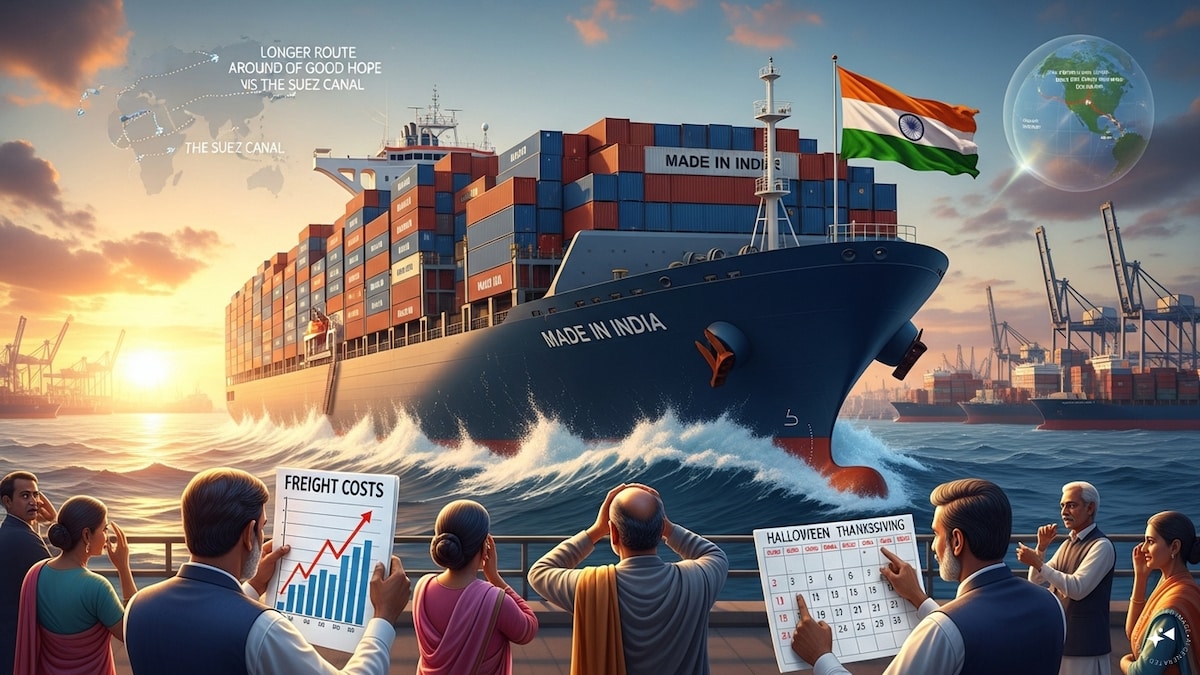
Indian exporters are facing yet another round of freight cost escalation, with shipping charges on almost every major route continuing to rise.Freight costs to the US, Europe and other Western regions have gone up by 3-4 times in the last couple of months.
This is further hampering India’s export capacity.The continued use of the longer Cape of Good Hope route is also impacting vessel schedules.
Indian exporters started using the route instead of the Suez Canal last year amid the Red Sea crisis and Houthi attacks.
The Cape route adds an additional 10-15 days to the voyage, further delaying the return of vessels.At the same time, festive season demand in US and Europe has further intensified the problem.
Supplies for the festive season typically begin in July-August every year.
Indian exporters are facing yet another round of freight cost escalation, with shipping charges on almost every major route continuing to rise.Freight costs to the US, Europe and other Western regions have gone up by 3-4 times in the last couple of months. On an average, exporters are now paying over $9,000 per container, compared with around $3,000 a couple of months ago.The sharp escalation in freight rates comes at a crucial time for Indian exporters, with the festive season and agricultural season approaching in key Western markets.Industry sources say multiple factors are contributing to the disruption, with the biggest issue being the timely availability of vessels rather than an outright shortage of vessels or containers.Congestion at ports has disrupted vessel schedules, affecting the timely availability of vessels for bookings. Industry experts say there is no shortage of vessels, but the disruption in schedules is making it difficult for exporters to secure vessels on time.Multiple blank sailings across several routes are further disrupting vessel schedules.Adding to the pressure, two out of five weekly shipping services to the US, including services to the East Coast, have been suspended. This is further hampering India’s export capacity.The continued use of the longer Cape of Good Hope route is also impacting vessel schedules. Indian exporters started using the route instead of the Suez Canal last year amid the Red Sea crisis and Houthi attacks. The Cape route adds an additional 10-15 days to the voyage, further delaying the return of vessels.At the same time, festive season demand in US and Europe has further intensified the problem. Supplies for the festive season typically begin in July-August every year. Exporters say that usually, freight charges increase every year in this period but this time the hike is extremely high with shipping companies charging 3-4 times of the usual price. This added with war risk charges, additional transportation charges to make sure the containers reach the most suitable port by road etc and other charged have increased the overall cost by many folds. And Indian exporters are bearing all this because they don't want to miss the peak festive season demand.With demand remaining strong and uncertainty over vessel schedules, shipping lines are charging exorbitant prices.Sunil Vaswani, Executive Director, Container Shipping Lines Association, told CNBC-TV18 that, "The current situation is not due to an actual shortage of vessels or containers, but a disruption in vessel schedules. This isn't an issue of vessel/container shortage. There is no shortage of vessels or containers. This is a matter of vessel schedules which is disrupted because of multiple reasons including Red Sea crisis, Strait of Hormuz Crisis and key and well-equipped ports like Jebel Ali not functioning at their full capacity. As a result, the voyage schedule is fully disrupted. The vessels are taking longer routes, stuck at ports due to congestion and taking more time to return. This has totally disrupted the integrity of the vessel schedule and bookings."He further said congestion at key transshipment and shipping hubs, including Colombo, Singapore and Malaysia, is intensifying the problem.Sources tell CNBC-TV18 that China is also frontloading exports to the US ahead of the festive season, further contributing to the lack of vessel availability on time.All of this is happening at a particularly crucial period for Indian exporters.The July-August period marks the beginning of the peak export season for Indian exporters catering to the festive demand in the US and Europe. This includes Diwali demand among the Indian diaspora as well as major Western festivals such as Halloween, Thanksgiving, Christmas and New Year.The period is also important for agricultural exports to these markets.Indian exporters typically begin shipping supplies from the end of July onwards to ensure that products reach overseas markets in time for the festive season. However, the unavailability of vessels on time, coupled with uncertainty over shipping schedules, is forcing exporters to pay exorbitant freight costs to avoid missing the peak festive season.With vessel schedules continuing to remain disrupted, exporters are now facing a double challenge, much higher freight costs and uncertainty over the timely availability of vessels.For Indian exporters, the concern is not merely the availability of shipping capacity, but whether that capacity will be available at the right time to meet peak-season demand.