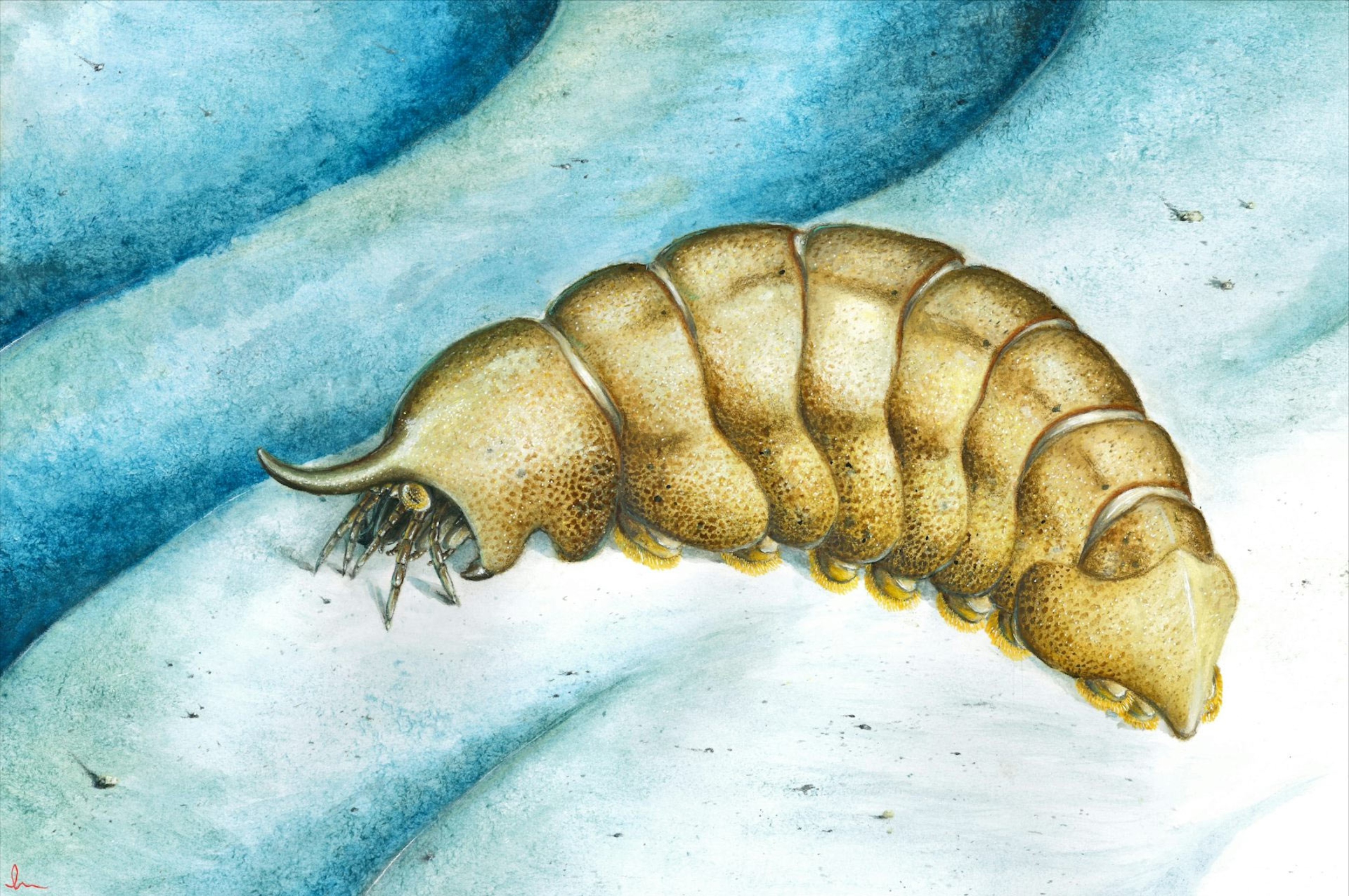
The fossil sat in a museum drawer for more than 60 years, collected in 1962 and largely ignored – until a researcher finally looked.
Known as the Furongian gap, it reads like a dip in the fossil record sandwiched between two bursts of life.
The team named it Magnicornaspis garwoodi, after Manchester paleontologist Russell Garwood, who has spent his career tracing the evolution of an ancient animal group.
Studying their bodies offers a rare look at how that branch of the animal tree took shape in its earliest days.
The animal carried those exaggerated head spines, and it lived in the Furongian – squarely inside the gap.
The world’s greatest fossil sites have one thing in common: someone went looking for them.
Paleontologists choose formations that already have a track record, dig in sediments that have yielded soft-bodied animals before, and build careers around places that reward the effort.
A specimen in the Smithsonian’s collections quietly upended that logic. Nobody went looking for it.
The fossil sat in a museum drawer for more than 60 years, collected in 1962 and largely ignored – until a researcher finally looked.
A familiar quiet stretch
Paleontologists have long run into the same problem with a specific window in time covering roughly 497 million to 485 million years ago, near the close of the Cambrian Period.
Known as the Furongian gap, it reads like a dip in the fossil record sandwiched between two bursts of life.
One of those bursts is the famous Cambrian explosion, when a dazzling variety of animals first showed up in the rock.
The other came later, in the Ordovician, when marine life expanded into the rich ecosystems that would define the seas for ages. Between them sat a stretch that looked comparatively barren.
The big question was always why. Did the oceans actually lose diversity, choked by shifting chemistry, cooling climates, and stretches of water starved of oxygen? Or were researchers simply not finding what was there?
That debate has run for years, laid out plainly in one widely cited paper asking whether the gap is real or just an illusion of missing rock.
The fossil nobody studied
The answer, at least in part, came from that slab of black shale collected during geological mapping near Québec, Canada. It went into the Smithsonian’s vast collections in Washington, D.C., and stayed there for more than half a century.
Russell Bicknell, a research fellow at Flinders University in Australia, came across the long-shelved specimen during his time at the American Museum of Natural History.
What he and his colleagues found was an arthropod – an animal with an external skeleton – preserved well enough to study in detail despite its age of roughly 500 million years.
The team named it Magnicornaspis garwoodi, after Manchester paleontologist Russell Garwood, who has spent his career tracing the evolution of an ancient animal group.
It was small, spiny, and broad-headed. It was also half a billion years old and virtually unknown.
Cousins of the spider
Magnicornaspis belongs to a rare and understudied family called the corcoraniids, a group that has long puzzled researchers because so few specimens exist.
They were small ocean-floor hunters, turning up in scattered sites across the globe from the Cambrian into the Ordovician.
The family carries real evolutionary weight. Corcoraniids sit near the base of the chelicerates – the lineage that eventually produced spiders, scorpions, and horseshoe crabs.
Studying their bodies offers a rare look at how that branch of the animal tree took shape in its earliest days. That makes any new corcoraniid valuable, but this one stood out for a specific reason.
It carried two large, forward-pointing spines on its head. This feature sets the creature apart from its known relatives and earns it a brand-new genus and species in the scientific record.
What the spines reveal
Here is where the find gets interesting. Until this study, the spiky head ornament seen in some corcoraniids was thought to be a later development – something that appeared once these animals reached the Ordovician.
Cambrian forms were supposed to be plainer. Magnicornaspis breaks that assumption.
The animal carried those exaggerated head spines, and it lived in the Furongian – squarely inside the gap.
That places the spiny body plan millions of years earlier than expected and shows it had a Cambrian origin after all.
The shift hints at changing defensive strategies within the group over time, with different species experimenting with spine placement on different parts of the body.
For an animal lineage this old and this poorly known, watching that variety emerge is a genuine addition to the story rather than a confirmation of what was already filed away.
How a soft body survived
The preservation itself tells part of the tale. Magnicornaspis turned up as a flattened impression in dark shale, with chemical mapping showing the body enriched in calcium, phosphorus, carbon, and sulfur.
That signature is consistent with the body being locked in mineral deposits shortly after death – though exactly when and how that process unfolded remains open to interpretation.
This kind of fine preservation usually shows up in special deposits where soft-bodied creatures get entombed before they rot away.
The chemistry behind that process has been worked out in a separate study on Cambrian deposits.
What surprised the researchers here is where it happened.
The Rivière-du-Loup Formation, the Quebec rock unit holding the fossil, formed in a relatively deep marine slope setting and had never been flagged as a place to find exceptional fossils. Now it looks like a strong candidate for one.
Rethinking a barren age
That location detail feeds directly into the bigger argument.
If a delicate, soft-bodied arthropod can survive in deep-water rocks that nobody thought to search carefully, then the supposed emptiness of the Furongian gap may say more about where people have dug than about what actually lived.
Study co-author Julien Kimmig, a paleontologist at the Karlsruhe Institute of Technology in Germany (KIT), sees this as part of a broader pattern building over the past two decades.
Each new find from this interval chips away at the idea of a sparse, lifeless late Cambrian and replaces it with something richer.
“The Furongian may not represent a true collapse in biodiversity, but rather a gap where scientists have looked and what kinds of rocks have been studied,” said Kimmig.
The fossil joins a growing list of late Cambrian sites suggesting these ecosystems stayed diverse and complex.
Treasure in the drawers
There is a second lesson here, and it has nothing to do with spines or shale. This breakthrough did not come from a dramatic dig in the field.
It came from a specimen catalogued and forgotten for over 60 years – recovered, finally, through patience and a fresh pair of eyes.
That points to the quiet power of museum collections, which hold mountains of under-examined material gathered during surveys and expeditions across the past century.
Revisiting old finds with modern imaging and chemical tools can reshape what scientists thought they understood about ancient life.
What is now clear: spiny corcoraniids existed in the Furongian, pushing a key feature of these early spider relatives back into the Cambrian.
The find gives researchers a fresh place to search and a fresh reason to doubt the old story of a barren age.
The wider rebound of marine life that followed, detailed in this review, may have had deeper roots than anyone credited.
The study is published in the journal BMC Biology.
Image Credit: Thomas Turner.
—–
Like what you read? Subscribe to our newsletter for engaging articles, exclusive content, and the latest updates.
Check us out on EarthSnap, a free app brought to you by Eric Ralls and Earth.com.
—–