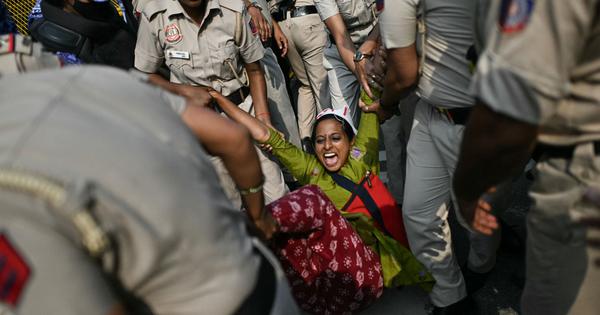
Photos and videos from the recent agitations show police dragging and bodily hauling away protesters , many of them young women .
Photo: Special arrangementScroll spoke to women protesters in Delhi and Pune about the rage driving them to hit the streets.
Photo: Divya AsleshaApart from gender discrimination, some young women were inspired to take up political activity by other socioeconomic problems.
“And I think that is also translating in some ways into how young women are making sense of their world,” she said.
Lalita, who has organised protests in Pune, said that she found the videos of police violence against women in Delhi unsurprising.
On October 10, the Delhi Police detained a group of people near INA Market for protesting against the controversial Special Intensive Revision of India’s voter rolls.
One of them was 22-year-old Ananya, who climbed onto the bonnet of the detention bus. A video shows that as the crowds closed in, a policeman shoved his pelvis against Ananya as she clung to the vehicle, while other women tried to push him away.
Ananya, a member of the Left-aligned All India Students Union, was undeterred by the incident, and was back on the streets the next day. “They think that if they hurt and traumatise us, we women won’t return to protest. But they can’t scare us off like this,” she said. “It is our right to have fair elections and protest peacefully.”
Like Ananya, many women protestors have been subjected to violence on the streets this year, both in July and October. Photos and videos from the recent agitations show police dragging and bodily hauling away protesters , many of them young women . Some women told Scroll they were groped and even beaten by the police .
Despite facing immense risks to their safety, women protestors have joined the protests in large numbers. In October, many had already been participating in ongoing agitations focused on violence against women, and continued on to join those against the SIR.
“While women had already participated in the paper leak protests in large numbers, it appears as if even more women have joined the protests this time,” said Mariam Dhawale, general secretary of the All India Democratic Women’s Association. “It’s possibly because a lot of them were already out on the streets protesting against a series of rape cases that occurred in the country.”
Ananya, who is 22 years old, is one of several women protestors who say they have been subjected to violence at the hands of the police in recent agitations. Photo: Special arrangement
Scroll spoke to women protesters in Delhi and Pune about the rage driving them to hit the streets. Their accounts suggest that they view their fight for safety, independence and rights as part of larger political struggles against injustice to marginalised groups, broader state failures, and importantly, a political regime that they view as misogynistic.
Referring to the Modi government’s “Beti Bachao, Beti Padhao” campaign, Sahar, a 20-year-old who is pursuing a master’s degree at Delhi University, said: “They see us as daughters when it’s convenient and question us using slurs. But do we not remain daughters when we’re being beaten up by the police?”
She added: “From facing sexual violence to losing your voting right to SIR, everything is political, and all these issues converge together.”
Political awakening
For many women who participated in the recent protests, the roots of their political awakening lay in experiences of gender discrimination at home.
Dhanashri, who is 21 years old, grew up in Pune watching her family favour her brother: he was gifted a bicycle and sent to a better school, and even served more food during meal times. Meanwhile, she was told to “adjust”.
“When we are young, we don’t understand or identify this discrimination as patriarchal but I did not like it,” she told Scroll in October during a small protest by student groups in Pune. “I still kept speaking up against it.”
Three years ago, in college, she joined the Left-leaning New Students and Youth Federation. That was when she began to understand patriarchy as more than discrimination, she said. “I used to get very angry in my initial years.”
Women’s liberation can often be perceived as an elite concern, but Dhanashri said, “Independence is important, be it a woman or man.”
Twenty-one-year old Dhanashri grew up watching her family favour her brother. She began to understand the wider context of patriarchy after joining a student group in college. Photo: Divya Aslesha
Dhanashri clashed frequently with her parents over the years because they did not like her being part of the student group. “My parents have even hit me for coming home late,” she said. However, with time, her parents have come to accept her beliefs. “They now know that I am fighting for the right things,” she said.
She added, “I keep open space for discussion with my family, even though sometimes we get irritated with each other. But it is okay, they have also grown up with a social conditioning, and it will take time to unlearn and change.”
Swapnaja, who is 29 years old, and is the Pune coordinator for Stree Mukti League, a revolutionary women’s organisation, recounted growing up with a father who hit her mother frequently. “I would read things about women’s choices, but often wondered, where is the full plan for women’s liberation, mukti, and how will we achieve it?” she said.
She went on to study engineering in Mumbai. She did not have very defined political ideas through these years, but her observations of the world around her troubled her – for instance, the glaring contrast between the rich and the poor. This motivated her to volunteer during the Covid-19 lockdown and help provide food to migrant workers.
“It felt wrong, given that they were being denied their right to earn a livelihood with dignity,” she said. “I was consumed by this question.”
This experience led her to formally join the Stree Mukti League. Today, she describes herself as a revolutionary, and says that understanding the “root of things” has been an important part of her politicisation.
She explained that anyone who was “bothered by the woman’s question” would try and “delve deep into it”. Analysing the problem more carefully would reveal a wider context – such as “the BJP’s propaganda” on so-called love jihad, as well as other socioeconomic matters.
“On why there is inflation today – we are told it is because of Muslims. Why is there unemployment – because Muslims are stealing jobs,” she said. “This attempt to create the figure of the “other” is automatically undone when you go to the root of matters.”
Growing up, Swapnaja, who is 29 years old, was troubled by her observations of injustice around her. During the Covid-19 lockdown, she volunteered to help provide food to migrant workers. Photo: Divya Aslesha
Apart from gender discrimination, some young women were inspired to take up political activity by other socioeconomic problems. For instance, 23-year-old Juliya, a member of the Left-aligned Students Federation of India, who grew up in Kerala, said she joined the organisation in school when it organised against buses that were refusing rides to children who could not afford tickets.
“SFI was the only group organising about this, and they managed to get the buses to accept students riding with their passes,” said Juliya. “This was a personal issue for me, so I joined them then and have stayed on ever since.”
The current protests
The protests that women had been organising and participating in Delhi before the SIR agitations focused on several problems, many pertaining to students. For instance, they demanded the improvement of crumbling campus infrastructure and the implementation of University Grants Commission regulations on equity on campuses, and also more broadly demanded better safety for women in public spaces.
Smriti, who is 20, and is the president of the Women’s Development Cell at Hindu College, had organised a protest against sexual violence in early October. “Public places are already unsafe, but often men stand outside our college gates, or they even come inside campus and leer at us, molest or flash us,” she said. She compared these agitations to the upswell of angry protests against the lack of safety for women in the winter of 2012 after a 22-year-old was brutally violated and gangraped, and died of severe injuries. “Why has nothing changed in so many years?” she said.
Young women were also angered by what they saw as the “protectionist, patriarchal logic” with which institutions responded to their demands, explained a feminist scholar who has studied women’s movements. The scholar cited the example of the Lady Shri Ram College shifting classes online after a 17-year-old girl was gangraped by three men in a park. Further, in response to the same incident, the Delhi Development Authority restricted access to its parks after sunset.
“Women’s safety really becomes a kind of code word for reconfiguring control over women,” said the scholar, who asked to remain anonymous because she works with a public institution and was not authorised to speak to the media. “But it is interesting for a new generation of women to discover that question in some ways for themselves.” She added, “Once you start seeing the politics in something, it’s easier to connect it to the politics of something else.”
A protest in Pune. Many women view their fight for safety, women’s rights and independence as part of larger political struggles, both against broader state failures, and for the rights of various marginalised groups. Photo: Divya Aslesha
Ananya recounted that the calls to protest against the SIR in October were circulated in several women’s WhatsApp groups active for “the smash the patriarchy” protests. “Women, even those who aren’t ideologically affiliated, responded with enthusiasm,” said Ananya. “They got enraged when they heard of the police sexually violating women protestors and journalists.”
Lalita, a 30-year-old member of the Revolutionary Workers Party of India in Pune, said young women had realised the limitations of “choice feminism” – which is the idea that women’s liberation is tied to their freedom to make choices for themselves.
“I have the right to wear what I want, but after getting educated – and look at the cost of education – do I have jobs?” said Lalita. “If I try to become independent, would I be able to sustain myself?”
Women’s slogans
The women’s protest marches drew particular attention and commentary on social media for their use of creative slogans such as “Ek chai, do samosa, inn mardon pe kya bharosa!” – a tea and two samosas, there is no trusting these men.
But women recounted that they had also raised more pointedly political slogans that did not receive as much attention – including some that targeted politicians who had been accused or convicted of crimes against women.
“We chanted – Kuldeep Singh se azaadi, Brij Bhushan se azaadi,” said Ananya. Kuldeep Singh Sengar , a legislator expelled from the BJP, was convicted in 2019 for raping a minor, and for later killing her father. Brij Bhushan Singh , a former BJP member of parliament, was accused of sexual assault by India’s top female wrestlers. His acquittal in August has been challenged by four wrestlers.
The slogans angered members of the Akhil Bharatiya Vidyarthi Parishad, a student organisation aligned with BJP’s ideological fountainhead, the Rashtriya Swayamsevak Sangh, Ananya recounted. “The ABVP miscreants suddenly came up to us and started misbehaving with us,” she said.
The feminist scholar argued that the regime’s lenience towards these leaders was revealing of its misogyny. “And I think that is also translating in some ways into how young women are making sense of their world,” she said.
Sahar, the 22-year-old Delhi University master’s student, argued, “Women know where the blame lies. While the protests were about the rape cases and our anger against patriarchal institutions, we know what kind of example this government has set by keeping leaders in power who have raped women.”
Sahar (in brown kurta) criticised the government for allowing leaders accused of violence against women to remain in power. Photo: Special arrangement
Women also targeted the regime’s most senior leaders. Sahar recalled that one of the placards said “Modiji kya ab culture shock hua?”
This was a response to a short video that Prime Minister Narendra Modi put up in July, after he came across videos of placards and slogans ridiculing him and the government. In his video, he had said it was a “cultural shock” for him to hear “daughters using such language”.
Sahar noted that apart from failing to tackle sexual violence, the government had also pursued policies which impacted women and minorities disproportionately. “It is married women, trans people and religious minorities who are facing the worst brunt of the SIR,” she said. “All of this is interconnected.”
Hypocrisy on gender
Many women protestors argued that it was ironic that the government had launched welfare schemes for girls and women, and yet unleashed violence against women in Delhi when they protested for their rights.
Lalita, who has organised protests in Pune, said that she found the videos of police violence against women in Delhi unsurprising. “We should all know what we are up against,” said Lalita. “All of this is being live-streamed. The evidence is available for all of us to see how this fascist state operates.”
She added, “We must know that the fascists use sexual violence and brutal violence as a tool to subjugate us.” Further, “We must also understand that our honour does not lie in women’s bodies,” she noted.
Like Ananya, many other women are also undeterred by police brutality. “So many of my comrades have been slapped, groped, their clothes have been torn, their t-shirts or kurtas pulled up,” said Juliya. “But we will still return.”
Juliya (in black t-shirt) at a protest in Delhi. She joined the Students Federation of India while in school when it organised against buses that were refusing rides to children who could not afford tickets. Photo: Special arrangement
Dhanashri, the 21-year-old student from Pune, was traveling to Delhi on October 8 to participate in protests when she and other students were pulled off their train in Itarsi and detained by the Madhya Pradesh police. “When I got detained, I felt that the only thing I had to do was resist,” she said. Her fear has since vanished. “I am no longer afraid of the state,” she said.
Ananya, too, echoed arguments about the government’s hypocrisy. “The state can mobilise so much security against peaceful protestors,” she said. “Where are these personnel, where is the state when women face sexual violence?
The feminist scholar argued that part of the reason police had responded violently to women was to make an example of them. “You don’t want other women to get the same kind of ideas, because there is a lot more at stake in ‘keeping women in control’,” she said.
The scholar pointed out that since many of the young women protestors are from Left groups, the regime was pushing forward a narrative about the protests that suggested, “These are not our betis and our betis wouldn’t do this”.
This argument, she said, was also being deployed to justify the use of force. “It’s almost like the argument is that because these are Left women, we need to treat them as ‘Left’, as ‘naxals’, and not as women,” she said.
If a 20-year-old has found her way to this politics, she said, “All of us don’t need to tell her what to do with that politics.” In fact, she explained, the recent protests had shattered the common belief that young women are not interested in feminist politics, or politics more generally. “There’s always a potential once someone starts seeing the world differently,” she said.