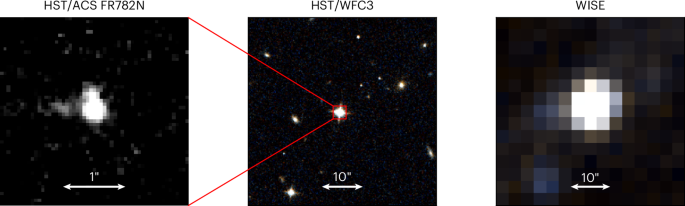
Fausnaugh, M. M. et al.
Curti, M. et al.
Yang, J. et al.
Burke, C. J. et al.
Gaskell, C. M. & Peterson, B. M. The accuracy of cross-correlation estimates of quasar emission-line region sizes.
Fausnaugh, M. M. et al. Space Telescope and Optical Reverberation Mapping Project. III. Optical continuum emission and broadband time delays in NGC 5548. Astrophys. J. 821, 56 (2016).
Cackett, E. M. et al. Supermassive black holes with high accretion rates in active galactic nuclei. XI. Accretion disk reverberation mapping of Mrk 142. Astrophys. J. 896, 1 (2020).
Pozo Nuñez, F., Bañados, E., Panda, S. & Heidt, J. Accretion disc reverberation mapping in a high-redshift quasar. Astron. Astrophys. 700, 8 (2025).
Vanden Berk, D. E. et al. The ensemble photometric variability of ~25,000 quasars in the Sloan Digital Sky Survey. Astrophys. J. 601, 692–714 (2004).
MacLeod, C. L. et al. A description of quasar variability measured using repeated SDSS and POSS Imaging. Astrophys. J. 753, 106 (2012).
Benati Gonçalves, H., Panda, S., Storchi Bergmann, T., Cackett, E. M. & Eracleous, M. Exploring quasar variability with ZTF at 0 < z < 3: a universal relation with the Eddington ratio. Astrophys. J. 988, 27 (2025).
York, D. G. et al. The Sloan Digital Sky Survey: technical summary. Astron. J. 120, 1579–1587 (2000).
Bellm, E. C. et al. The Zwicky Transient Facility: system overview, performance, and first results. Publ. Astron. Soc. Pac. 131, 018002 (2019).
Fan, X., Bañados, E. & Simcoe, R. A. Quasars and the intergalactic medium at cosmic dawn. Annu. Rev. Astron. Astrophys. 61, 373–426 (2023).
Abramowicz, M. A., Czerny, B., Lasota, J. P. & Szuszkiewicz, E. Slim accretion disks. Astrophys. J. 332, 646 (1988).
Wang, J.-M., Szuszkiewicz, E., Lu, F.-J. & Zhou, Y.-Y. Emergent spectra from slim accretion disks in active galactic nuclei. Astrophys. J. 522, 839–845 (1999).
Nakajima, K. et al. JWST census for the mass-metallicity star formation relations at z = 4-10 with self-consistent flux calibration and proper metallicity calibrators. Astrophys. J. Suppl. Ser. 269, 33 (2023).
Curti, M. et al. JADES: Insights into the low-mass end of the mass–metallicity–SFR relation at 3 < z < 10 from deep JWST/NIRSpec spectroscopy. Astron. Astrophys. 684, 75 (2024).
Jiang, Y.-F., Davis, S. W. & Stone, J. M. Iron opacity bump changes the stability and structure of accretion disks in active galactic nuclei. Astrophys. J. 827, 10 (2016).
Wright, E. L. et al. The Wide-field Infrared Survey Explorer (WISE): mission description and initial on-orbit performance. Astron. J. 140, 1868–1881 (2010).
Fan, X. et al. The discovery of a gravitationally lensed quasar at z = 6.51. Astrophys. J. Lett. 870, 11 (2019).
Yang, J. et al. Probing early supermassive black hole growth and quasar evolution with near-infrared spectroscopy of 37 reionization-era quasars at 6.3 < z ≤ 7.64. Astrophys. J. 923, 262 (2021).
Skrutskie, M. F. et al. The Two Micron All Sky Survey (2MASS). Astron. J. 131, 1163–1183 (2006).
Dye, S. et al. The UKIRT Hemisphere Survey: definition and J-band data release. Mon. Not. R. Astron. Soc. 473, 5113–5125 (2018).
Schneider, A. C. et al. The second and third data releases from the UKIRT Hemisphere Survey. Astron. J. 170, 86 (2025).
Yang, J. et al. Deep XMM-Newton observations of an X-ray weak broad absorption line quasar at z = 6.5. Astrophys. J. Lett. 924, 25 (2022).
Kara, E. & García, J. Supermassive black holes in X-rays: from standard accretion to extreme transients. Annu. Rev. Astron. Astrophys. 63, 379–430 (2025).
Cackett, E. M., Horne, K. & Winkler, H. Testing thermal reprocessing in active galactic nuclei accretion discs. Mon. Not. R. Astron. Soc. 380, 669–682 (2007).
Kelly, B. C., Bechtold, J. & Siemiginowska, A. Are the variations in quasar optical flux driven by thermal fluctuations?. Astrophys. J. 698, 895–910 (2009).
Netzer, H. The Physics and Evolution of Active Galactic Nuclei (Cambridge Univ. Press, 2013).
Shakura, N. I. & Sunyaev, R. A. Black holes in binary systems. Observational appearance. Astron. Astrophys. 24, 337–355 (1973).
Edelson, R. et al. Space Telescope and Optical Reverberation Mapping Project. II. Swift and HST reverberation mapping of the accretion disk of NGC 5548. Astrophys. J. 806, 129 (2015).
Abuter, R. et al. A dynamical measure of the black hole mass in a quasar 11 billion years ago. Nature 627, 281–285 (2024).
Greene, J. E. & Ho, L. C. Estimating black hole masses in active galaxies using the Hα emission line. Astrophys. J. 630, 122–129 (2005).
Kaspi, S. et al. Reverberation measurements for 17 quasars and the size–mass–luminosity relations in active galactic nuclei. Astrophys. J. 533, 631–649 (2000).
Panda, S., Pozo Nuñez, F., Bañados, E. & Heidt, J. Probing the C IV continuum size–luminosity relation in active galactic nuclei with photometric reverberation mapping. Astrophys. J. Lett. 968, 16 (2024).
Schlafly, E. F., Meisner, A. M. & Green, G. M. The unWISE Catalog: two billion infrared sources from five years of WISE imaging. Astrophys. J. Suppl. Ser. 240, 30 (2019).
Lang, D. unWISE: unblurred coadds of the WISE imaging. Astron. J. 147, 108 (2014).
Barbary, K. SEP: Source Extractor as a library. J. Open Source Softw. 1, 58 (2016).
Bertin, E. & Arnouts, S. SExtractor: software for source extraction. Astron. Astrophys. Suppl. 117, 393–404 (1996).
Schlawin, E. et al. JWST noise floor. I. Random error sources in JWST NIRCam time series. Astron. J. 160, 231 (2020).
Vayner, A. et al. First results from the JWST early release science program q3d: Ionization cone, clumpy star formation, and shocks in a z = 3 extremely red quasar host. Astrophys. J. 955, 92 (2023).
Predehl, P. et al. The eROSITA X-ray telescope on SRG. Astron. Astrophys. 647, A1 (2021).
Merloni, A. et al. The SRG/eROSITA all-sky survey. First X-ray catalogues and data release of the western galactic hemisphere. Astron. Astrophys. 682, 34 (2024).
Schlafly, E. F. & Finkbeiner, D. P. Measuring reddening with Sloan Digital Sky Survey Stellar Spectra and recalibrating SFD. Astrophys. J. 737, 103 (2011).
Cardelli, J. A., Clayton, G. C. & Mathis, J. S. The relationship between infrared, optical, and ultraviolet extinction. Astrophys. J. 345, 245 (1989).
Burke, C. J. et al. A characteristic optical variability time scale in astrophysical accretion disks. Science 373, 789–792 (2021).
Peterson, B. M. An Introduction to Active Galactic Nuclei (Cambridge Univ. Press, 1997).
Gaskell, C. M. & Peterson, B. M. The accuracy of cross-correlation estimates of quasar emission-line region sizes. Astrophys. J. Suppl. Ser. 65, 1 (1987).
Zu, Y., Kochanek, C. S. & Peterson, B. M. An alternative approach to measuring reverberation lags in active galactic nuclei. Astrophys. J. 735, 80 (2011).
Zu, Y., Kochanek, C. S., Kozłowski, S. & Udalski, A. Is quasar optical variability a damped random walk?. Astrophys. J. 765, 106 (2013).
Peterson, B. M. et al. On uncertainties in cross-correlation lags and the reality of wavelength-dependent continuum lags in active galactic nuclei. Publ. Astron. Soc. Pac. 110, 660–670 (1998).
Peterson, B. M. et al. Central masses and broad-line region sizes of active galactic nuclei. II. A homogeneous analysis of a large reverberation-mapping database. Astrophys. J. 613, 682–699 (2004).
Breedt, E. et al. Long-term optical and X-ray variability of the Seyfert galaxy Markarian 79. Mon. Not. R. Astron. Soc. 394, 427–437 (2009).
Kelly, B. C., Becker, A. C., Sobolewska, M., Siemiginowska, A. & Uttley, P. Flexible and scalable methods for quantifying stochastic variability in the era of massive time-domain astronomical data sets. Astrophys. J. 788, 33 (2014).
Netzer, H. Continuum reverberation mapping and a new lag–luminosity relationship for AGN. Mon. Not. R. Astron. Soc. 509, 2637–2646 (2022).
Montano, J. W. et al. Optical continuum reverberation in the dwarf Seyfert nucleus of NGC 4395. Astrophys. J. Lett. 934, 37 (2022).
Weisenbach, L., Schechter, P. L. & Pontula, S. ‘Worst-case’ microlensing in the identification and modeling of lensed quasars. Astrophys. J. 922, 70 (2021).
Mosquera, A. M. & Kochanek, C. S. The microlensing properties of a sample of 87 lensed quasars. Astrophys. J. 738, 96 (2011).
Planck Collaboration. Planck 2018 results. VI. Cosmological parameters. Astron. Astrophys. 641, 6 (2020).