The Moon would act as a natural shield, blocking radio interference produced by Earth and creating an unusually quiet environment for radio astronomy.
That could also provide a new way of investigating dark matter.
Although dark matter cannot be observed directly through light, its gravitational influence helped shape the distribution of ordinary matter in the early Universe.
The CosmoCube team says its observations could therefore offer clues about the properties of dark matter and possible interactions between dark matter and ordinary matter.
If successful, CosmoCube would give astronomers access to an era that has remained largely hidden from direct observation.
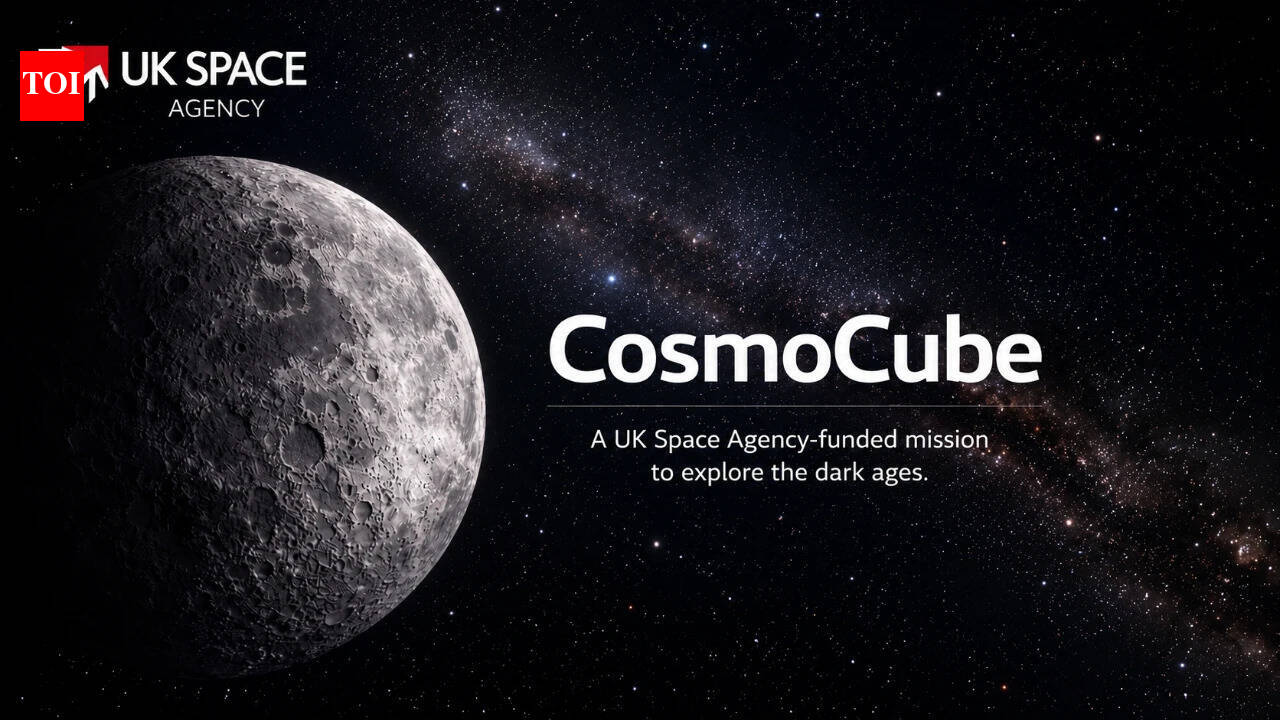
Image: CosmoCube's Website
CosmoCube will search for a signal from the Universe's Dark Ages
The Moon could provide the radio silence Earth cannot
The ancient hydrogen signal could reveal how the first structures formed
A small satellite could open a new window onto cosmic history
Long before stars illuminated the cosmos, the Universe passed through a mysterious period known as the Cosmic Dark Ages. No galaxies were shining across the darkness, and almost no visible light for astronomers to study. Yet the young Universe was filled with neutral hydrogen, and that hydrogen left behind an extremely faint radio signature that could reveal what was happening during this otherwise elusive period. Now, an international team including scientists from the University of Portsmouth is developing CosmoCube, a small satellite that could orbit the Moon and listen for that ancient signal from the far side. The Moon would act as a natural shield, blocking radio interference produced by Earth and creating an unusually quiet environment for radio astronomy. The mission is designed to detect the redshifted 21-centimetre hydrogen signal, potentially opening a new observational window onto the early Universe, the formation of cosmic structure and the mysterious role of dark matter. The original research and mission details were published by the University of Portsmouth.The Cosmic Dark Ages began after the Universe had cooled enough for neutral hydrogen to form, but before the first stars and galaxies switched on.This period, roughly spanning from 380,000 years after the Big Bang to the emergence of the first luminous structures, remains one of the least directly observed chapters in cosmic history. Without stars, there was little light available for conventional telescopes to trace. According to the research ‘The CosmoCube lunar mission for probing the dark ages and cosmic dawn via 21-cm cosmology,’ CosmoCube is designed to approach this problem through radio astronomy. Neutral hydrogen can produce radiation at a wavelength of 21 centimetres through a quantum-mechanical transition. As the Universe expanded, that signal became stretched to much longer wavelengths, moving it into low-frequency radio bands. The satellite would use a precision-calibrated radiometer to measure these extremely faint signals and build a map of their intensity across the sky.Detecting such a weak signal from Earth is extraordinarily difficult because the planet is surrounded by radio interference. Human communications, satellites and other electronic systems generate signals that can overwhelm the ancient radiation scientists are trying to measure. Earth's ionosphere also interferes with low-frequency observations.CosmoCube's solution is to take the experiment into lunar orbit. When the satellite travels behind the Moon, the lunar body can block radio-frequency noise coming from Earth, effectively creating a natural shield between the instrument and one of the largest sources of interference. The University of Portsmouth describes this as creating a “quiet spot” in space where the satellite can listen for the faint radio signal from the distant past. The proposed spacecraft is based on a lightweight CubeSat-style platform and is intended to orbit around 100 kilometres above the Moon. The mission concept currently envisages an operational lifetime of about two years, during which the satellite would repeatedly make measurements from the radio-quiet far side before returning to a position where it can transmit its data towards Earth.The 21-centimetre signal is valuable because it could preserve information about conditions in the Universe before the first stars appeared. By measuring how the signal changes, researchers hope to reconstruct how primordial hydrogen evolved as gravity gradually pulled matter together and the first cosmic structures began taking shape. That could also provide a new way of investigating dark matter. Although dark matter cannot be observed directly through light, its gravitational influence helped shape the distribution of ordinary matter in the early Universe. The CosmoCube team says its observations could therefore offer clues about the properties of dark matter and possible interactions between dark matter and ordinary matter. The mission could also contribute to questions surrounding the Hubble tension, the continuing discrepancy between different measurements of the Universe's expansion rate. More broadly, observing the Dark Ages could provide tests of physics that cannot easily be performed using observations of the more mature Universe.CosmoCube is still a proposed mission rather than an operational spacecraft. The project is led by the University of Cambridge, with the University of Portsmouth, STFC RAL Space and industry partners including Surrey Satellite Technology Ltd involved in its development. The University of Portsmouth has said that instrument development is already under way, including laboratory prototypes and environmental testing. The team has been working towards a four to five year roadmap for reaching lunar orbit before the end of the decade. The project has also received substantial UK Space Agency backing. In 2024, the agency awarded £1.5 million to support CosmoCube's development, with Nasa's Jet Propulsion Laboratory also involved in improving the spacecraft concept and exploring potential additional payloads. If successful, CosmoCube would give astronomers access to an era that has remained largely hidden from direct observation. Instead of looking for ancient light from the first stars, it would listen for the radio signature of the hydrogen that existed before those stars had even formed. The University of Portsmouth's research announcement describes the mission as an attempt to find an “ancient whisper” from the early Universe. That whisper may be extraordinarily faint, but if CosmoCube can isolate it from the noise of modern technology, it could reveal how the dark, simple Universe evolved into the complex cosmos filled with stars and galaxies that exists today.