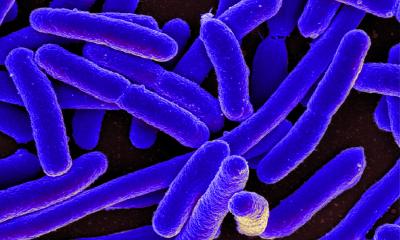
To achieve this, the researchers harnessed the bacterium's natural ability to adapt – in this case, Escherichia coli.
The bacterium did not evolve to perform computations, but to survive.
In its environment, it must constantly detect signals: which nutrients are present, in what quantities, and how these conditions change over time.
In the case of the clinical samples, the bacterium is placed directly in contact with patients' plasma.
Remarkably, a bacterium that has never been trained is able to perform tasks that are normally assigned to machine learning algorithms.
To achieve this, the researchers harnessed the bacterium's natural ability to adapt – in this case, Escherichia coli. The bacterium did not evolve to perform computations, but to survive. In its environment, it must constantly detect signals: which nutrients are present, in what quantities, and how these conditions change over time. In response, it adjusts its metabolism and growth. Rather than viewing bacterial growth simply as a biological phenomenon, the scientists use it for information processing.
How does it work? In the case of the clinical samples, the bacterium is placed directly in contact with patients' plasma. It responds to the plasma's chemical composition by growing faster or more slowly, generating a growth curve that reflects all the signals it has detected. For other computational tasks described in the article, the problem is first translated into a nutrient mixture, and the bacterium responds in exactly the same way – through its pattern of growth. In both cases, the resulting growth curve is then measured and used to generate an answer – for example, to classify a sample into one category rather than another, in this case according to the risk of developing a mild or severe form of Covid-19. Remarkably, a bacterium that has never been trained is able to perform tasks that are normally assigned to machine learning algorithms.
This approach could lead to simple, affordable diagnostic and prognostic tools that can be deployed even where technical resources are limited. The research team now plans to explore other applications, such as monitoring environmental samples, particularly urban wastewater, or analysing other types of clinical samples. More broadly, the study points to a new possibility: using genetically unmodified living organisms as systems capable of converting the complexity of a sample into usable information.
Source: INRAE - National Research Institute for Agriculture, Food and Environment