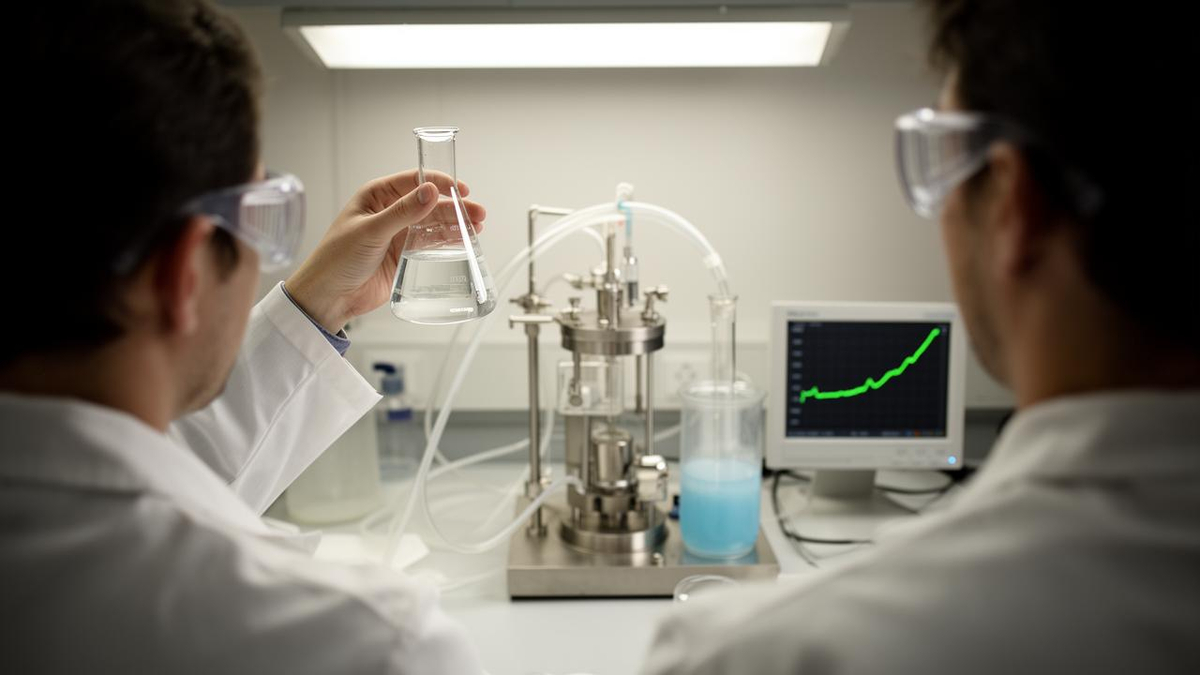
South Korean researchers have developed an integrated process that electrochemically converts captured carbon dioxide directly into high-purity formic acid (methanoic acid) without requiring separate separation, purification, or compression steps.
Formic acid is a substance widely used as a raw material in leather, textile, rubber, and pharmaceutical manufacturing, and this technology is being evaluated as having significantly boosted commercialization potential by cutting production costs to nearly half the current market price.
To overcome these limitations, the research team designed an integrated process linking CO₂ capture, electrochemical conversion, and formic acid purification into a single chain.
First, they used triethylamine to capture CO₂ in the form of bicarbonate dissolved in water, then fed the capture solution directly into an electrochemical reactor without any separate treatment.
The team also developed an amine exchange process using a substance called butylimidazole to separate the produced formate into high-purity formic acid.
South Korean researchers have developed an integrated process that electrochemically converts captured carbon dioxide directly into high-purity formic acid (methanoic acid) without requiring separate separation, purification, or compression steps. Formic acid is a substance widely used as a raw material in leather, textile, rubber, and pharmaceutical manufacturing, and this technology is being evaluated as having significantly boosted commercialization potential by cutting production costs to nearly half the current market price.
The Korea Institute of Science and Technology (KIST) announced on August 9 that a research team led by Senior Researcher Won Da-hye and Principal Researcher Lee Woong of the Clean Energy Research Center, in collaboration with a team led by Professor Lee Chan-woo of Kookmin University's Department of Chemistry, had achieved this breakthrough. The research results were published online in April in the international journal Joule, published by Cell Press, and were selected as the August cover paper.
Conventional carbon capture and utilization (CCU) technologies require captured CO₂ to be separated, purified, and compressed into gas form, consuming substantial energy and incurring significant costs. While some technologies that directly utilize the capture solution are under development, most focus on producing gaseous products such as carbon monoxide, limiting their ability to directly produce liquid chemical products.
To overcome these limitations, the research team designed an integrated process linking CO₂ capture, electrochemical conversion, and formic acid purification into a single chain. First, they used triethylamine to capture CO₂ in the form of bicarbonate dissolved in water, then fed the capture solution directly into an electrochemical reactor without any separate treatment.
To enhance conversion efficiency, the team developed a specialized catalyst mixing tin and copper. In this catalyst, copper plays the role of stably maintaining tin in a state favorable for formate production. As a result, they succeeded in converting 94% of the captured CO₂ into formate. The optimized tin-copper catalyst recorded a formate production efficiency of 60% and stably produced formate at a concentration of 2.62 moles even during continuous reactions exceeding 100 hours.
The team also developed an amine exchange process using a substance called butylimidazole to separate the produced formate into high-purity formic acid. This process enables the recovery and reuse of the triethylamine used in capture, while converting the formate into a form that is easy to distill, yielding high-purity formic acid of up to 98% by weight.