In southeastern Iran, perched on the Gulf of Oman, the Chabahar port comprises two terminals: Shahid Kalantari and Shahid Beheshti.
However, the most vital step in India’s involvement in the port occurred in 2016 when India, Iran, and Afghanistan signed a trilateral agreement.
For India, the Chabahar port in Iran is vital.
The Chabahar port allows India to circumvent Pakistan in its trading with Central Asia.
A Live Mint report from June noted that India and Iran would soon revive plans to expand the strategic Chabahar Port, as geopolitical conditions in the region began to stabilise.
After Donald Trump declared the ceasefire to be dead, the United States launched strikes against Iran on Thursday (July 9). The US Central Command (Centcom) said they had struck approximately 90 military targets, including missile and drone storage as well as military logistics sites along Iran’s coastline.
The US forces said the latest attacks against Iran were aimed at “their ability to threaten the freedom of navigation in the Strait of Hormuz”, citing recent strikes against commercial ships in the waterway.
STORY CONTINUES BELOW THIS AD
Shortly later, visuals emerged of the US strikes targeting Iran’s southeastern port city of Chabahar. Iranian media reported several explosions across Chabahar, resulting in power outages. This significantly expands the geographical scope of the conflict beyond the Strait of Hormuz.
This strike on the Iranian port city poses a significant concern for India. We explain why.
What do we know of the US strikes on Chabahar?
On Thursday, the US took aim at 90 targets in Iran, with Iranian media reporting explosions in several locations, including Bushehr, home to Iran’s nuclear power plant complex, and the southern port cities of Chabahar, Konarak, Bandar Abbas and Sirik.
#WATCH | Chabahar under fire. U.S. strikes hit Iran's only deep-water port tonight, with Iranian state media (IRIB) and CENTCOM-linked reporting both indicating the maritime traffic control tower was struck, along with the Shahid Beheshti dock and police-force dock. Roughly half… pic.twitter.com/rk8Mg7o9mX — Alpha Defense™🇮🇳 (@alpha_defense) July 9, 2026
Residents of the port city were quoted as saying that they could hear multiple blasts while emergency services responded to damaged infrastructure.
Unlike previous US operations concentrated around Bandar Abbas and military installations overlooking the Strait of Hormuz, striking Chabahar signals that Washington is now willing to target Iranian facilities farther east along the country’s coastline.
STORY CONTINUES BELOW THIS AD
What is the Chabahar port?
Chabahar, which sits at the mouth of the Gulf of Oman, is the country’s first deepwater port and serves as one of Tehran’s most important gateways to the Indian Ocean.
The port has long been viewed as a critical economic lifeline for Iran.
The port is also part of the proposed International North-South Transport Corridor (INSTC), a multi-modal transportation project linking the Indian Ocean and Persian Gulf to the Caspian Sea via Iran, and onward to northern Europe via St Petersburg in Russia.
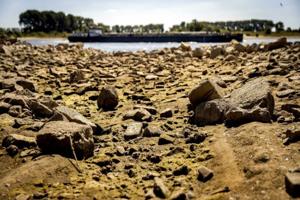
In southeastern Iran, perched on the Gulf of Oman, the Chabahar port comprises two terminals: Shahid Kalantari and Shahid Beheshti. India has been involved in the Shahid Beheshti. File image/AFP
Why does the Chabahar port matter to India?
The US strikes on Chabahar are also of importance to India. That’s because New Delhi has been involved in the development of the port since 2002. In the following year, during then Iranian President Syed Mohammad Khatami’s visit to India, he and Prime Minister Atal Bihari Vajpayee signed a roadmap of strategic cooperation, one of the key projects in which was Chabahar.
However, the most vital step in India’s involvement in the port occurred in 2016 when India, Iran, and Afghanistan signed a trilateral agreement. Following this, the Indian Shipping Ministry worked at a rapid pace to develop the port, and in December 2017, the first phase of Shahid Beheshti port was inaugurated, and India sent its first consignment of wheat to Afghanistan through Chabahar that same year.
India has invested at least $120m in equipping the port.
For India, the Chabahar port in Iran is vital. First, because of its geography. The Chabahar port allows India to circumvent Pakistan in its trading with Central Asia. C Raja Mohan, strategic affairs editor and contributing editor on international affairs for The Indian Express, told _The Indian Expres_s, “The easiest routes for India to Central Asia and Russia are through Pakistan and Afghanistan. The next best is through Iran, which borders Central Asia and the Caspian Sea.”
STORY CONTINUES BELOW THIS AD
Even Kabir Taneja, a fellow at the India-based Observer Research Foundation think tank, echoed similar sentiments. “Chabahar is important for India’s connectivity endeavours in Central Asia, a region not easily accessible for New Delhi,” he told Al Jazeera.
There is a second, strategic reason why the port matters to India. In November 2016, Pakistan inaugurated the China-funded port of Gwadar at the mouth of the Gulf of Oman. Experts noted that China’s involvement meant that it could be used to either economically or militarily challenge India.
However, with Chabahar, India found an escape. It gives New Delhi a strategic presence that mitigates the risks posed by Gwadar by outflanking it.
Workers resting at the Shahid Beheshti Port in the southeastern Iranian coastal city of Chabahar, on the Gulf of Oman. File image/AFP
So do the US strikes on Chabahar impact India?
No, not directly. In September 2025, the Trump administration announced that it was revoking all exemptions to Iran-related sanctions, including for Chabahar. However, India lobbied and pushed for the exemption until April 26.
As a result of the waiver being revoked, India temporarily transferred its stake in the Chabahar Free Zone to a local Iranian entity to avoid the impact of renewed US sanctions, said multiple reports.
At the time, India’s Ministry of External Affairs spokesperson Randhir Jaiwal noted that New Delhi was discussing the issue with Tehran and Washington. “Obviously, the current conflict is also a complicating factor,” Jaiswal added, speaking about the US-Iran war.
STORY CONTINUES BELOW THIS AD
The US-Iran peace deal signed in June gave India hope of continuing its involvement in the stalled Chabahar Port. A Live Mint report from June noted that India and Iran would soon revive plans to expand the strategic Chabahar Port, as geopolitical conditions in the region began to stabilise.
“With the security situation showing signs of improvement, both sides are expected to revisit the roadmap for normalising operations and enhancing capacity at Chabahar,” said an official aware of the matter.
But with the latest strikes and Trump declaring the ceasefire to be dead, these talks are also jeopardised
For India, this means a strategic loss. Every escalation involving Chabahar makes the project’s future uncertain, noted News18, adding that the conflict raises security risks, discourages commercial activity, and makes future investment decisions significantly more difficult.
The strikes on Chabahar imperil India’s long-term vision and its ability to act as a counterweight to China’s growing influence in the region.
STORY CONTINUES BELOW THIS AD
_With inputs from agencies
_

)