A review by Cheema et al.
published in The Journal of Clinical Investigation (JCI 2026;136(12):e205777, doi:10.1172/JCI205777) surveys contemporary approaches to estimating biological age (BA).
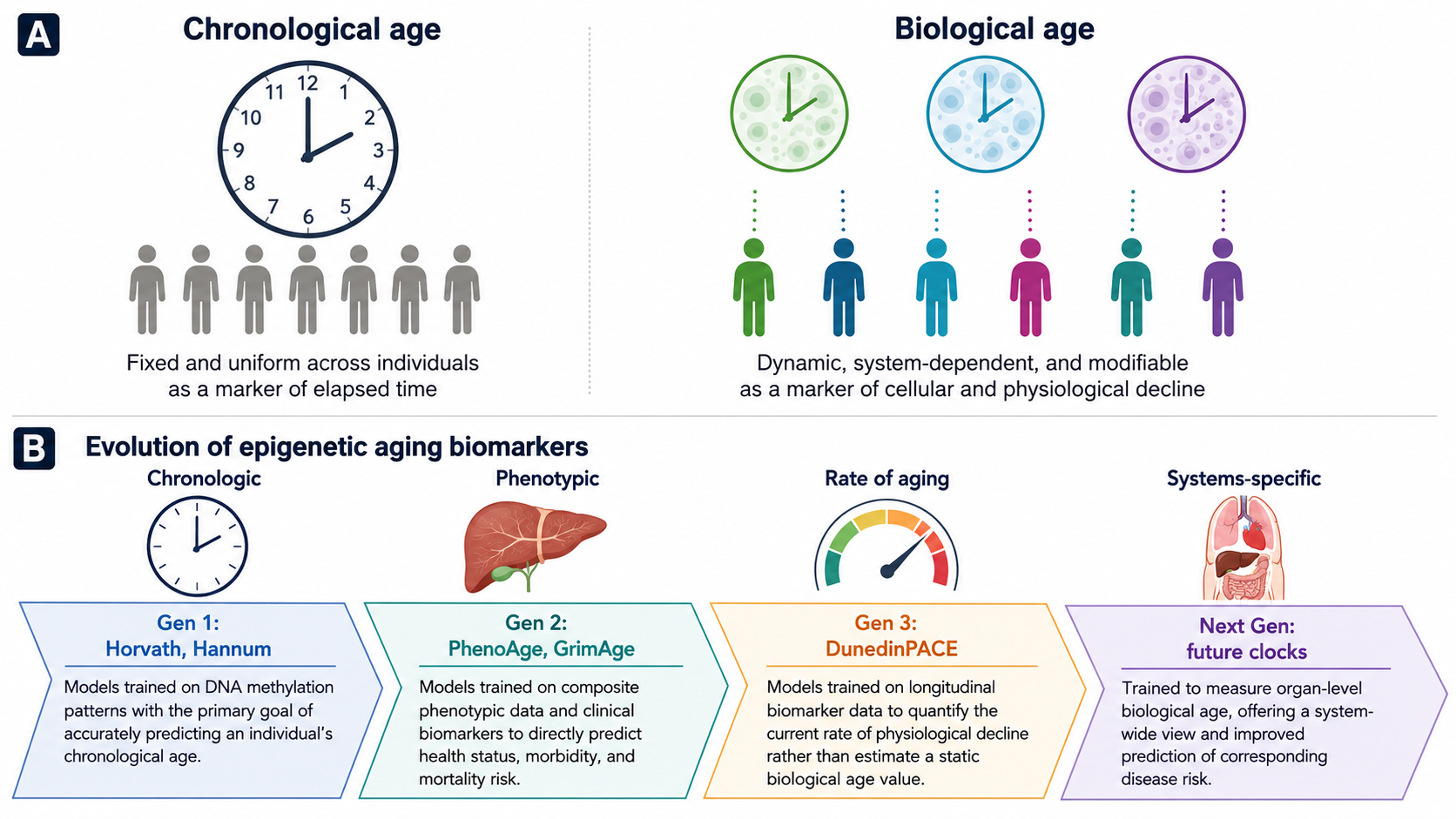
The paper documents a progression from simple functional tests such as gait speed and frailty measures to molecular and digital approaches, and explicitly categorizes epigenetic clocks into generations: first-generation clocks trained on chronological age (examples: Horvath, Hannum), second-generation clocks tied to phenotypic outcomes (examples: PhenoAge, GrimAge), and third-generation clocks measuring pace or rate of aging (example: DunedinPACE).
The review lists data modalities now in active development for BA: DNA methylation, proteomics, blood biomarkers, medical imaging, wearables, and AI analysis of clinical text and scans.
The authors state that prospective validation is required before routine clinical deployment and note that the role of these tools in standard care remains unresolved.
A review by Cheema et al. published in The Journal of Clinical Investigation (JCI 2026;136(12):e205777, doi:10.1172/JCI205777) surveys contemporary approaches to estimating biological age (BA). The paper documents a progression from simple functional tests such as gait speed and frailty measures to molecular and digital approaches, and explicitly categorizes epigenetic clocks into generations: first-generation clocks trained on chronological age (examples: Horvath, Hannum), second-generation clocks tied to phenotypic outcomes (examples: PhenoAge, GrimAge), and third-generation clocks measuring pace or rate of aging (example: DunedinPACE). The review lists data modalities now in active development for BA: DNA methylation, proteomics, blood biomarkers, medical imaging, wearables, and AI analysis of clinical text and scans. The authors state that prospective validation is required before routine clinical deployment and note that the role of these tools in standard care remains unresolved.