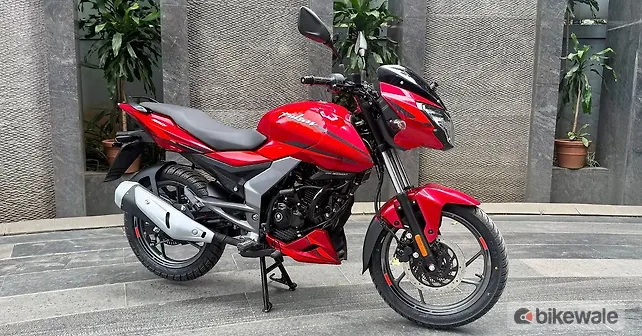
Three ride modes called Road, Rain and Sport are now part of the package on selected Pulsar 125 variants and across the Pulsar 150 range.
The new Pulsar 150 engine produces 13.6bhp, while the Pulsar 125 develops 11.7bhp.
Unlike the ride modes on the Pulsar 125, Crawl Tech is shown as standard across the entire 125 and 150 range.
Both the new Pulsar 125 and Pulsar 150 ranges now use monoshock rear suspension.
On the Pulsar 125, the base model gets a coloured LCD display, monoshock, Crawl Tech and an LED headlamp.
Pulsar 125 starts at Rs. 92,990; Pulsar 150 starts at Rs. 1,15,233
New engines make 11.7bhp and 13.6bhp; stronger low-rpm torque delivery
Higher variants get ride modes, five-inch TFT displays
Bajaj Pulsar 125 and Pulsar 150 have been launched in India marking one of the biggest updates yet for two of the oldest names in the Pulsar family. The new Pulsar 125 starts at Rs. 92,990, while the Pulsar 150 begins at Rs. 1,15,233, both ex-showroom. Beyond the new engines, Bajaj has added features such as ride modes, Crawl Tech, monoshock suspension and, on the higher variants, five-inch TFT displays with navigation.
The Pulsar 150 range consists of three choices. The Single Disc version costs Rs. 1,15,233, while the Twin Disc with a single seat is priced at Rs. 1,22,184. The Twin Disc with the split-seat configuration costs Rs. 1,23,187.
The Pulsar 125 has a wider four-variant spread. The base version costs Rs. 92,990, followed by the STD Single Seat at Rs. 99,291. The STD Split Seat costs Rs. 1,00,288, while the Premium Split Seat sits at the top at Rs. 1,04,318. All prices mentioned here are ex-showroom.
What stands out is just how much technology Bajaj has pushed into motorcycles operating at the lower end of the performance spectrum. Three ride modes called Road, Rain and Sport are now part of the package on selected Pulsar 125 variants and across the Pulsar 150 range. Seeing selectable riding modes on motorcycles producing 11.7bhp and 13.6bhp is unusual, although whether riders genuinely need three different settings with this level of performance is another question.
The launch presentation also makes an important distinction within the Pulsar 125 range. The base version does not get the three ride modes. They are available from the mid-level versions onwards and are also fitted to the top model. On the Pulsar 150, both the Single Disc and Twin Disc versions receive the modes.
The new Pulsar 150 engine produces 13.6bhp, while the Pulsar 125 develops 11.7bhp. Bajaj says 85% of available torque can be accessed from 3,000rpm onwards on both motorcycles. The company has worked on the gearbox with the same objective. Deeper gear bevels improve tractability and reduce the amount of clutch use required in lower gears.
Crawl Tech takes the low-speed approach another step further. The system allows the motorcycle to continue moving slowly without the rider having to constantly provide throttle input. It is designed to reduce clutch and throttle effort in crawling traffic while also lowering the possibility of stalling.
Unlike the ride modes on the Pulsar 125, Crawl Tech is shown as standard across the entire 125 and 150 range. The chassis has also received a major change. Both the new Pulsar 125 and Pulsar 150 ranges now use monoshock rear suspension.
On the Pulsar 125, the base model gets a coloured LCD display, monoshock, Crawl Tech and an LED headlamp. A Type-C charging socket is available as an option. However, it misses the ride modes, LED indicators, hazard lamps and ISG.
Moving up to the mid-level Pulsar 125 brings the three ride modes, a five-inch TFT, LED indicators, hazard lights, ISG and a standard Type-C charging port. Buyers can choose either a single seat or split seat at this level. The top version continues with the five-inch TFT and the same core technology package but is offered only with the split-seat arrangement.
The Pulsar 150 follows a simpler two-level feature structure despite having three price points. The Single Disc model receives all three riding modes, monoshock suspension, a coloured LCD display, Crawl Tech, LED headlamp and USB Type-C charging.
Twin Disc version makes the larger jump. It gets a five-inch TFT with Google Maps navigation, LED indicators, hazard lamps and ISG, while also adding the rear disc brake. It can be ordered with either a single seat or split seat.
Moving from the Rs. 1,15,233 Pulsar 150 Single Disc to the Rs. 1,22,184 Twin Disc Single Seat costs Rs. 6,951. For that money, the buyer gets the TFT with Google Maps, an additional rear disc, LED indicators, hazard lights and ISG. On equipment alone, that looks like a fairly reasonable jump.
Choosing the split-seat Twin Disc after that costs only another Rs. 1,003. The decision between the two TD versions will therefore largely come down to whether the buyer prefers the cleaner single-seat appearance or the sportier split-seat arrangement.
The Pulsar 125 follows a similar pattern. The jump from Rs. 92,990 for the base model to Rs. 99,291 for the STD Single Seat is Rs. 6,301, but this is where most of the technology arrives. The TFT, ride modes, LED indicators, hazard lights and ISG make the higher version feel substantially less basic.
Going from the STD Single Seat to the STD Split Seat costs just Rs. 997. The Premium Split Seat then increases the price to Rs. 1,04,318.