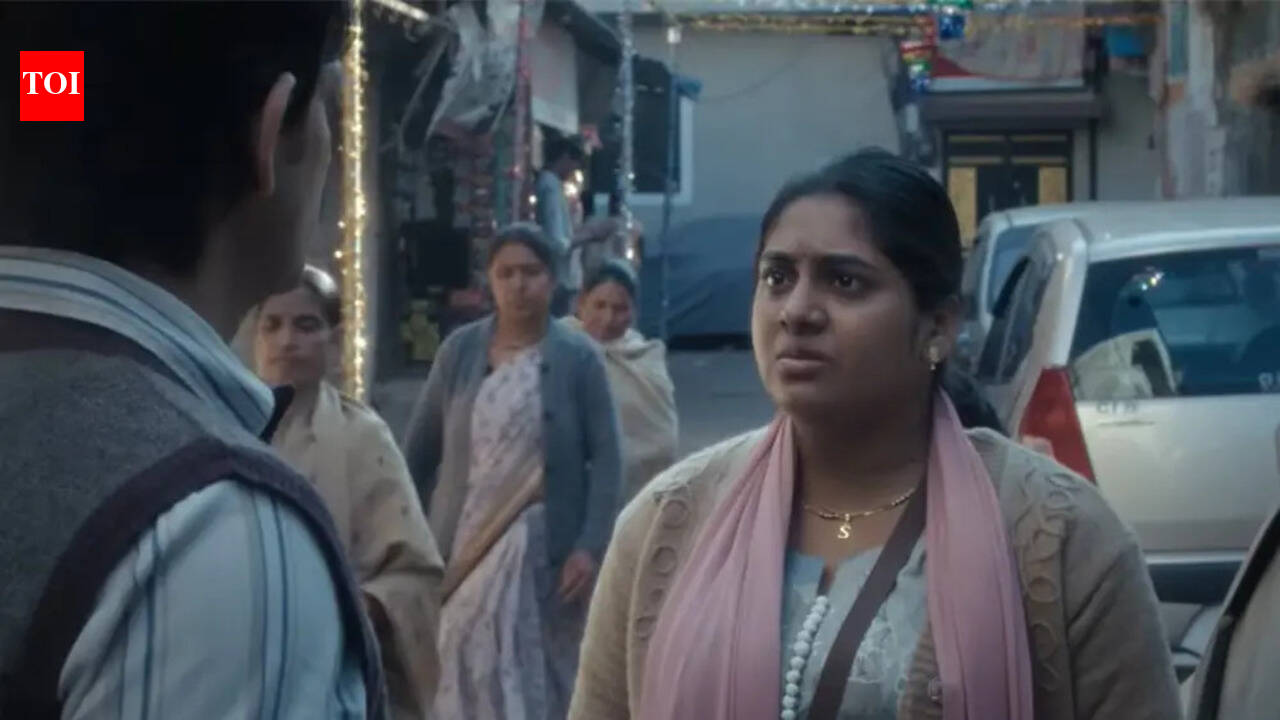
Story: Babita Singh, an underestimated cop visiting her in-laws for the first time, is torn between investigating her childhood friend’s murder and confronting the hidden lies threatening her own marriage.
Babita Singh Reporting enters the same territory but takes a markedly more intimate and subdued route.
Babita Singh Reporting is ultimately not an adrenaline-fuelled police thriller.
The film takes its time to show how institutional humiliation and domestic control can gradually erode a person’s sense of self—and how the search for truth can become a means of finding oneself.
For viewers drawn to melancholic, contemplative and character-driven thrillers, Babita Singh Reporting offers a quietly powerful experience that lingers beyond its central mystery.
Story: Babita Singh, an underestimated cop visiting her in-laws for the first time, is torn between investigating her childhood friend’s murder and confronting the hidden lies threatening her own marriage. Review: Some investigations begin with a crime; Babita Singh’s begins with a crisis of self-belief. Played with quiet vulnerability by Nimisha Sajayan , Babita is an underestimated Sub-Inspector who has joined the force in place of her late father but is mostly confined to paperwork and treated as little more than a subordinate. Her colleagues call her ‘Baby’, a nickname that reflects how little they think of her. At home, things are no different. Her husband, Sharad (Anshumaan Pushkar), wants her to quit her “worthless” job and devote herself to the family. Her attempt to win Inspector Sethi’s (Rajesh Kumar) approval by recording a social media video of him arriving at the police station only reinforces the power imbalance. She hopes the gesture will help get her leave sanctioned so she can finally visit her in-laws in Rewa, Madhya Pradesh. But Sethi demands favours that compromise her dignity, and Baby eventually finds herself suspended. What initially seems like a professional setback takes an unexpected turn when she travels to her in-laws’ home and reconnects with her childhood friend Bansi ( Barun Sobti ), who soon dies under suspicious circumstances. The investigation becomes more than a murder mystery for Baby. It gives her a purpose at a time when every aspect of her life is defined by other people’s expectations. As she begins looking into Bansi’s death, she is simultaneously confronted by the everyday brutality of patriarchy within her own household. The film’s central conflict therefore operates on two levels: Baby is trying to uncover who killed her friend while also attempting to reclaim control over a life in which she is constantly told what she should and should not be. Women police officers negotiating professional responsibilities, domestic expectations and institutional sexism have made for compelling viewing in recent years, from Aranyak to Dahaad . Babita Singh Reporting enters the same territory but takes a markedly more intimate and subdued route. The film is less interested in presenting Baby as an extraordinary investigator and more invested in examining the emotional transformation of an ordinary woman who has spent years being made to feel inadequate. This is where Nimisha Sajayan proves particularly effective. Having previously portrayed the suffocating realities of domesticity in The Great Indian Kitchen , she once again captures the quiet anguish of a woman trapped inside expectations she never chose. Baby is not a stereotypically sharp or fearless cop. She doubts herself, struggles professionally and carries the emotional burden of her inability to conceive because of health issues. Sajayan plays these vulnerabilities without turning Baby into a victim, allowing her gradual awakening to feel organic rather than manufactured. The film benefits considerably from the creative sensibilities of producer Sudeep Sharma, known for the grounded worlds of Paatal Lok and Kohrra , and director Ambiecka Pandit, whose work on Black Warrant also demonstrated an affinity for darker, realistic storytelling. Writer Amita Vyas combines familiar investigative-thriller elements with a more character-driven examination of a woman’s need to be heard and valued. Rather than suddenly transforming Baby into an action-oriented supercop, the screenplay builds her confidence through small discoveries and moments of resistance. This 131-minute drama is also enriched by its evocative setting, with Bhopal and Rewa captured with a strong sense of place. The understated beauty of these locations complements the film’s sombre mood, while the local milieu adds authenticity to Baby’s journey and makes her world feel lived-in rather than merely serving as a backdrop. However, the film does occasionally struggle to maintain momentum. The investigative thread, which should provide the narrative with urgency, sometimes takes a back seat to the domestic drama. The central question—whether Baby will finally stand up for herself, both as a police officer and as a woman—is compelling, but the screenplay does not always sustain the tension surrounding it. Some stretches feel deliberately slow rather than genuinely atmospheric, making the narrative lose its grip intermittently. The supporting performances, thankfully, keep the film grounded. Anshumaan Pushkar brings considerable nuance to Sharad, portraying him not as a conventional villain but as a loving yet deeply conditioned husband who genuinely believes he knows what is best for his wife. Barun Sobti leaves an impression despite his limited screen time, while Rajesh Kumar and Geetika Vidya Ohlyan lend credibility to the police-world dynamics. Sunita Rajwar is convincing as Baby’s mother-in-law, even though her character largely operates within the familiar template of the difficult, judgmental in-law. Babita Singh Reporting is ultimately not an adrenaline-fuelled police thriller. Its real investigation is into the psychological cost of constantly being underestimated. The film takes its time to show how institutional humiliation and domestic control can gradually erode a person’s sense of self—and how the search for truth can become a means of finding oneself. The pacing may test patience in places, but the strong performances, atmospheric storytelling and sensitive treatment of its protagonist make the film worthwhile. For viewers drawn to melancholic, contemplative and character-driven thrillers, Babita Singh Reporting offers a quietly powerful experience that lingers beyond its central mystery.
3.5 Direction 3.0 Dialogues 3.5 Story 3.0 Music 4.0 Visual Appeal 3.5 Overall Critic Rating