The same mission also revealed two hydrothermal vent fields around 13,100 feet down.
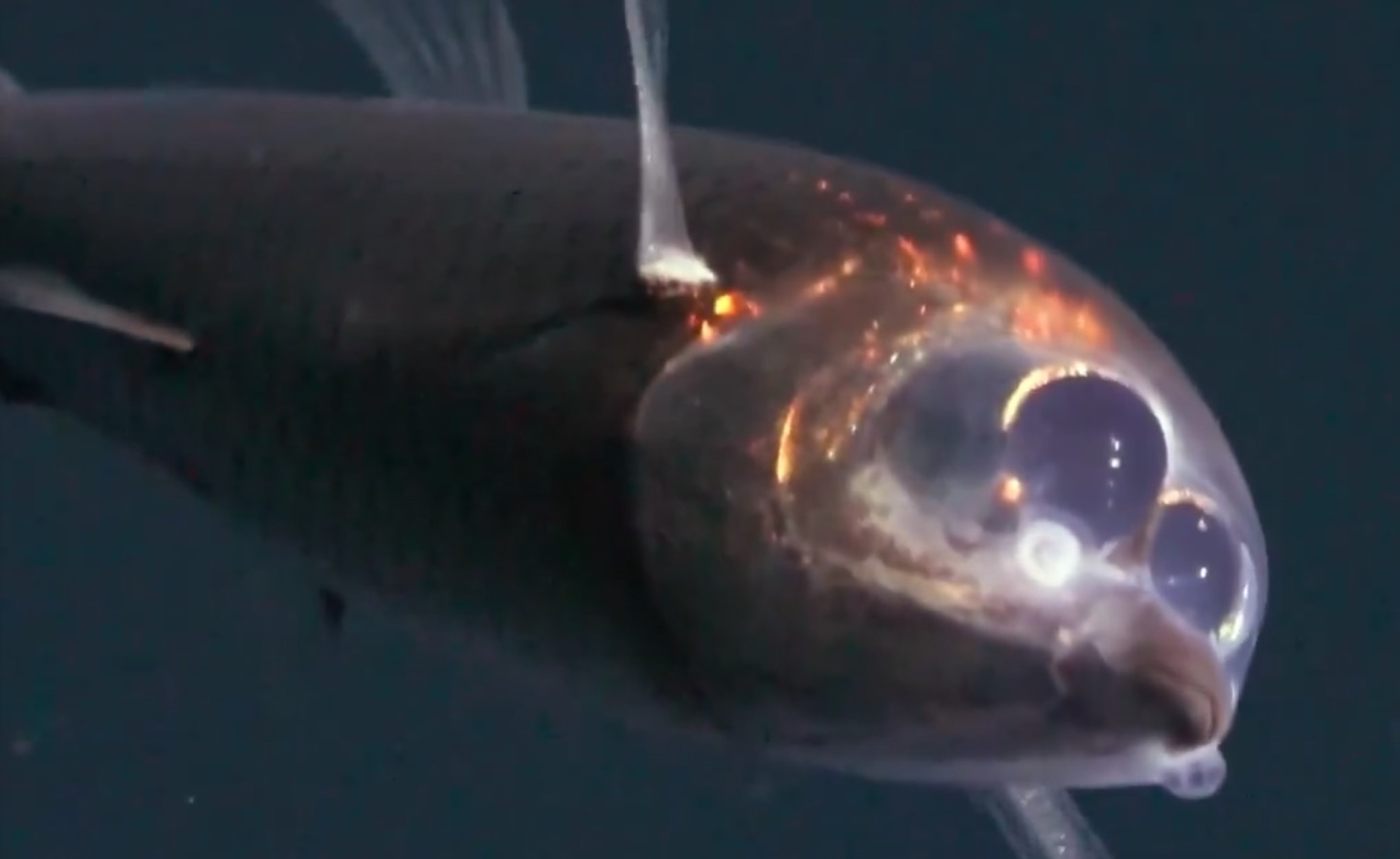
In the Atlantic Ocean, scientists have filmed a barreleye fish with a transparent dome-like head alive in the wild for the first time.
The same mission also revealed two hydrothermal vent fields around 13,100 feet down and documented other eerie deep-sea animals, including ghostly crabs, shrimp, anemones, and deep-sea bigfin squid.
From warming seas to growing interest in seabed mining and industrial expansion, human decisions can affect fragile marine systems long before scientists fully understand them.
Jyotika Virmani, executive director of the Schmidt Ocean Institute, said the vent systems could help answer much bigger questions about life itself.
The same mission also revealed two hydrothermal vent fields around 13,100 feet down.
In the Atlantic Ocean, scientists have filmed a barreleye fish with a transparent dome-like head alive in the wild for the first time.
The haunting footage is a reminder that even in one of the most studied oceans on Earth, some of its strangest residents have remained almost entirely hidden.
What happened?
A team led by Aaron Micallef, a marine scientist at the Monterey Bay Aquarium Research Institute, spent a month exploring the Doldrums Megatransform and Fracture Zone using the ROV SuBastian and the AUV The Childlike Empress.
At 2,329 feet, where sunlight is faint, the expedition encountered Winteria telescopa and recorded what ScienceAlert described as the first-known footage of the barreleye fish in the wild, citing the Schmidt Ocean Institute.
Since the fish's transparent, fluid-filled head dome collapses when it is brought to the surface, researchers seldom get to observe the species intact. The footage therefore provides a rare opportunity to study the barreleye's tubular eyes and how the animal functions in its natural environment.
The same mission also revealed two hydrothermal vent fields around 13,100 feet down and documented other eerie deep-sea animals, including ghostly crabs, shrimp, anemones, and deep-sea bigfin squid.
Why does it matter?
The Doldrums region spans about 23,000 square miles of seafloor, yet much of it remains barely explored.
The deep ocean is increasingly being shaped by human activity, even when people never see it directly. From warming seas to growing interest in seabed mining and industrial expansion, human decisions can affect fragile marine systems long before scientists fully understand them.
Advanced submersibles, imaging systems, and research vessels allowed scientists to document delicate creatures that would otherwise have remained unknown.
The hydrothermal vents appear to be linked to serpentinization, a chemical process that can support life without sunlight. That makes them valuable for understanding not only Earth's oceans, but also the possibility of life on ocean worlds beyond our planet.
What's being done?
Researchers are continuing to analyze the footage, biological observations, and geological samples gathered during the voyage. More scientific papers are expected as the team studies the vents and the ecosystems around them.
Jyotika Virmani, executive director of the Schmidt Ocean Institute, said the vent systems could help answer much bigger questions about life itself. "Serpentinization is a process in which seawater reacts with minerals in rocks, producing heat and chemical energy that allow life to thrive in the deep ocean without sunlight, so a better understanding of these systems could provide clues for finding life on other planets," she said.
The expedition also underscores the value of funding ocean exploration before fragile habitats are altered by climate shifts or industrial pressure. Careful mapping and imaging can help scientists identify ecosystems worth protecting before damage is done.
"This discovery shows why exploration still matters," Micallef said. Paula Zapata Ramirez, a marine scientist at the Universidad Pontificia Bolivariana in Colombia, said, "Every sample, every image, and every discovery brings us one step closer to understanding the hidden parts of our planet."
Get TCD's free newsletters for easy tips, smart advice, and a chance to earn $5,000 toward home upgrades. To see more stories like this one, change your Google preferences here.