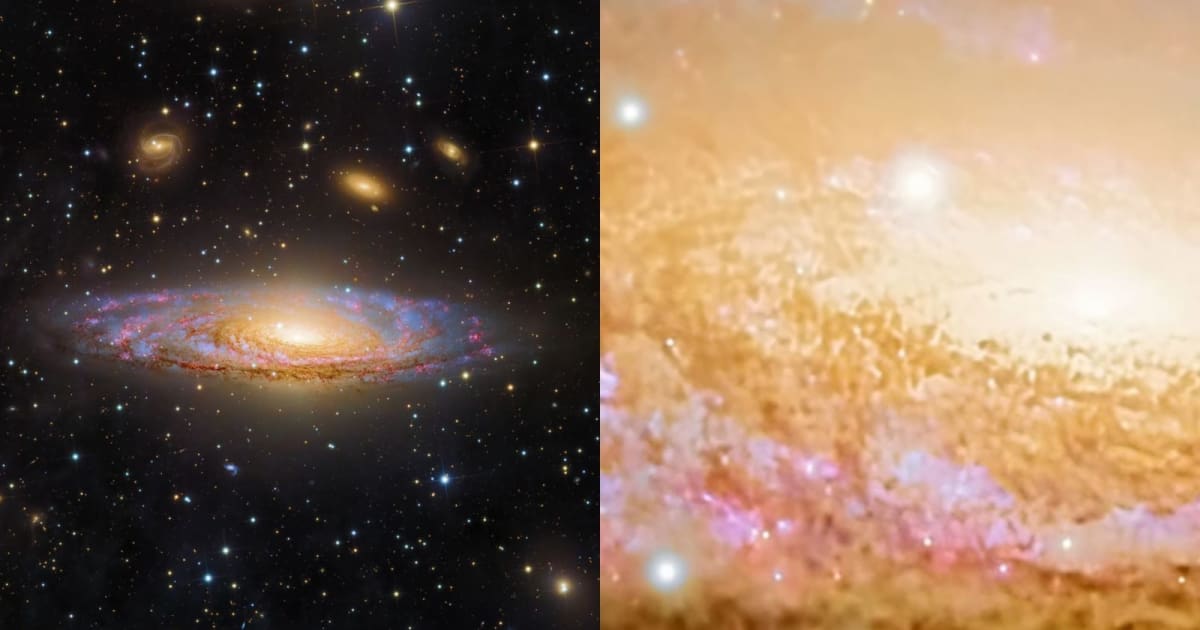
Astrophotographer shares incredible ‘deep field’ image featuring a supernova discovered two weeks agoThe supernova was found by NASA-funded ATLAS and had a magnitude of 17.3 at the time of discovery.
True to his promise made a few days ago, astrophotographer Andrew McCarthy has released a deep-field image of a spiral galaxy that is under the spotlight for its brand-new supernova.
After capturing over 100 hours worth of exposures, I'm pleased to share my latest "Deep Field" image, containing THOUSANDS of galaxies and a brand-new supernova that just kicked off ~2 weeks ago!
Here's a better video showing the appearance of the new supernova.
Social media has been flooded with pictures of the supernova as several photographers are trying to capture it from their backyards.
Astrophotographer shares incredible ‘deep field’ image featuring a supernova discovered two weeks ago
The supernova was found by NASA-funded ATLAS and had a magnitude of 17.3 at the time of discovery.
True to his promise made a few days ago, astrophotographer Andrew McCarthy has released a deep-field image of a spiral galaxy that is under the spotlight for its brand-new supernova. On X, McCarthy shared a photo of the spiral galaxy Caldwell 30, or NGC 7331, along with hundreds of other galaxies that make up the Deer Lick Group.
After capturing over 100 hours worth of exposures, I'm pleased to share my latest "Deep Field" image, containing THOUSANDS of galaxies and a brand-new supernova that just kicked off ~2 weeks ago!
Timelapse showing the supernova, prints, and more details in the thread 👇 pic.twitter.com/RptuuTrxKy — Andrew McCarthy (@AJamesMcCarthy) September 17, 2026
“A lucky capture made this photo tell a story of intergalactic civilizations… lost in time. This is a photo of NGC 7331 & Friends, often referred to as the Deer Lick Group. While I was capturing this 100 hour exposure, a star exploded, giving this image a new point of interest I never expected (sic),” he posted on Instagram. McCarthy also shared a video showing the same area that he documented in previous years and the progress he has made in photographing the Deer Lick Group since then.
McCarthy had first shared pictures of the supernova last week while he was luckily in the middle of another project involving the spiral galaxy. He compiled a video using just four hours of exposure—two hours before and two hours after the supernova appeared—to show the appearance of the stellar explosion near the galactic core. As for the supernova, it has been named SN 2026aaiv, and it can be found in the constellation Pegasus. It was discovered by the NASA-funded Asteroid Terrestrial-impact Last Alert System (ATLAS) and had a magnitude of 17.3 at the time of discovery, per The Sky Live.
Here's a better video showing the appearance of the new supernova. Each frame is a stack from ~2 hours of exposures captured through RGB filters to see it in color.
I was lucky I was in the middle of a massive ~100 hour project with this galaxy- the final shot will be SO cool pic.twitter.com/Rph4vWAd9N — Andrew McCarthy (@AJamesMcCarthy) September 6, 2026
By September 15, its brightness increased to a magnitude of 12.2—enough to be spotted with a 6-inch telescope, according to Sky & Telescope. In astronomy, the lower or more negative the number, the brighter the object, and the higher or more positive the number, the fainter the object. The full Moon has a magnitude of minus 12.6, whereas the Sun has a magnitude of minus 26.7.
A picture showing Caldwell 30 with a white circle highlighting the location of supernova SN 2014C in it. (Image Source: ESA/Hubble & NASA/D. Milisavljevic (Purdue University))
This supernova, which lies about 45 million light-years away, is a Type Ia eruption that occurs when a white dwarf in a binary star system explodes. NASA says there are two ways a white dwarf explodes—it either becomes unstable by siphoning off material from its companion star, or merges with another white dwarf, which makes it unstable. Such explosions can reach an absolute magnitude of minus 19, which makes them about 5 billion times brighter than the Sun. Social media has been flooded with pictures of the supernova as several photographers are trying to capture it from their backyards. According to NASA, Type Ia supernovae like SN 2026aaiv are very rare in the Milky Way, and they occur roughly once every 500 years.
More on Starlust
"Never encountered objects that act like this": NASA’s Chandra reveals a new class of cosmic objects
New study reveals fresh clues about the mysterious origin of comet 3I/ATLAS