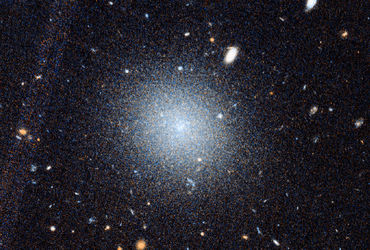
Image: keckobservatory.orgAstronomers have reportedly discovered a rare galaxy that appears to have almost no dark matter, adding a new clue to one of the biggest mysteries in the universe.
The galaxy, named DF9, was observed using the W M Keck Observatory in Hawaii and is the third known galaxy found to be lacking dark matter.
Earlier observations had identified two similar galaxies, DF2 and DF4, which also appeared to contain little or no dark matter.
With the discovery of DF9, researchers believe all three galaxies may have formed during the same high-speed cosmic collision that separated normal matter from dark matter.
Scientists believe the collision may have removed gas and dark matter from the original galaxies, leaving behind new galaxies made mostly of ordinary matter.
Image: keckobservatory.org
Astronomers have reportedly discovered a rare galaxy that appears to have almost no dark matter, adding a new clue to one of the biggest mysteries in the universe. The galaxy, named DF9, was observed using the W M Keck Observatory in Hawaii and is the third known galaxy found to be lacking dark matter.
The study, led by researchers from Yale University and published in The Astrophysical Journal, suggests that DF9 is part of a unique linear structure of faint galaxies that may have formed after a violent collision between galaxies.
Earlier observations had identified two similar galaxies, DF2 and DF4, which also appeared to contain little or no dark matter. With the discovery of DF9, researchers believe all three galaxies may have formed during the same high-speed cosmic collision that separated normal matter from dark matter.
Scientists believe the collision may have removed gas and dark matter from the original galaxies, leaving behind new galaxies made mostly of ordinary matter. Researchers say this rare discovery provides stronger evidence that dark matter exists as a physical substance rather than being explained only by alternative theories of gravity.