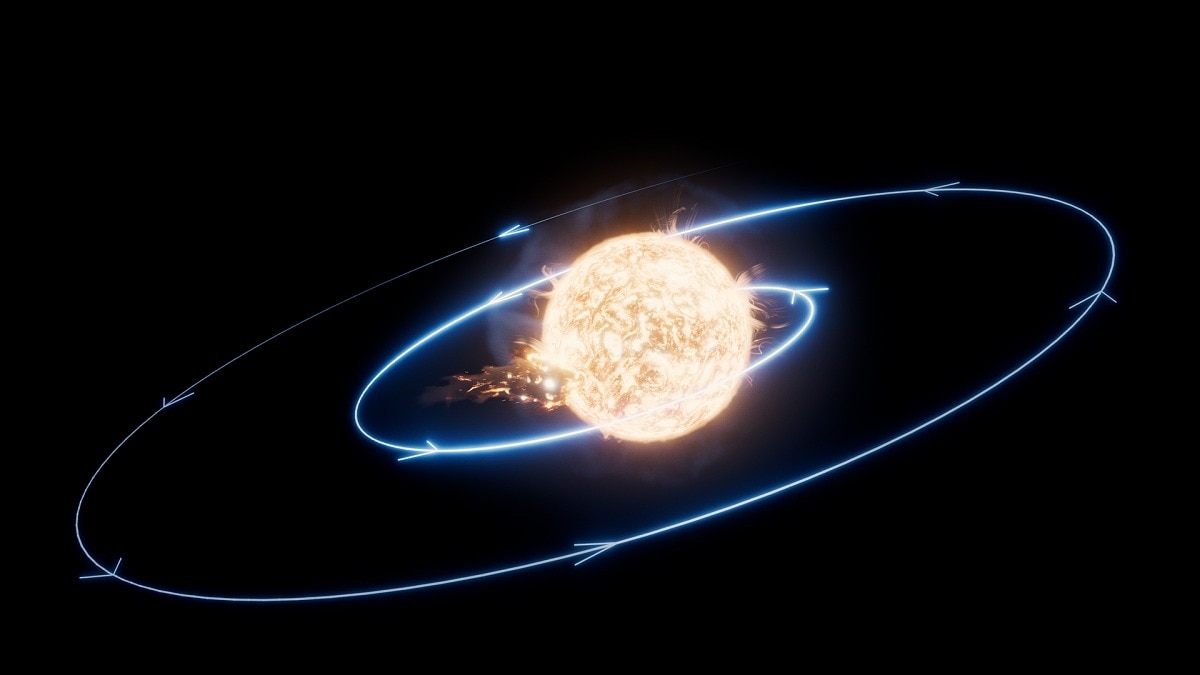
The star, known as TOI-5882, appears to have engulfed a planet sometime in its recent history, according to a new study published in The Astrophysical Journal.
While stars naturally contain small amounts of lithium, planets are significantly richer in the element.
When a star swallows a planet, it absorbs large quantities of lithium, creating a detectable chemical signature.
Using a technique known as spectroscopy, researchers analysed light from TOI-5882 and found unusually high lithium levels in its atmosphere.
As a result, astronomers must reconstruct these events long after they happen, using indirect clues much like forensic investigators.
In a remarkable cosmic detective story, astronomers have uncovered compelling evidence that a sun-like star located about 1,300 light-years from Earth consumed one of its own planets, leaving behind chemical fingerprints that revealed the stellar crime.
The star, known as TOI-5882, appears to have engulfed a planet sometime in its recent history, according to a new study published in The Astrophysical Journal. The research was led by Brooke Kotten of the University of Michigan and involved a team of 14 scientists from the United States and Chile.
Read Full Story
The breakthrough came from an unexpected clue: lithium.
"You are what you eat," Kotten said while explaining the discovery. While stars naturally contain small amounts of lithium, planets are significantly richer in the element. When a star swallows a planet, it absorbs large quantities of lithium, creating a detectable chemical signature.
Using a technique known as spectroscopy, researchers analysed light from TOI-5882 and found unusually high lithium levels in its atmosphere. To confirm the anomaly, they compared the star with 62 similar stars of comparable age, mass and temperature.
The results were striking. No matter how the data was analysed, TOI-5882 ranked among the most lithium-rich stars in the sample, placing it above at least 97 per cent of comparable stars.
Based on the lithium enrichment, scientists estimate the devoured world may have been between a few times Earth's mass and the size of Neptune.
Planetary engulfment is a known phenomenon in astronomy, but catching one in the act is nearly impossible. The process can occur in a matter of days or weeks, an instant on cosmic timescales.
As a result, astronomers must reconstruct these events long after they happen, using indirect clues much like forensic investigators.
"This field is exciting because you're solving a mystery," Kotten said. "We can't watch the crime happen, so we have to work with all the clues we're given."
What makes TOI-5882 particularly intriguing is that the star has not yet expanded into a red giant, the stage when stars commonly engulf nearby planets. Instead, researchers suspect a massive brown dwarf orbiting the star may have played a role.
The brown dwarf, more than 20 times the mass of Jupiter, could have gravitationally disturbed the doomed planet's orbit, eventually sending it spiraling into the star.
The discovery also offers a glimpse into the distant future of our own solar system. In roughly 5 billion years, the Sun is expected to expand into a red giant and likely engulf Mercury and Venus, and possibly Earth.
For now, TOI-5882 stands as one of the clearest examples yet of a star that literally consumed one of its planets.
- Ends