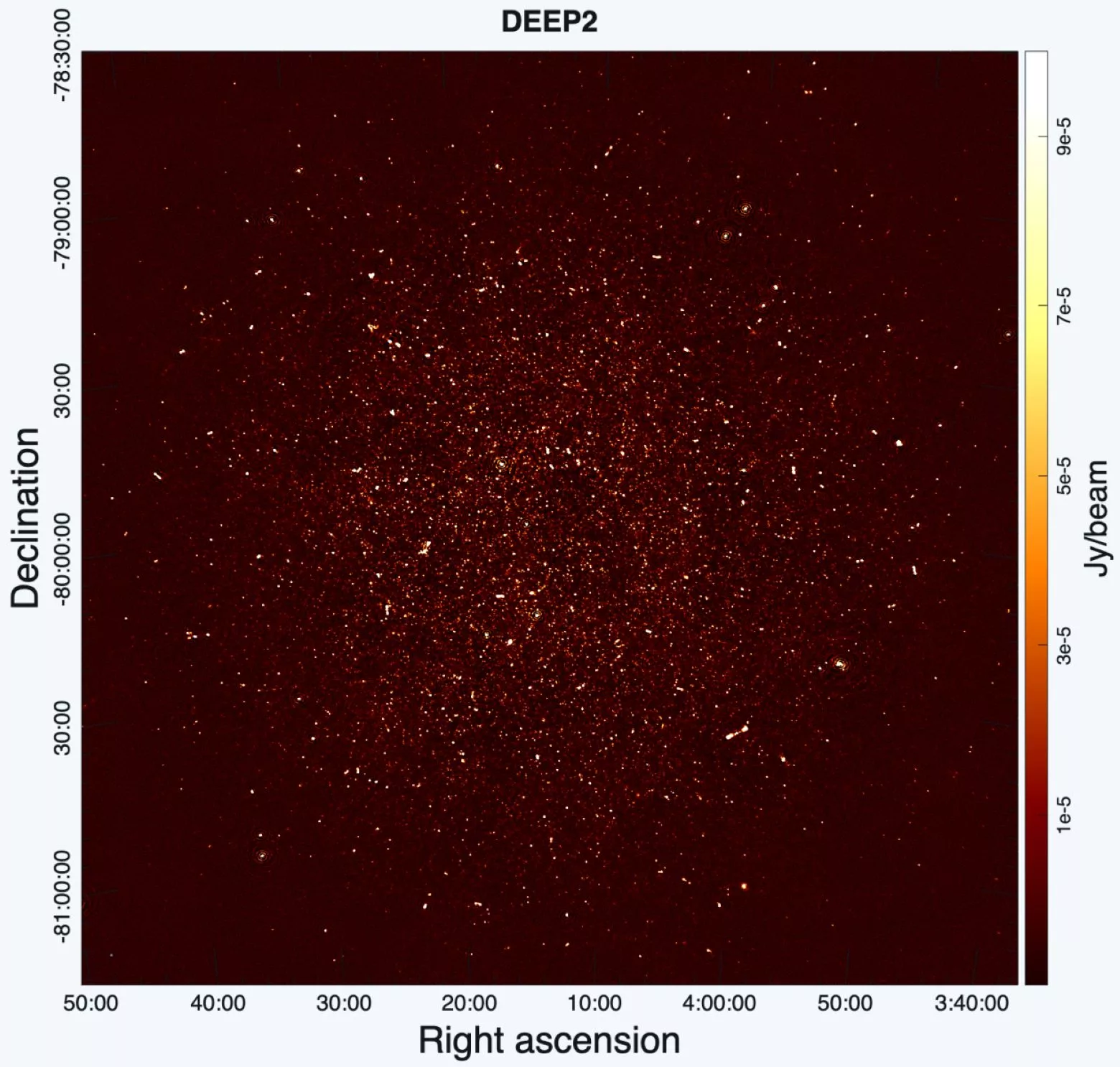
The result, published in The Astrophysical Journal Letters, is a milestone for a technique called hydrogen intensity mapping, and a tantalizing glimpse of the cosmic web itself.
Neutral hydrogen atoms naturally emit a faint radio signal at a wavelength of 21 centimeters.
As the Universe expands, this signal is stretched, allowing astronomers to tune into different epochs of cosmic history.
“Hydrogen intensity mapping has long been seen as a promising way to map the Universe efficiently, but the signal is extremely faint and difficult to isolate.
“The fact that this signal can be extracted from observations not originally designed for hydrogen intensity mapping is very encouraging.
For many years, astronomers have dreamed of mapping the Universe not galaxy by galaxy, but in sweeping strokes, revealing the invisible framework of matter over billions of light-years. This dream has now advanced significantly.
A research team from the University of Manchester and the University of the Western Cape, led by scientists at those institutions, has successfully detected a very weak radio signal emitted by neutral hydrogen gas billions of light-years away. The signal, which is known as the “21-centimeter line”, was picked up using South Africa’s MeerKAT radio telescope and has been stretched to longer wavelengths due to the expansion of the Universe.
The result, published in The Astrophysical Journal Letters, is a milestone for a technique called hydrogen intensity mapping, and a tantalizing glimpse of the cosmic web itself.
Neutral hydrogen atoms naturally emit a faint radio signal at a wavelength of 21 centimeters. As the Universe expands, this signal is stretched, allowing astronomers to tune into different epochs of cosmic history.
MeerKAT captured clearest view yet of centre of the Milky Way
Traditionally, detecting hydrogen at great distances has required combining radio data with optical surveys of galaxies. But in this new study, the team succeeded using radio observations alone, a first for this technique.
Rather than listing galaxies one by one, intensity mapping measures the combined light emitted by hydrogen from a huge number of galaxies that cannot be resolved. It’s similar to hearing the general noise of a crowd rather than identifying each person’s voice, enabling astronomers to study enormous volumes of space with unprecedented efficiency.
The team looked at 96 hours’ worth of MeerKAT observations and identified hydrogen emitted during two separate periods in the history of the universe, signals which had traveled for four to five billion years before arriving at Earth. The measurements show how hydrogen varies over distances of several million light-years, similar to the distance between the Milky Way and its neighbor, Andromeda.
“This is a very exciting milestone,” said Dr. Sourabh Paul, lead author of the study. “Hydrogen intensity mapping has long been seen as a promising way to map the Universe efficiently, but the signal is extremely faint and difficult to isolate. Detecting it directly with MeerKAT shows that this technique is becoming a practical tool for cosmology.”
A giant radio galaxy could be home to almost 30 Milky Way galaxies
Extracting such a faint signal is no easy feat. Foreground radio emissions, human-made interference, and instrumental effects all swamp the delicate hydrogen line.
“This was a challenging data analysis process,” explained Professor Mario Santos. “It is particularly remarkable that the data used in this study were taken in 2018, when MeerKAT had only just started science operations. There is now a rich trove of MeerKAT data waiting to be explored with this method.”
Hydrogen is the raw material of galaxies. By mapping its distribution, astronomers can study how galaxies form and evolve, and how dark matter shapes the cosmic web.
“Neutral hydrogen is one of the key ingredients for understanding how galaxies form,” said Dr. Zhaoting Chen, co-author of the study. “With intensity mapping, we don’t need to detect every individual galaxy. Instead, we measure the collective signal across large cosmic volumes, giving us a new way to study both galaxy evolution and the underlying matter distribution of the Universe.”
The fact that this discovery has important implications for future surveys: hydrogen intensity mapping is expected to be a major area of scientific research for the Square Kilometer Array Observatory (SKAO), the world’s largest radio telescope project, of which MeerKAT is a precursor.
“MeerKAT continues to open new windows for cosmology,” said Professor Laura Wolz of the Jodrell Bank Center for Astrophysics. “The fact that this signal can be extracted from observations not originally designed for hydrogen intensity mapping is very encouraging. It shows the enormous scientific value of MeerKAT data and points the way to future observations with SKAO.”
Future observations of larger areas of the sky and for longer periods of time will enable astronomers to map hydrogen with even greater detail, and with this they hope to find out how galaxies formed, how dark matter shaped the Universe’s huge filaments, and how cosmic evolution progressed over billions of years.
At the moment, the weak signal of hydrogen detected by MeerKAT serves as a thrilling reminder that even within the silence of the cosmos there are signals waiting to be picked up, signals which are able to alter our maps of the Universe itself.
Journal Reference: