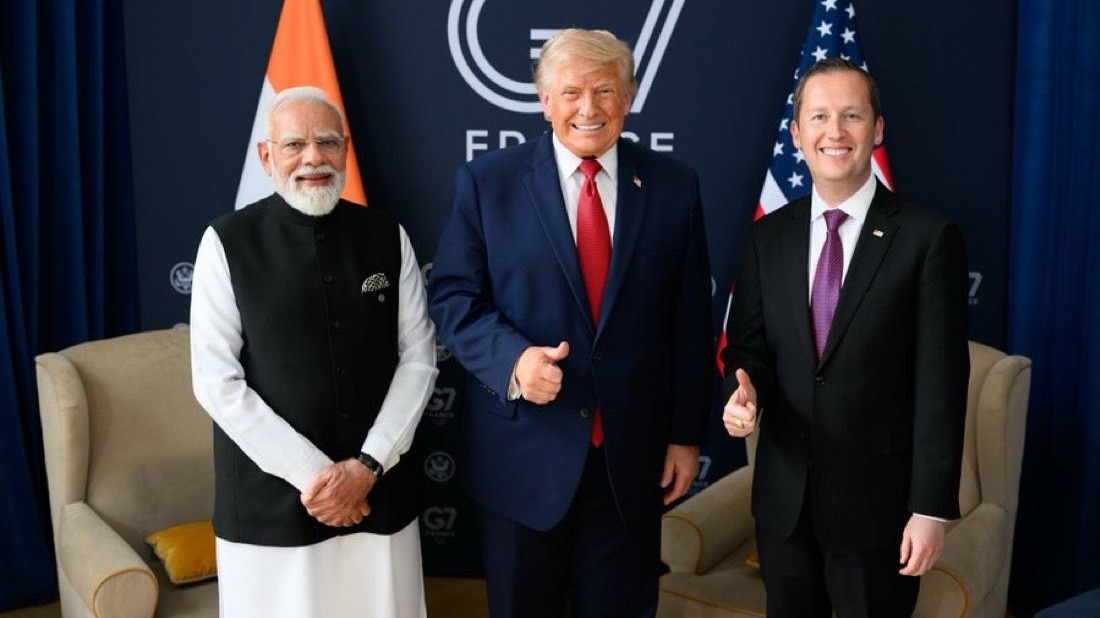
At the absolute centre of that rescue operation stood one man: US Ambassador to India, Sergio Gor.
ENTER SERGIO GOR: THE QUIT PIVOTThe turnaround did not begin with a grand summit, but with a quiet, calculated insertion.
On September 11, 2025, Sergio Gor sat before the Senate Foreign Relations Committee for his confirmation hearing.
In barely six months, Sergio Gor halted a geopolitical tailspin and placed the Washington-New Delhi axis back on a trajectory of aggressive growth.
If the last eight months are any indication, Sergio Gor is already pouring the concrete for the next chapter.
It was a handshake sixteen months in the making.
Those sixteen months can be neatly bifurcated into two distinct eras: eight months of diplomatic free fall, followed by eight months of gruelling, painstaking reconstruction. Together, they culminated in the June 17 G7 meeting between President Donald Trump and Prime Minister Narendra Modi—two leaders who, despite intense recent turbulence, grasped the absolute strategic necessity of getting this relationship right.
Read Full Story
For casual observers in Washington, the Trump–Modi bilateral in France was just another summit photo-op. But for the foreign policy veterans who watched the relationship rapidly unravel before slowly pulling out of its dive, it represented something far more consequential: the successful rescue of the 21st century's most vital geopolitical partnership.
At the absolute centre of that rescue operation stood one man: US Ambassador to India, Sergio Gor.
THE FREE FALL: WHEN THE WHEELS CAME OFF
The soaring optimism that followed the February 2025 Trump-Modi meeting evaporated with whiplash-inducing speed. Expectations had been sky-high that India would be the first major power to secure a landmark trade arrangement with the new Trump administration.
Instead, New Delhi demurred, declining to sign even a preliminary framework before the administration rolled out its aggressive Liberation Day tariff measures.
Then came a cascading series of crises.
The terrorist attack in Pahalgham, rocked the region, followed immediately by Washington urging Pakistan to cease hostilities. Over a tense four-day conflict, uncomfortable optics emerged: Washington praising a Pakistani military leader who had elevated himself to Field Marshal; repeated public reminders of US intervention to separate the two nuclear-armed neighbours; and a surreal Nobel Peace Prize campaign emanating from a country India viewed as a state sponsor of terrorism.
To compound the friction, voices claiming proximity to President Trump took to the airwaves, publicly disparaging India and wading into highly sensitive domestic issues.
When punitive US tariffs finally dropped, the diplomatic freeze was complete. By late summer, the strategic momentum built painstakingly over two decades seemed to be fracturing beyond repair.
ENTER SERGIO GOR: THE QUIT PIVOT
The turnaround did not begin with a grand summit, but with a quiet, calculated insertion.
On September 11, 2025, Sergio Gor sat before the Senate Foreign Relations Committee for his confirmation hearing. Long before he took the seat, Gor had done his homework. He had consulted his predecessor, Eric Garcetti, mapped the historical fault lines of the partnership, and relentlessly analysed not just what had broken, but what could still be salvaged.
advertisement
Six days later, on September 17, President Trump called Prime Minister Modi to wish him a happy birthday. To the public, it was routine protocol. In the backrooms of Washington and New Delhi, it was recognised as the critical first step toward a thaw.
By October 9, just two days after his Senate confirmation, Gor made his first public move. Standing before attendees at the Indian Embassy's Diwali celebration in Washington, he didn't sugarcoat the friction. Acknowledging the challenges, he delivered a meticulously calibrated message: India still had a friend in the White House. He publicly highlighted his direct, high-level channels alongside Indian Ambassador Vinay Kwatra.
The signal was unmistakable. The lines were open.
The next day, Gor was in New Delhi, personally delivering a message from President Trump to Prime Minister Modi. It wasn't a breakthrough, but it was an opening. Gor understood a fundamental truth of statecraft: diplomacy advances not through press releases, but through the granular restoration of trust.
THE SILENT SHIFT AND THE KENNEDY CENTER MASTERCLASS
When Gor returned to Washington later that month, the political weather began to change.
The virulent anti-India rhetoric that had saturated American cable news suddenly evaporated. Pundits who had spent months pillorying New Delhi went conspicuously quiet. No memos were leaked, no announcements made—yet seasoned Beltway insiders knew exactly what was happening. The blast radius was being contained.
advertisement
The sheer gravity of Gor's internal capital became fully visible at his November 10 reception at the Kennedy Center. The room was a cross-section of Trump’s inner circle: Secretary of State Marco Rubio, Commerce Secretary Howard Lutnick, Chief of Staff Susie Wiles, and USTR Jamieson Greer.
But it was Secretary Rubio’s remarks that illuminated why Gor was tapped for the mission. Rubio recounted a dinner they shared in the UK, where Gor spotted music legend Mick Jagger. When Rubio suggested it was inappropriate to interrupt the icon, Gor flatly disagreed. He walked straight up to Jagger's table, pointed back at the Secretary of State, and said:
"That is Secretary Marco Rubio. He's a big fan. He was too hesitant to say hello, so I wanted to do it on his behalf."
The room erupted in laughter, but the anecdote served as a perfect geopolitical metaphor. Sergio Gor possessed the sheer audacity to initiate conversations others avoided.
He was a barrier-breaker—a trait that would prove indispensable in the Indo-Pacific.
advertisement
THE REBUILD: MECHANICS OF A RESCUE
Returning to New Delhi in January 2026, Gor put the diplomatic machinery into overdrive.
Within weeks, the US and India struck an interim trade framework, slashing the 25 percent punitive tariffs down to 18 percent—a crucial, face-saving metric lower than the tariffs imposed on India's western neighbour.
Next came Pax Silica. Recognising the initiative's immense technological and strategic gravity, Gor manoeuvred to ensure India's integration. He simultaneously ran a relentless ground game in Washington. During his April visit, he spent 10 days meeting with over sixty senior officials across the Pentagon, the State Department, and the White House to ensure New Delhi's priorities remained front and centre. He even managed to have India’s Foreign Secretary, Vikram Misri, meet with Secretary Rubio at the White House, an unplanned meeting.
This laid the groundwork for Secretary Rubio’s highly anticipated visit to India last month. Gor knew optics mattered as much as policy.
Months in advance, he ensured a Quad Foreign Ministers meeting would anchor the trip, restoring the Indo-Pacific’s premier strategic framework to centre stage. Throughout Rubio's gruelling four-day sprint across Delhi, Kolkata, Agra, and Jaipur, Gor operated in the shadows, ensuring the choreography was flawless.
Rubio’s mandate was simple: Reassurance.
advertisement
"This is not a reset," Rubio emphasised to his counterparts. It was a continuation. India remained an indispensable ally.
THE ROOM WHERE IT HAPPENED
The true test of Gor's handiwork arrived yesterday, June 17, at the G7 Summit.
The chemistry between Trump and Modi, once thought deeply damaged, was highly visible. PM Modi raised maritime security concerns; Trump offered condolences for lost seafarers. The US President then took a step further than anticipated, unequivocally declaring that if India were ever attacked, the United States would come to its defence.
Gesturing to his heavy-hitting delegation—Rubio, Wiles, Bessent, and Greer—Trump delivered the ultimate verdict on the administration's renewed posture:
"Ask them. They all like India."
Seated quietly in the room was Ambassador Sergio Gor. He smiled and nodded. The moment spoke entirely for itself.
THE NEXT CHAPTER
Alliances of this magnitude do not fix themselves. They require strategic patience, gruelling back-channel manoeuvring, and relentless engagement. In barely six months, Sergio Gor halted a geopolitical tailspin and placed the Washington-New Delhi axis back on a trajectory of aggressive growth.
Skeptics undoubtedly remain, and institutional caution in New Delhi is justified. But with a comprehensive trade agreement looming as early as July, the momentum is undeniable.
Both Rubio and Gor have heavily signalled that a monumental presidential visit to India is on the horizon—a prospect Trump himself teased during the G7 bilateral. History dictates that visits of that calibre are built on the foundation of massive strategic announcements.
If the last eight months are any indication, Sergio Gor is already pouring the concrete for the next chapter.
- Ends