Precision MedicineCADAbRe produced 2.5 billion antibody fragments on phage in 2026, with DNA synthesis costing €38,000At The Antibody Series 2026 (TAS 2026), speakers explored how computational design, AI, and increasingly complex antibody formats could expand what antibodies can do.
One emerging ambition is to design antibodies with desirable properties from the outset, rather than discovering candidates first and optimizing them later.
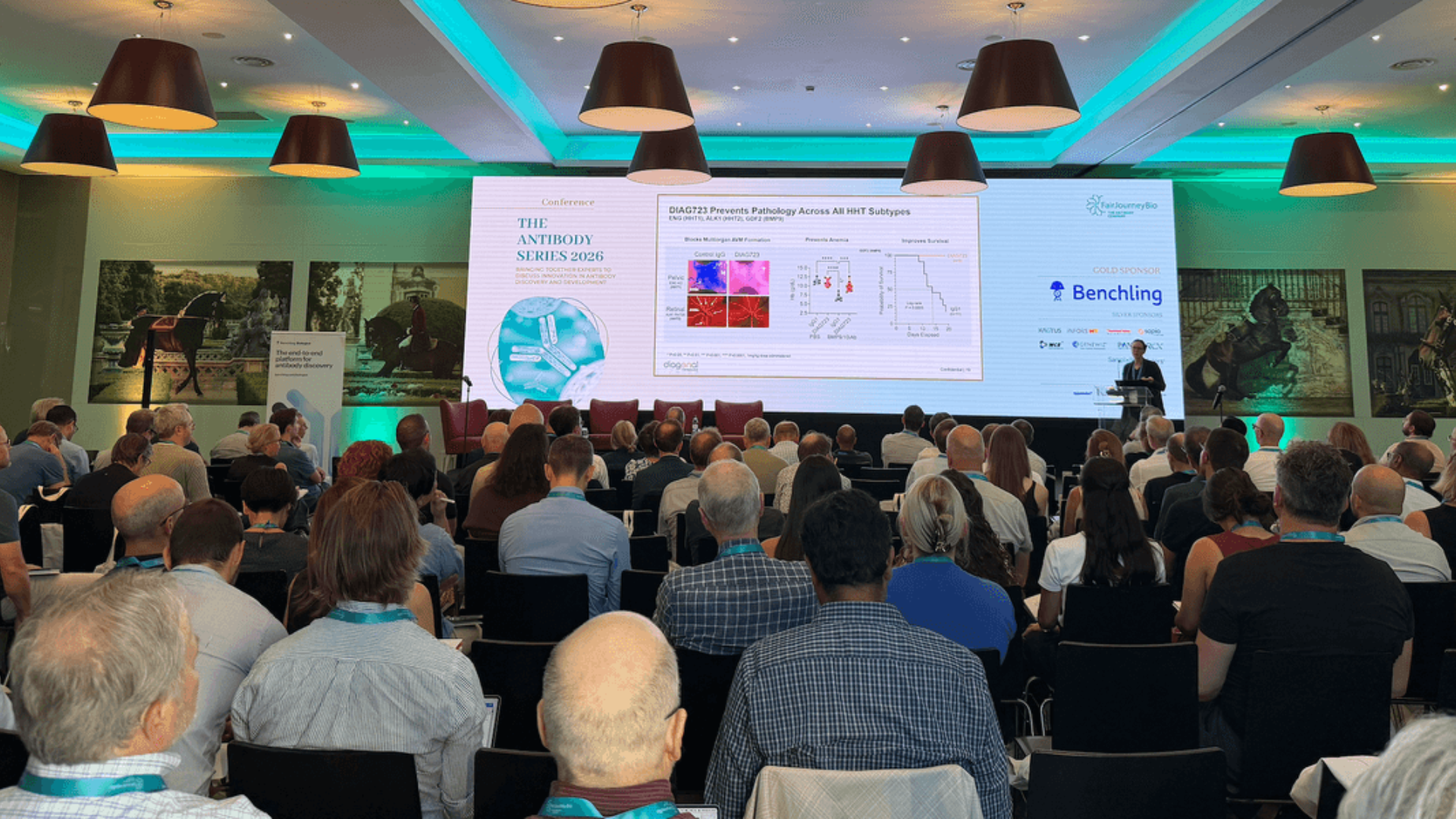
Sarel Fleishmann, Professor at the Weizmann Institute of Science, discussed computationally designed antibody repertoires and described CADAbRe, a structure- and energy-based approach.
According to Fleishmann's presentation, the team produced 2.5 billion antibody fragments on phage in 2026, with DNA synthesis costing €38,000.
Discover the ofspoke on harnessing multispecificity to drive novel functions, describing a move beyond simple binding toward deliberate biological design.
Precision Medicine
CADAbRe produced 2.5 billion antibody fragments on phage in 2026, with DNA synthesis costing €38,000
At The Antibody Series 2026 (TAS 2026), speakers explored how computational design, AI, and increasingly complex antibody formats could expand what antibodies can do.
Mark van Dijk, Chief Scientific Officer at Fairjourney Biologics, said antibody technology may no longer be the main limitation. He said, “the biology is the limitation.” Researchers can increasingly design molecules with the stability, specificity, and potency they want, but identifying which biological interactions to target and how to turn them into an effective treatment remains much harder.
One emerging ambition is to design antibodies with desirable properties from the outset, rather than discovering candidates first and optimizing them later. Sarel Fleishmann, Professor at the Weizmann Institute of Science, discussed computationally designed antibody repertoires and described CADAbRe, a structure- and energy-based approach. The method uses hundreds of human antibody frameworks and designs compatible sequences for CDR H3, with the aim of producing a library containing billions of potential antibodies that are both structurally varied and predicted to fold stably.
According to Fleishmann's presentation, the team produced 2.5 billion antibody fragments on phage in 2026, with DNA synthesis costing €38,000. CADAbRe is intended to make diversity more deliberate by incorporating structural constraints before the library reaches the experimental stage.
Computational tools were another major theme at the conference. Sai Reddy, Professor at ETH Zurich, focused on the sequence-to-specificity problem: given the amino acid sequences of an antibody and an antigen, can a model predict whether the two will recognize each other? He said molecular specificity is a scarce asset in drug discovery and that finding an antibody with the right binding properties can take years of screening and experimentation.
Reddy’s goal is to use AI to make that search more efficient by helping researchers sift through large collections of antibodies and antigens and identify likely interactions without experimentally testing every possible pairing or first predicting their structures. That is the idea behind CALM, or Cross-attention Adaptive Immune Receptor–Antigen Language Model. The model learns from known antibody–antigen pairs to identify sequence patterns associated with recognition and can be used in both directions, asking which antigens an antibody might recognize or which antibodies might bind a particular antigen.
Upcoming Conferences and Events
Melissa Geddie of Diagonal Therapeutics spoke on harnessing multispecificity to drive novel functions, describing a move beyond simple binding toward deliberate biological design. She said valency, multispecificity, and geometry can now be engineered by intention, giving rise to next-generation, multifunctional antibodies.
Geddie said antibody engineering has evolved from monospecific binding to multispecific biology, with molecules designed to bring together elements such as two cells, bridging them, driving co-stimulation, or controlling precisely where activity takes place. She pointed to Radiant's Multabody platform, a multispecific, multi-affinity antibody format that goes beyond conventional bi- or trispecific designs.
The third major theme was the development of more complex antibody formats designed to produce biological effects that a conventional monoclonal antibody cannot achieve alone. Joanne Hulme, Chief Scientific Officer at Radiant Biotherapeutics, described the progression from monoclonal antibodies to bispecific and multispecific molecules, where researchers can combine multiple binding specificities within a single therapeutic.
Radiant’s Multabody platform combines multivalency and multispecificity within a single molecule. Hulme said Multabodies can engage multiple epitopes on the same target or different disease-associated targets at the same time, increasing avidity while allowing the molecule to engage more than one biological pathway.
Hulme highlighted the company’s lead program, RBT-101, which targets 4-1BB, a co-stimulatory receptor involved in T cell activation and persistence. Previous efforts to develop 4-1BB agonists, such as urelumab, have been limited by liver toxicity. In contrast, Radiant reported that RBT-101 produced complete responses in all treated animals in a colorectal cancer mouse model, with no signs of liver toxicity. When the mice were rechallenged with fresh tumor cells three months after treatment, there was no detectable tumor growth, suggesting long-lived antitumor immunological memory.
Discover the ofspoke on harnessing multispecificity to drive novel functions, describing a move beyond simple binding toward deliberate biological design. She said valency, multispecificity, and geometry can now be engineered by intention, giving rise to next-generation, multifunctional antibodies.Geddie said antibody engineering has evolved from monospecific binding to multispecific biology, with molecules designed to bring together elements such as two cells, bridging them, driving co-stimulation, or controlling precisely where activity takes place. She pointed to, a multispecific, multi-affinity antibody format that goes beyond conventional bi- or trispecific designs.The third major theme was the development of more complex antibody formats designed to produce biological effects that a conventional monoclonal antibody cannot achieve alone., Chief Scientific Officer at, described the progression from monoclonal antibodies to bispecific and multispecific molecules, where researchers can combine multiple binding specificities within a single therapeutic.Radiant’splatform combines multivalency and multispecificity within a single molecule. Hulme said Multabodies can engage multiple epitopes on the same target or different disease-associated targets at the same time, increasing avidity while allowing the molecule to engage more than one biological pathway.Hulme highlighted the company’s lead program,, which targets, a co-stimulatory receptor involved in T cell activation and persistence. Previous efforts to develop 4-1BB agonists, such as, have been limited by liver toxicity. In contrast, Radiant reported that RBT-101 produced complete responses in all treated animals in a colorectal cancer mouse model, with no signs of liver toxicity. When the mice were rechallenged with fresh tumor cells three months after treatment, there was no detectable tumor growth, suggesting long-lived antitumor immunological memory.Discover the latest health news and emerging precision medicine news shaping the future of healthcare.