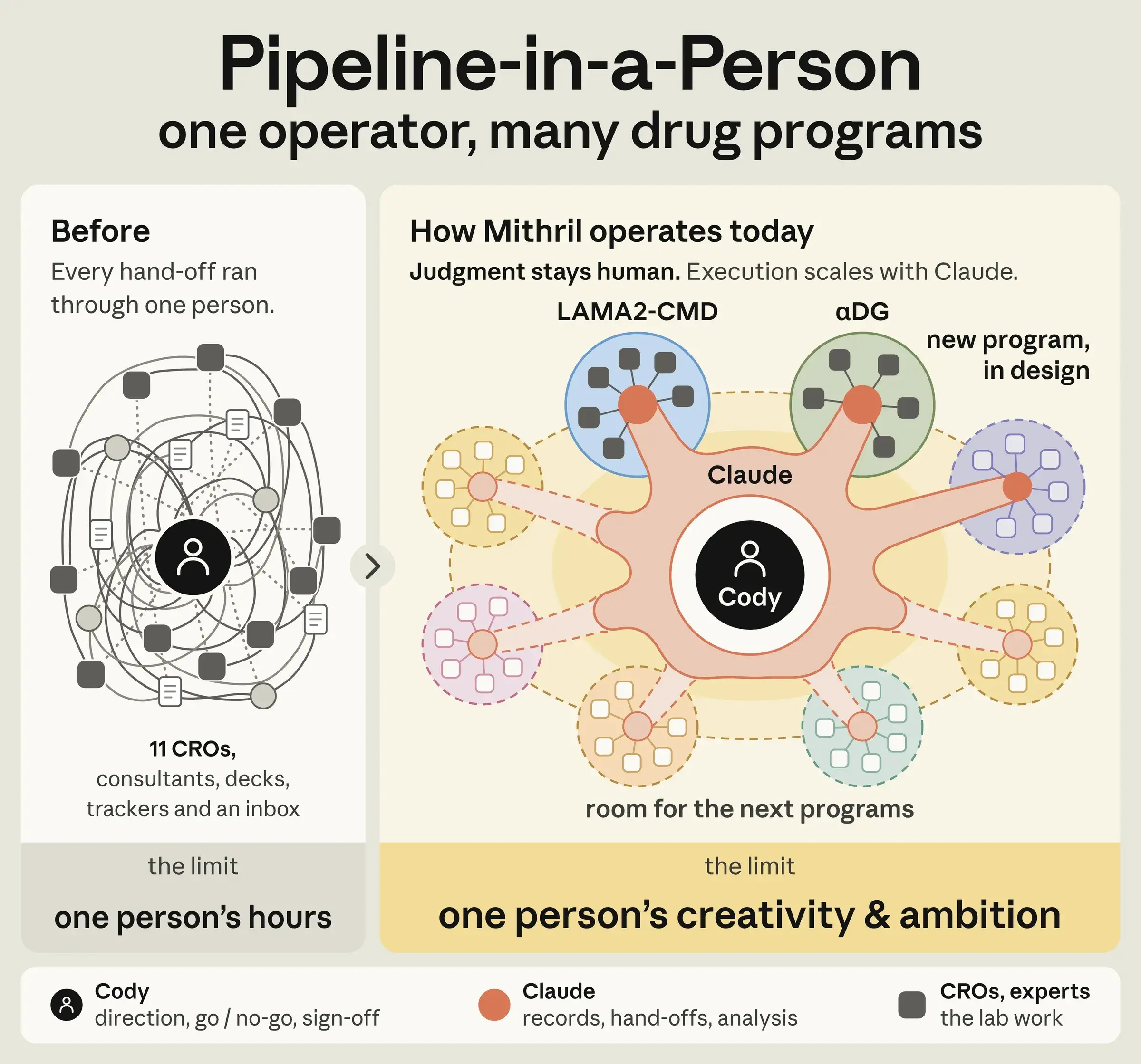
Another acquisition brings an even smaller company into Anthropic’s drug-development effort: Cambridge, Massachusetts-based Mithril Medicine had one full-time employee.
Anthropic disclosed Oct. 27 that it acquired Mithril in July.
Tranbarger has joined Anthropic to “both continue that work and spearhead our broader internal drug development effort,” he wrote on LinkedIn.
Building on earlier research into repairing those connections, Mithril developed bispecific antibodies that bind two targets to form a molecular bridge.
“Mithril was founded to develop bispecific antibodies for patients with LAMA2-CMD and other [extracellular matrix]-related genetic diseases,” Tranbarger wrote.
Two cofounders and fewer than 10 employees made up Coefficient Bio, the biology-focused AI startup Anthropic acquired in a deal R&D World covered in April. Another acquisition brings an even smaller company into Anthropic’s drug-development effort: Cambridge, Massachusetts-based Mithril Medicine had one full-time employee.
That employee, founder Cody Tranbarger, directed part-time scientific consultants and 11 outside laboratories, using Claude to help manage experiments, data and logistics. Anthropic disclosed Oct. 27 that it acquired Mithril in July. Its programs targeting two rare muscular dystrophies became Anthropic’s first internal drug-development programs. Tranbarger has joined Anthropic to “both continue that work and spearhead our broader internal drug development effort,” he wrote on LinkedIn.
Tranbarger brought experience across biotech finance and operations to that arrangement. A 2025 graduate of Harvard’s joint MS/MBA biotechnology program, he began his career as an investment banking analyst at Goldman Sachs, then worked at Casdin Capital, a New York life-sciences investment firm focused on biotech and genomics, and at Prime Medicine, a Cambridge-based gene-editing company developing therapies based on prime editing. He later became an entrepreneur-in-residence at Atlas Venture, an early-stage Cambridge biotech venture firm that helps launch companies. In his post, he thanked Atlas Venture, along with Jason Rhodes, Jernej Godec and Michael Gladstone, for their “inexhaustible support.”
Behind the single-employee company stood eight paid consultants and advisers contributing expertise in biology, antibody engineering and research planning. Mithril’s team designed and oversaw the experiments; contract laboratories produced the antibodies, measured their binding, ran cell-based assays and conducted the mouse studies.
Mithril’s first results concern LAMA2-related congenital muscular dystrophy. Mutations in the LAMA2 gene, which encodes the laminin-α2 protein, weaken the connections anchoring muscle fibers to surrounding tissue. Building on earlier research into repairing those connections, Mithril developed bispecific antibodies that bind two targets to form a molecular bridge.
Anthropic says the company reached mouse proof of principle in under 18 months. The accompanying technical report, which awaits peer review, describes early research molecules. At roughly six weeks of age, seven mice receiving one antibody format showed about twice the grip strength and peak triceps force of four mice given a control solution.
Researchers assigned treatment by litter without randomization and tested the antibody group 126 to 161 days after the control group, with a colony relocation in between. Those differences complicate attribution of the gains to treatment. The report calls for concurrent, blinded replication.
Alongside the mouse experiments, the report describes how Claude helped coordinate laboratory work. During a week the team selected as its best recent example, Claude synthesized a 341-page production report covering 113 antibody constructs in under eight minutes. When a team member overruled its recommendation to measure how quickly all 113 bound to and detached from their targets, Claude revised the plan and related drafts to cover 89 within four minutes.
Some errors survived human review. The team examined six Claude errors, at least three of which reached outside laboratories in emails people had edited and sent. One requested less material per tube than a laboratory needed; the team corrected it before filling began. Two errors in Claude’s review of production data went unnoticed for more than four days.
“Mithril was founded to develop bispecific antibodies for patients with LAMA2-CMD and other [extracellular matrix]-related genetic diseases,” Tranbarger wrote. “Along the way, what began as an exercise in staying lean evolved into the thesis for an entirely new operating model, which we now call Pipeline-in-a-Person.” Anthropic plans to test that model across additional rare-disease programs. Tranbarger estimates that turning a new program idea into a design plan and experimental strategy took two to three days with Claude, versus one to two months without it, according to Anthropic. “If we get it right, the result will be more programs, higher hit rates, and broader patient impact,” he wrote. Mithril aims to select formal drug candidates in 2027. Successful further development could put the LAMA2 program into human trials as early as late 2028. Its second program, for alpha-dystroglycanopathy, targets trials as early as 2029.