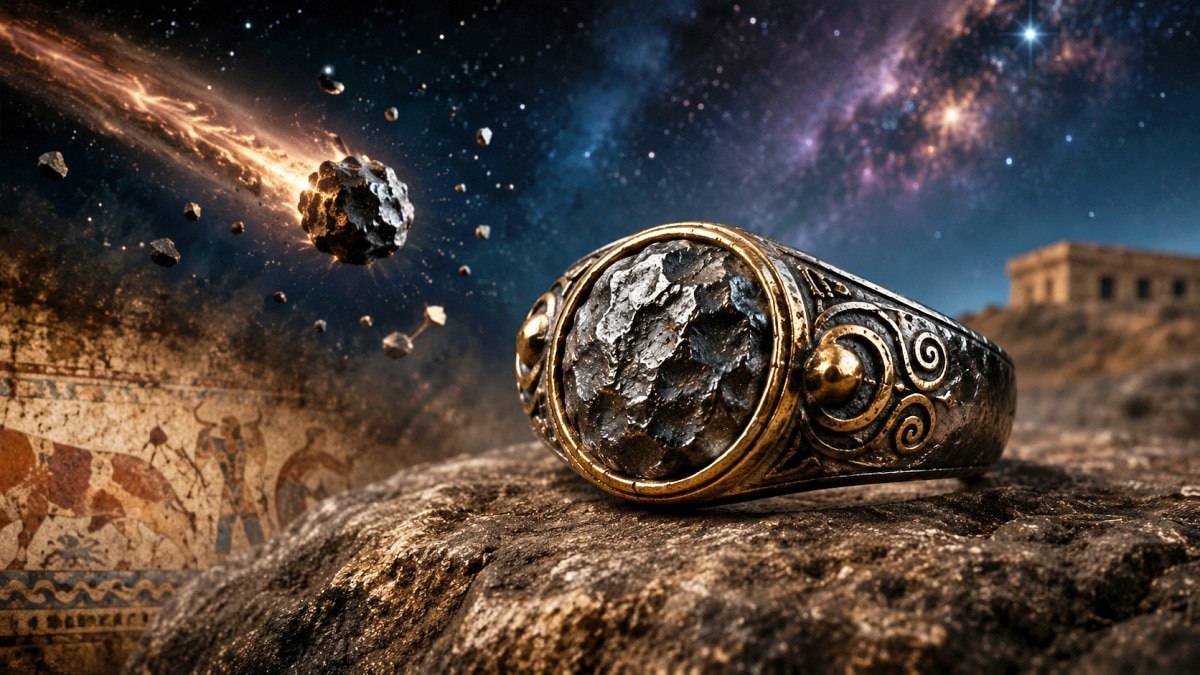
A new study has found evidence that elite members of the Minoan and Mycenaean civilisations wore finger rings crafted from meteoritic iron, metal originating from meteorites that formed in space, at times outside our Solar System, and later crashed to Earth.
The results revealed that 13 objects, all finger rings, contained significant amounts of nickel, a key indicator of meteoritic origin.
Sci., 2026)The findings suggest that meteoritic iron was not used for everyday tools or weapons.
Many of the rings combined meteoritic iron with gold, silver or bronze, further highlighting their value.
Interestingly, the use of meteoritic iron appears to have declined around the time the Mycenaean palatial system collapsed around 1200 BC.
Long before humans mastered iron smelting, some of the most powerful people in the ancient Mediterranean may have been wearing jewelry made from material that literally fell from the sky.
A new study has found evidence that elite members of the Minoan and Mycenaean civilisations wore finger rings crafted from meteoritic iron, metal originating from meteorites that formed in space, at times outside our Solar System, and later crashed to Earth.
Read Full Story
Researchers analysed 91 iron artifacts dating from the Bronze Age and Early Iron Age, excavated from 33 archaeological sites and preserved in 19 museums.
Using a portable X-ray fluorescence (XRF) instrument, they measured the chemical composition of the objects to determine whether they were made from smelted iron or iron derived from meteorites.
The results revealed that 13 objects, all finger rings, contained significant amounts of nickel, a key indicator of meteoritic origin. Of these, nine were identified as very likely to be made from meteorites, while one was considered quite likely and three others require further investigation. A selection of the items analyzed in this study. Those with red dots are likely to incorporate iron from meteorites. (Photo: Gounelle & Mantzourani, J. Archaeol. Sci., 2026)
The findings suggest that meteoritic iron was not used for everyday tools or weapons. Instead, it appears to have been reserved for prestigious jewellery worn by members of the palatial elite.
Most of the rings were discovered in elaborate tombs alongside luxury items such as gold vessels, amber jewellery and carved seals, indicating they belonged to high-status individuals. Many of the rings combined meteoritic iron with gold, silver or bronze, further highlighting their value.
Researchers believe these space-metal rings may have served as symbols of power, wealth and prestige during the Late Bronze Age.
The study also raises intriguing questions about where the material came from. Because meteorites are relatively rare in Greece, the researchers suggest the raw meteoritic iron may have been imported from Egypt, where meteorites are more commonly preserved in desert environments and where extensive trade links already existed.
Interestingly, the use of meteoritic iron appears to have declined around the time the Mycenaean palatial system collapsed around 1200 BC. As smelted iron became more common, these rare cosmic rings gradually disappeared.
The discovery offers a remarkable glimpse into a time when metal from beyond Earth was transformed into jewellery for kings, nobles and elites, centuries before iron became a cornerstone of human civilisation.
- Ends