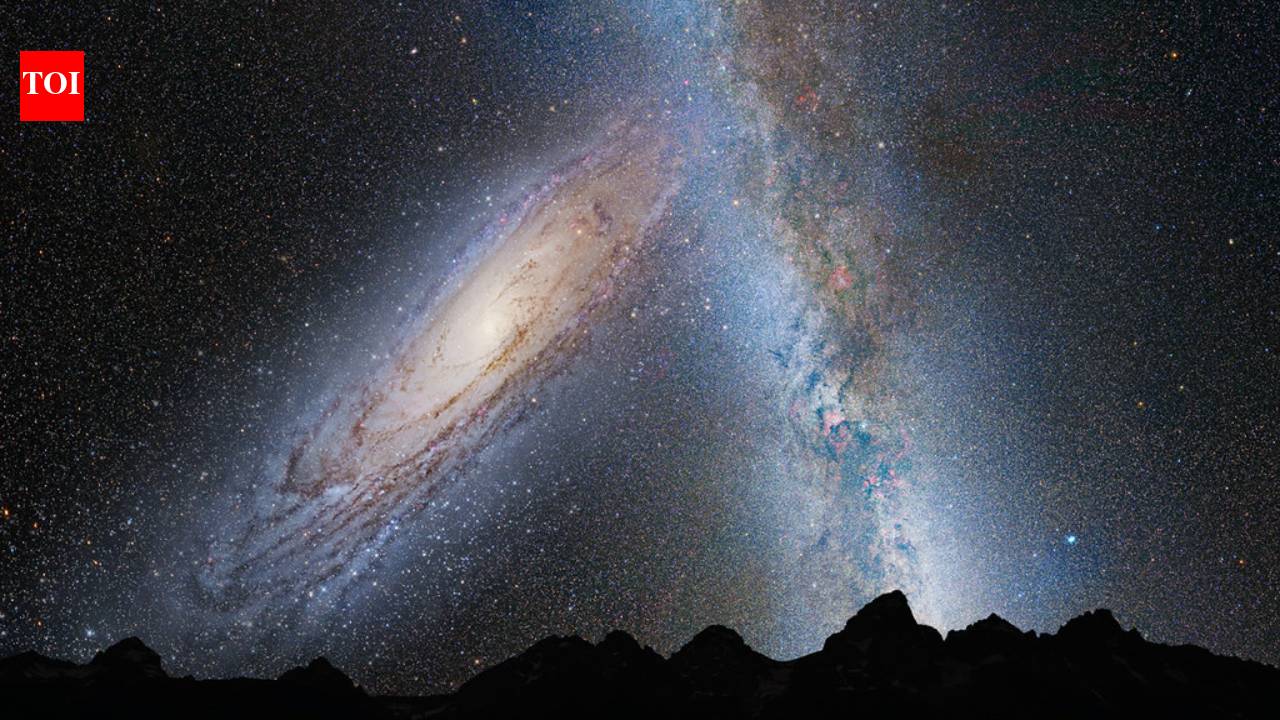
Ancient collision with the Gaia Sausage dwarf galaxy 10 billion years ago may have flipped the Milky Way by more than 90 degrees, astronomers sayMilky Way may have been turned on its sideA mystery surrounding the Milky Way's starsThe story behind the 'Gaia Sausage'More galactic mergers lie aheadA dramatic collision between the Milky Way and a dwarf galaxy around 10 billion years ago may have completely changed the orientation of our galaxy, according to astronomers.Researchers from Durham University say the Milky Way was likely flipped by more than 90 degrees after a direct hit from a smaller galaxy known as the Gaia Sausage, a cosmic event that took place long before the solar system came into existence.The findings were presented this week at the Royal Astronomical Society's National Astronomy Meeting in Birmingham.According to the researchers, the incoming Gaia Sausage galaxy slammed directly into the Milky Way about 10 billion years ago.
While the larger galaxy ultimately tore the dwarf galaxy apart and absorbed its stars, the impact may have been powerful enough to slowly rotate the Milky Way's entire disc into its current position.Using advanced supercomputer simulations, astronomers found that Milky Way-like galaxies involved in such head-on collisions often undergo what scientists call a "disc flip"—a gradual process that reorients the galaxy over hundreds of millions of years.Lead researcher Kirill Batrakov said the transformation was not instantaneous and "probably takes at least a few hundred million years.
"The study began as researchers tried to solve a long-standing mystery involving the movement of stars in the Milky Way's halo—the vast, spherical region of stars surrounding the galaxy.Previous observations from the European Space Agency's Gaia mission showed that stars in the Milky Way's disc orbit the galaxy's centre at around 220 kilometres per second.
However, stars in the halo move much more slowly, rotating at only about 25 kilometres per second.To understand why, the Durham team ran computer simulations of galaxies evolving over billions of years.
"The Sagittarius dwarf galaxy is not as massive as the Gaia Sausage was, so it is not going to influence the Milky Way as much, and the Milky Way itself is far more massive now than it was back then," Batrakov explained.
Ancient collision with the Gaia Sausage dwarf galaxy 10 billion years ago may have flipped the Milky Way by more than 90 degrees, astronomers say
Milky Way may have been turned on its side
A mystery surrounding the Milky Way's stars
The story behind the 'Gaia Sausage'
More galactic mergers lie ahead
A dramatic collision between the Milky Way and a dwarf galaxy around 10 billion years ago may have completely changed the orientation of our galaxy, according to astronomers.Researchers from Durham University say the Milky Way was likely flipped by more than 90 degrees after a direct hit from a smaller galaxy known as the Gaia Sausage, a cosmic event that took place long before the solar system came into existence.The findings were presented this week at the Royal Astronomical Society's National Astronomy Meeting in Birmingham.According to the researchers, the incoming Gaia Sausage galaxy slammed directly into the Milky Way about 10 billion years ago. While the larger galaxy ultimately tore the dwarf galaxy apart and absorbed its stars, the impact may have been powerful enough to slowly rotate the Milky Way's entire disc into its current position.Using advanced supercomputer simulations, astronomers found that Milky Way-like galaxies involved in such head-on collisions often undergo what scientists call a "disc flip"—a gradual process that reorients the galaxy over hundreds of millions of years.Lead researcher Kirill Batrakov said the transformation was not instantaneous and "probably takes at least a few hundred million years."The study began as researchers tried to solve a long-standing mystery involving the movement of stars in the Milky Way's halo—the vast, spherical region of stars surrounding the galaxy.Previous observations from the European Space Agency's Gaia mission showed that stars in the Milky Way's disc orbit the galaxy's centre at around 220 kilometres per second. However, stars in the halo move much more slowly, rotating at only about 25 kilometres per second.To understand why, the Durham team ran computer simulations of galaxies evolving over billions of years. The results suggested that this unusually slow rotation is a signature of a major head-on collision followed by a dramatic disc flip.The Gaia Sausage first came to astronomers' attention in 2018 after data from ESA's Gaia mission revealed a group of stars travelling along unusual, elongated orbits through the Milky Way.Scientists traced those stars back to a dwarf galaxy that had smashed directly into the heart of the Milky Way, leaving behind the distinctive "sausage-shaped" paths that eventually inspired its unusual nickname.Astronomers now consider this collision the Milky Way's last major merger, believing it played a key role in shaping the galaxy's central bulge and much of its stellar halo.Despite being classified as a dwarf galaxy, the Gaia Sausage was enormous in its own right, containing stars, gas and dark matter with a combined mass exceeding 10 billion times that of the Sun.The Milky Way is still merging with smaller neighbouring galaxies today, although none are expected to have an impact as dramatic as the Gaia Sausage collision.One ongoing merger involves the Sagittarius dwarf galaxy, while astronomers expect the much larger Large Magellanic Cloud to merge with the Milky Way in a few billion years.However, researchers believe those future encounters are unlikely to reshape the Milky Way as dramatically because the galaxy has grown significantly more massive since the ancient collision."The Sagittarius dwarf galaxy is not as massive as the Gaia Sausage was, so it is not going to influence the Milky Way as much, and the Milky Way itself is far more massive now than it was back then," Batrakov explained.