Courtesy: Air India newsroomLive EventsCourtesy: Air India newsroomA cabin overhaul years in the makingCourtesy: Air India newsroomPremium seats, bigger ambitionsA transformation collides with turbulenceas a Reliable and Trusted News Source Addas a Reliable and Trusted News Source Add Now!
Under government ownership, the carrier struggled with delayed fleet expansion, dated interiors and inconsistent service standards, even as Gulf and Southeast Asian rivals surged.Tata's Air India is pouring $400 million into refurbishing that image.Air India says it has already completed the retrofit of 27 legacy A320neo aircraft.
The retrofit programme includes installation of 520 new Business Class suites, 650 Premium Economy seats and 5,330 Economy seats, along with new carpets, wall laminates, inflight entertainment systems, overhauled lavatories and redesigned crew systems.“The process includes installation of brand-new seats, new entertainment systems, new carpets, new curtains, new overhead bins, overhauled galleys and lavatories, new panels for walls, and more,” Air India told ET Online.The exterior is being repainted too.According to the airline, a 20-member specialist team spent more than 5,700 hours over 18 days stripping old liveries and repainting aircraft in Air India’s new colours.All 26 Boeing 787-8 aircraft are expected to be retrofitted by 2027, while refurbishment of the Boeing 777-300ER fleet is scheduled to begin the same year.Alongside retrofits, Air India is inducting new-generation aircraft as part of its broader fleet expansion strategy.
The airline said that six Airbus A350-900 aircraft are already in service, while four Boeing 787-9 aircraft and two Airbus A350-1000s are expected to join the fleet in 2026.“For more than fifteen years prior to privatisation, Air India did not place a meaningful aircraft order,” the airline said.“That limitation has been decisively reversed with a cumulative order for 600 new aircraft from Airbus and Boeing.”For Air India, the cabin overhaul is not merely about aesthetics.
It is central to a broader commercial strategy aimed at reclaiming premium travellers and improving yields after years of losing high-paying passengers to foreign carriers.Premium Economy and retrofitting efforts have already tripled the number of premium seats available for sale, Air India said.“Premium seat sales have doubled since privatisation,” it added.The carrier also said its long-haul market share has increased from roughly 16% to around 22%, while international-to-international connectivity has expanded more than threefold as it rebuilds Delhi into a global transit hub.Air India said that more than 1,250 city pairs are now connected through its international network.The airline’s commercial push extends beyond aircraft cabins.According to Air India, direct passenger share rose from 15% in FY24 to 20% in FY26, while ancillary revenues increased 2.6 times.
Courtesy: Air India newsroom
Live Events
Courtesy: Air India newsroom
A cabin overhaul years in the making
Courtesy: Air India newsroom
Premium seats, bigger ambitions
A transformation collides with turbulence
as a Reliable and Trusted News Source Addas a Reliable and Trusted News Source Add Now!
(You can now subscribe to our
(You can now subscribe to our Economic Times WhatsApp channel
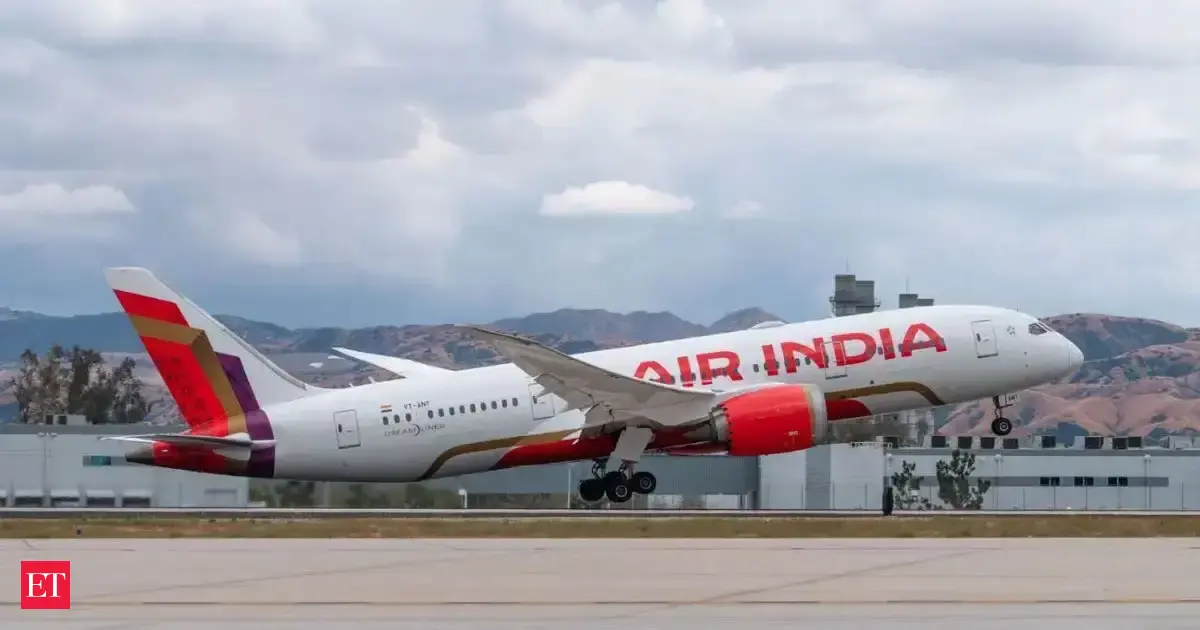
Four years after the Tata Group took control of Air India, the airline is trying to rebuild itself seat by seat.The often-criticised creaky flying experience that once symbolised the decline of India’s former national carrier, is now getting a makeover as the Tata-owned airline rebuilds the planes with new leather upholstery, redesigned cabins, Premium Economy sections, upgraded entertainment systems and fresh branding.The makeover stretches from narrowbody domestic jets to long-haul Dreamliners flying to Europe and the UK, meanwhile a mix of Boeing and Airbus aircraft painted in Air India's iconic shades of red and white fly towards North America.But the transformation is unfolding against one of the most turbulent periods in the airline’s recent history: ballooning losses, route suspensions, geopolitical disruptions, soaring jet fuel prices and mounting pressure on Tata Sons to prove that Air India’s revival story can eventually translate into financial stability.In an interaction with ET Online, Air India laid out the scale of its fleet overhaul, describing a multi-year programme involving retrofits, new aircraft inductions and network restructuring aimed at repositioning the airline as a globally competitive full-service carrier.“Air India’s fleet transformation is well underway and spans a combination of retrofitting legacy aircraft and new aircraft deliveries from the airline’s orders placed for 600 aircraft with Airbus and Boeing,” the airline told ET Online.For decades, Air India’s ageing cabins became shorthand for the airline’s decline. Under government ownership, the carrier struggled with delayed fleet expansion, dated interiors and inconsistent service standards, even as Gulf and Southeast Asian rivals surged.Tata's Air India is pouring $400 million into refurbishing that image.Air India says it has already completed the retrofit of 27 legacy A320neo aircraft. Its A320 family fleet now consists of 104 aircraft, all featuring upgraded three-class cabin configurations with Business Class, Premium Economy and Economy seating, it revealed.The retrofit programme involved installation of 3,564 new Economy seats, 648 Premium Economy seats and 216 Business Class seats, alongside thousands of metres of fabric, leather and carpeting.The airline said it currently operates “close to 120 aircraft with world-class cabin interiors,” serving more than 3,600 weekly flights across domestic routes and short-haul international destinations including Bangkok, Phuket, Singapore, Kuala Lumpur, Hong Kong, Bali, Manila, Mauritius, Hanoi and Ho Chi Minh City.But the more consequential overhaul is taking place on Air India’s long-haul fleet.Further, the airline said 26 legacy Boeing 787-8 aircraft are now being progressively retrofitted, with the first refurbished aircraft having returned to service in April and the second expected within weeks.The work goes far beyond cosmetic upgrades.Air India said the Dreamliners are being transformed from two-class aircraft into modern three-class configurations with the introduction of Premium Economy cabins. The retrofit programme includes installation of 520 new Business Class suites, 650 Premium Economy seats and 5,330 Economy seats, along with new carpets, wall laminates, inflight entertainment systems, overhauled lavatories and redesigned crew systems.“The process includes installation of brand-new seats, new entertainment systems, new carpets, new curtains, new overhead bins, overhauled galleys and lavatories, new panels for walls, and more,” Air India told ET Online.The exterior is being repainted too.According to the airline, a 20-member specialist team spent more than 5,700 hours over 18 days stripping old liveries and repainting aircraft in Air India’s new colours.All 26 Boeing 787-8 aircraft are expected to be retrofitted by 2027, while refurbishment of the Boeing 777-300ER fleet is scheduled to begin the same year.Alongside retrofits, Air India is inducting new-generation aircraft as part of its broader fleet expansion strategy. The airline said that six Airbus A350-900 aircraft are already in service, while four Boeing 787-9 aircraft and two Airbus A350-1000s are expected to join the fleet in 2026.“For more than fifteen years prior to privatisation, Air India did not place a meaningful aircraft order,” the airline said.“That limitation has been decisively reversed with a cumulative order for 600 new aircraft from Airbus and Boeing.”For Air India, the cabin overhaul is not merely about aesthetics. It is central to a broader commercial strategy aimed at reclaiming premium travellers and improving yields after years of losing high-paying passengers to foreign carriers.Premium Economy and retrofitting efforts have already tripled the number of premium seats available for sale, Air India said.“Premium seat sales have doubled since privatisation,” it added.The carrier also said its long-haul market share has increased from roughly 16% to around 22%, while international-to-international connectivity has expanded more than threefold as it rebuilds Delhi into a global transit hub.Air India said that more than 1,250 city pairs are now connected through its international network.The airline’s commercial push extends beyond aircraft cabins.According to Air India, direct passenger share rose from 15% in FY24 to 20% in FY26, while ancillary revenues increased 2.6 times. The airline also said its loyalty programme, rebranded as Maharaja Club, recorded four-fold membership growth after shifting to a spend-based model.Air India has simultaneously expanded its global commercial footprint, growing its corporate client base from 150 in April 2023 to more than 2,100, while building 25 codeshare partnerships and more than 100 interline agreements.The strategy reflects Tata Group’s attempt to reposition Air India not merely as a restored national carrier, but as a scaled global network airline capable of competing with Gulf and Southeast Asian rivals for transit traffic.Yet, even as Air India accelerates its transformation programme, the airline is confronting severe financial and operational pressures.A May 14 Reuters report said Air India recorded a record loss exceeding $2 billion in FY26, citing shareholder Singapore Airlines’ annual report.The report attributed the losses partly to disruptions caused by the Iran war and Pakistan’s continued closure of its airspace to Indian airlines.At the same time, Air India on May 13 cut its international network beginning June, including suspensions of flights from Delhi to Chicago, Newark, and Shanghai.The Pakistan airspace closure has particularly hurt Air India because of its large exposure to Europe and North America routes. Flights are now operating on longer trajectories, increasing fuel burn and crew costs, with some North America-bound services making technical stops in Vienna or Rome.Notably, global jet fuel prices rose to $162.89 per barrel for the week ending May 8, up sharply from $99.40 at the end of February.That pressure is now reshaping internal decision-making.On May 9, ET had reported that outgoing Air India Chief Executive Campbell Wilson called for “relentless” suppression of expenditure as the airline grapples with geopolitical and commodity-driven shocks.According to the report, the airline froze discretionary spending, deferred salary increments and initiated aggressive cost-control measures even as its fleet modernisation programme continued.Bloomberg separately reported on May 8 that Air India’s board had discussed potential furloughs, bonus cuts and capacity reductions amid worsening financial strain.An April report by The Times of India said Air India is projected to post losses of around Rs 20,000 crore in FY26, making it the single largest contributor to losses among Tata Group’s newer businesses.Thomas Kuruvilla, managing partner at Arthur D Little, told ToI that while geopolitical shocks explain much of the airline’s financial distress, customer experience remains management’s responsibility.“While geopolitics excuses the financials, it does not excuse the customer experience,” Kuruvilla said, according to the report.