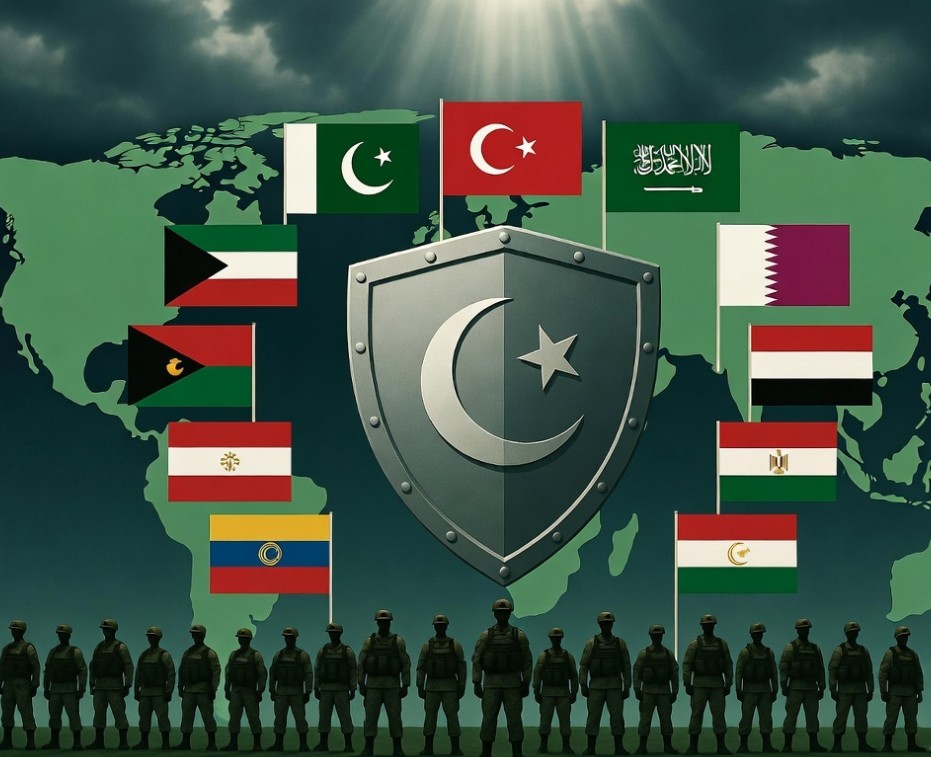
In September 2025, Pakistan and Saudi Arabia signed the Strategic Mutual Defense Agreement (SDMA) on the lines of NATO’s collective defense clause.
In the aftermath, Iran attacked Jordan, Iraq, Israel, the UAE, Kuwait, Bahrain, and Saudi Arabia.
Can Pakistan Deliver Its Promises on SecuritySince Pakistan and Saudi Arabia signed their much-publicized mutual defense agreement, Pakistan has been fighting a war with Afghanistan, whereas Saudi Arabia was repeatedly attacked by Iran.
Last week, Yemen’s Houthi rebels launched attacks on Saudi Arabia and have now declared a naval blockade of the country.
In fact, under Crown Prince Mohammed bin Salman’s Vision 2030, Saudi Arabia is pursuing economic transformation and requires strong partnerships with major economies.
Three years after signing a broad defense cooperation agreement with Pakistan, Kuwait has reportedly ratified the pact with Islamabad.
The agreement was approved through decree-law no. 73 of 2026 and published in the official gazette Kuwait Al-Youm on July 26.
The pact establishes a framework for cooperation between the two armed forces, focusing on military training, education, intelligence sharing, logistics, defense technology, research and exchanges of expertise, with the aim of strengthening institutional military ties between the two countries, Kuwait Times reported.
The agreement also includes cooperation in military manufacturing, electronic communications systems, scientific research, military media and cultural and sports activities. A joint military committee will oversee implementation, including organizing exercises, official visits and other joint programs.
It also includes provisions governing the protection of classified information exchanged between the two sides, preventing the transfer of confidential documents or materials to third parties without prior written approval.
According to reports, the agreement will remain in force for five years and will be automatically renewed unless either country chooses to withdraw.
The agreement was ratified at a time when all Gulf countries, including Kuwait, are facing renewed security challenges due to the ongoing US-Iran War.
Notably, just one and a half years ago, Pakistan signed a defense agreement with Saudi Arabia, which also included a mutual defense clause on the lines of NATO’s Article 5, wherein an attack on one country is considered an attack on both countries, obliging the other country to provide military, economic, intelligence, and diplomatic support to the attacked country.
Earlier, Pakistan had suggested that Turkey and Qatar are also considering joining the Pakistan-Saudi Strategic Mutual Defense Agreement (SDMA).
Pakistan-aligned strategic thinkers even quipped that the agreement will bring in Turkish arms, Pakistani nuclear weapons, and Saudi and Qatari Petro-dollars and energy security.
While the Pakistan-Kuwait defense agreement does not include a mutual defense clause on the lines of NATO’s Article 5, the signing of the agreement will nevertheless further ignite speculation about an Islamic NATO in the making, which will seek a collective security arrangement outside traditional Western frameworks and independent of the United States.
However, talks of an Islamic NATO are largely symbolic rather than substantive, constrained by deep-seated internal rivalries, enduring structural dependence on the United States, and broader geopolitical calculations that render it operationally unviable and impractical.
In fact, the narrative of an Islamic NATO, largely driven by Pakistan, echoes the earlier rhetoric of an “Islamic bomb” that Islamabad promoted throughout the 1970s and 1980s, a vision that ultimately came to nothing.
A West Asian Security Architecture Without the US?
For decades, all West Asian countries, with the sole exception of Iran, have depended on the US for their defense and security.
In fact, the US has as many as 18 military bases in the region.
The US has strategic security partnerships with Saudi Arabia, Egypt, Jordan, Kuwait, Bahrain, the UAE, and Qatar.
Turkey, meanwhile, is a NATO member. It also hosts American nuclear weapons at the Incirlik Air Base as part of a NATO nuclear-sharing agreement. An estimated 20 to 50 B61 nuclear gravity bombs are stored there under US control, though Turkey has no independent authority to use them.
However, ever since the Hamas terror attacks on Israel in October 2023, the West Asian region has been going through a churning.
In the aftermath, Israel declared its goal of ‘Total Victory’ and has since attacked six regional countries, including Palestine, Lebanon, Syria, Qatar, Yemen, and Iran. While Israel has often had brief wars and skirmishes against the first three (Palestine, Lebanon, and Syria), it attacked Yemen, Qatar, and Iran for the first time.
The Israeli “belligerence” is believed to have fueled collective insecurities and made Gulf states look for new security guarantees and new partners.
In September 2025, Pakistan and Saudi Arabia signed the Strategic Mutual Defense Agreement (SDMA) on the lines of NATO’s collective defense clause. The most important clause of the agreement states, “Aggression against one country shall be considered aggression against both.”
While not explicitly stated, some Pakistani leaders, including Defense Minister Khwaja Asif, had suggested that the agreement extend Pakistan’s nuclear umbrella protection to Saudi Arabia.
Notably, the agreement was signed just weeks after an Israeli airstrike on Qatar on September 9, 2025, which reportedly took even Washington by surprise.
Qatar hosts the largest US military base in the region, but that was not enough to deter Israel.
In the same month, Doha signed a new security pact with the US, in which Washington explicitly pledged Qatar’s security.
“The United States shall regard any armed attack on the territory, sovereignty, or critical infrastructure of the State of Qatar as a threat to the peace and security of the United States,” it said, adding, in the event of such an attack, the United States shall take all lawful and appropriate measures — including diplomatic, economic, and, if necessary, military — to defend the interests of the United States and of the State of Qatar and to restore peace and stability.
However, the US-Iran War that began earlier in February this year once again destabilized the entire region and demonstrated the inability of the US to provide foolproof security in the region.
In the aftermath, Iran attacked Jordan, Iraq, Israel, the UAE, Kuwait, Bahrain, and Saudi Arabia.
The US’s inability to thwart these attacks is further pushing Gulf countries to explore new security partners. In this atmosphere of geopolitical upheaval, Pakistan is pushing itself as a credible security partner that can fill the vacuum left behind by the US.
Can Pakistan Deliver Its Promises on Security
Since Pakistan and Saudi Arabia signed their much-publicized mutual defense agreement, Pakistan has been fighting a war with Afghanistan, whereas Saudi Arabia was repeatedly attacked by Iran.
Last week, Yemen’s Houthi rebels launched attacks on Saudi Arabia and have now declared a naval blockade of the country.
As per the terms of the agreement, by now Pakistan should have declared a war on Iran and the Houthis, and Saudi Arabia should have declared a war on Afghanistan. However, neither has this happened, which highlights that the mutual defense clause has loopholes.
In fact, far from attacking Iran, Pakistan was hosting the US-Iran peace talks on its territory, even when Saudi oil fields were under Iranian attacks.
Security analysts have already highlighted that Riyadh is unlikely to come to Islamabad’s aid if there is war between India and Pakistan.
In fact, under Crown Prince Mohammed bin Salman’s Vision 2030, Saudi Arabia is pursuing economic transformation and requires strong partnerships with major economies. Riyadh views India as a long-term economic partner as it diversifies away from oil dependence.
Islamic NATO a Myth?