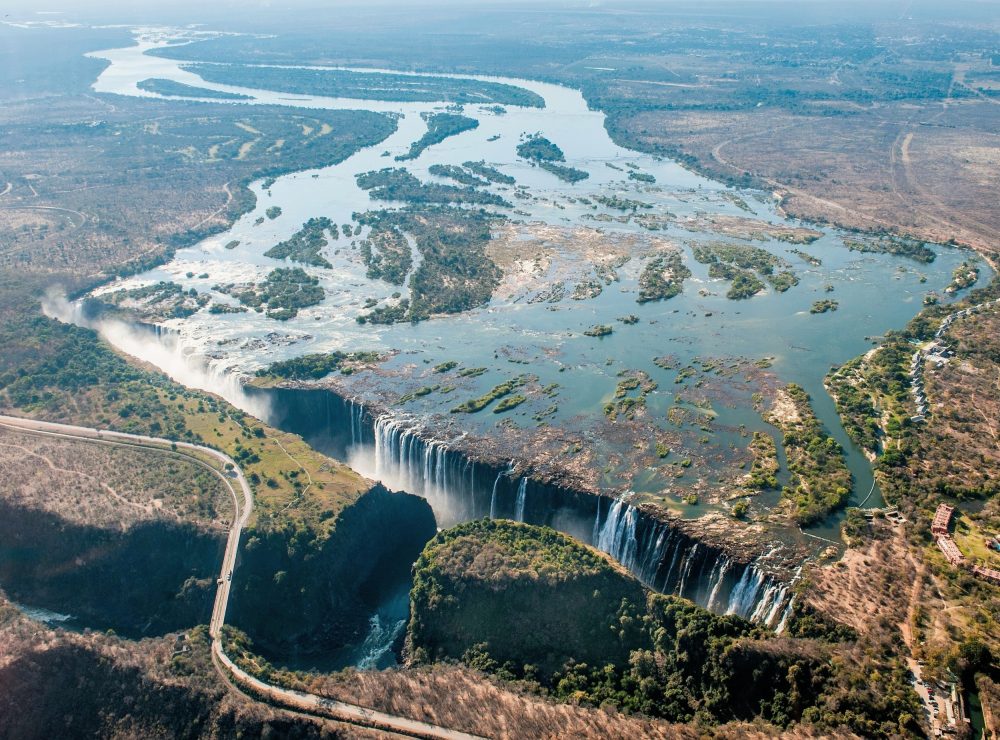
Deep mantle gases detectedThe springs sit along the Kafue Rift, a long crack in the Earth’s crust that runs across Zambia.
Gas from the six springs inside the Kafue Rift showed a clear mantle component that was not detected in the two springs outside the rift.
“The hot springs along the Kafue rift of Zambia have helium isotope signatures which indicate that the springs have a direct connection with the Earth’s mantle,” said Daly.
A continent that’s splittingIf the Kafue Rift is truly cracking through Earth’s rigid outer shell, it is part of something much larger.
Zambia already runs geothermal surveys along the Kafue Rift in hopes of generating power locally.
A new plate boundary forming is not supposed to be subtle. Plates ripping apart make earthquakes, volcanoes, and landscapes that change fast enough to track on maps.
The clearest sign of one forming in central Zambia turned up not on a seismometer but in hot spring water.
Gas escaping with the bubbles came from depths that should not easily connect to the surface.
Deep mantle gases detected
The springs sit along the Kafue Rift, a long crack in the Earth’s crust that runs across Zambia.
Researchers had long suspected the rift might still be active. Until this study, no one had proven it.
Mike Daly, a professor of earth sciences at the University of Oxford, led a team that went looking for an answer in the bubbling water itself.
His group sampled gas from eight geothermal wells and springs across the region. Six sat within the suspected rift zone. Two sat on stable ground outside it.
Sampling the springs
At each site, the team collected gas bubbling freely from the water and sealed it in copper tubes.
Back at Oxford, they analyzed each sample for traces of helium isotopes and other elements.
Isotopes are different versions of the same element, identical chemically but slightly different in mass.
The proportions of certain isotopes in a gas reveal where it has been. Crust and mantle leave very different signatures.
The helium clue
Earth’s mantle, the layer of hot rock that sits beneath the crust, holds a kind of helium that is exceptionally rare at the surface.
Crustal rocks generate a different version through slow radioactive decay. The ratio between the two reveals where any sample of gas originated.
Past work at Yellowstone has used this measurement to detect connections to deep magma.
Here, the signatures point to gases rising from rocks roughly 25 to 100 miles below the surface.
Gas from the six springs inside the Kafue Rift showed a clear mantle component that was not detected in the two springs outside the rift.
The contrast was sharp enough to rule out air contamination or ordinary crustal noise.
“The hot springs along the Kafue rift of Zambia have helium isotope signatures which indicate that the springs have a direct connection with the Earth’s mantle,” said Daly.
Africa’s other rift
Readings from the Kafue Rift fell in the same range as samples from the East African Rift system – the ancient crack to the north that has been opening for millions of years.
That made the comparison useful. Africa’s eastern rift is further along, with active volcanoes and deepening valleys that go back millions of years.
Zambia’s samples were consistent with an earlier stage of the same process. A crack beginning to reach down into hot rock. Mantle fluids finding their way up. No volcanoes yet.
A continent that’s splitting
If the Kafue Rift is truly cracking through Earth’s rigid outer shell, it is part of something much larger.
The fault zone stretches roughly 1,550 miles, from Tanzania down through Botswana and into Namibia.
Researchers call it the Southwest African Rift, and if it keeps developing, it could split Africa in half along a new plate boundary.
For decades, scientists assumed East Africa would one day pull free of the continent along the Great Rift Valley. It might still. But that rifting moves slowly, and the geometry around Africa pushes back.
A southwestern path could prove faster. The underlying geology there lines up more favorably with the ocean ridges on either side of the continent, making a full break easier.
“A rift may become a plate boundary, but commonly a rift’s activity ceases before the point of lithospheric break-up and plate boundary formation,” said Daly.
Rifts can provide energy
The discovery has practical implications. Early-stage rifts can produce geothermal heat and pockets of helium and hydrogen not yet diluted by volcanic gases.
Zambia already runs geothermal surveys along the Kafue Rift in hopes of generating power locally. The new evidence of mantle connection makes those prospects considerably more interesting.
Helium runs short in global supply, in demand for medical scanners, microchips, and rocket fuel. Hydrogen, increasingly sought as a clean fuel, can also accumulate in early rifts.
Recent work in similar settings has flagged early-stage rifts as some of the most promising places to look for these resources. Kafue joins that short list.
Broader implications of the study
Until this study, no one had directly confirmed that the Kafue Rift was tearing into Earth’s mantle. Geochemistry now closes that gap.
Boundary faults are active, the crust is fracturing, and gas from deep below has already reached the surface – at least along the section sampled.
Daly is careful about how far that applies. “However, this study is based on helium analyses from one general area in the Southwest African Rift System, which is thousands of kilometers long,” he said.
More fieldwork along the rest of the rift, including segments in Botswana and Namibia, is already underway, with results expected later this year.
What changes is the conversation about Africa’s eventual break. East Africa has long held the spotlight.
Now, Zambia emerges as a serious candidate for where Africa’s next true plate boundary could form.
The study is published in the journal Frontiers in Earth Science.
—–
Like what you read? Subscribe to our newsletter for engaging articles, exclusive content, and the latest updates.
Check us out on EarthSnap, a free app brought to you by Eric Ralls and Earth.com.
—–