A team of scientists at Rice University has developed a new organic synthesis method to form carbon-carbon bonds essential for natural product and pharmaceutical synthesis.
Their work, published this week in Nature Catalysis, revamps the catalytic method for new carbon-carbon bond formation, known as alkene hydroalkylation, using a cheaper, more environmentally friendly system involving sulfur, iron, and violet light.
The carboxylic acid group is then washed away right inside the reaction mixture, producing carbon dioxide as a nontoxic, easily discarded byproduct.
Iron, sulfur, and violet light catalyze the reaction, avoiding precious metals like palladium and expensive activating reagents previously used to controllably extend hydrocarbon chains through new carbon-carbon bond formation.
The authors applied their new method to pharmaceutical synthesis, showing they could employ it to efficiently synthesize a GPR119 agonist used as a weight-loss drug.
A team of scientists at Rice University has developed a new organic synthesis method to form carbon-carbon bonds essential for natural product and pharmaceutical synthesis. Their work, published this week in Nature Catalysis, revamps the catalytic method for new carbon-carbon bond formation, known as alkene hydroalkylation, using a cheaper, more environmentally friendly system involving sulfur, iron, and violet light. Corresponding author Julian West spoke optimistically about her lab’s latest advance, declaring, “This method allows us to build out an organic molecule cheaply, easily and flexibly. It also opens up ways to develop and test entirely new molecules, which could be the key for discovering the medicines of tomorrow.”
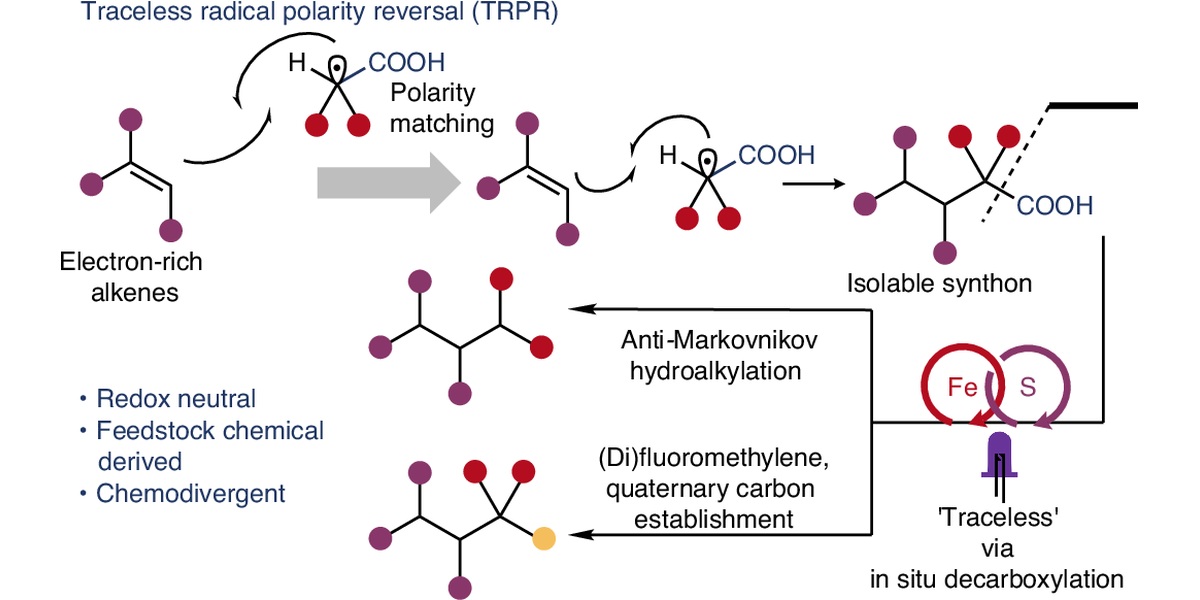
Connecting two saturated, or electron-rich, carbons has long been a challenge whose solution would enable more efficient drug scaffold synthesis. The team overcame this challenge by forcing a non-standard charge, or polarity, imbalance between a carbon in a double bond (alkene) and a carbon group missing an electron (alkyl radical) to be added to the alkene using a strategy they call traceless radical polarity reversal (TRPR).
With TRPR, a carboxylic acid, like the compounds found in vinegar, is introduced to temporarily make the alkyl radical electron-deficient, allowing the alkyl group to attach to the alkene in the exact orientation that the chemist chooses. The carboxylic acid group is then washed away right inside the reaction mixture, producing carbon dioxide as a nontoxic, easily discarded byproduct. Iron, sulfur, and violet light catalyze the reaction, avoiding precious metals like palladium and expensive activating reagents previously used to controllably extend hydrocarbon chains through new carbon-carbon bond formation.
The authors applied their new method to pharmaceutical synthesis, showing they could employ it to efficiently synthesize a GPR119 agonist used as a weight-loss drug. The study did not attempt to scale up the method to meet industrial demands, and the team achieved moderate yields in most test reactions, leaving room for further experiments and method improvements. Describing the key advance of their work, the authors state, “[T]his design proceeds using cheap and sustainable earth-abundant element catalysts while avoiding the need for stoichiometric activating reagents and generating carbon dioxide as a benign by-product, providing a direct and redox-neutral approach to afford hydroalkylation products.”
Sources: Nature Catalysis, EurekAlert!