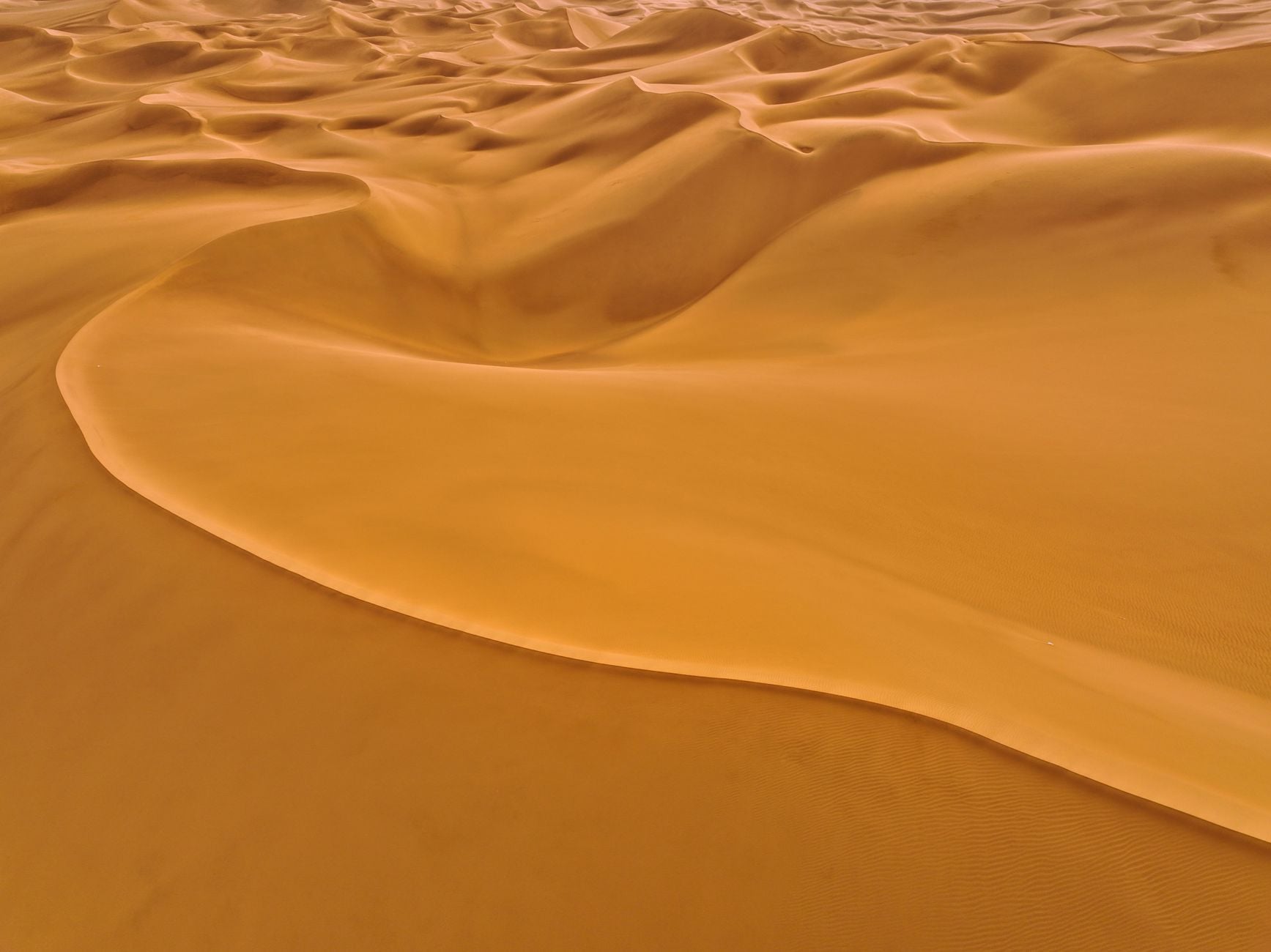
Individual ridges are commonly one to two kilometres wide, about 100 metres high and tens to hundreds of kilometres long.
The required ice porosity, about 65 per cent in that analysis, appeared too high for a sand dune.
Titan’s dunes, however, may have remained active for tens to hundreds of thousands of years.
The vehicle is planned to fly between sites, collect surface material and analyse it with onboard instruments during a nominal 3.3-year mission.
The next decisive evidence about Titan’s dunes is therefore likely to come from a sample cup rather than another remote image.
Cassini’s radar found dark, nearly parallel dune belts running across Titan’s equatorial regions. Individual ridges are commonly one to two kilometres wide, about 100 metres high and tens to hundreds of kilometres long. Together, the fields occupy a substantial fraction of Saturn’s largest moon.
Their scale is measured more confidently than their composition. NASA’s Cassini overview presents one widely used interpretation in which the sand consists of water-ice grains coated with hydrocarbons that settled from Titan’s atmosphere. Other analyses of Cassini data find little exposed water ice in the mobile dune material and instead favour grains dominated by solid organic compounds and nitriles.
No spacecraft has sampled one of the dunes. The ice-grain description is therefore a plausible model, not a laboratory identification of every grain.
Cassini mapped sand seas through the orange haze
Titan’s thick atmosphere hides most surface detail from an ordinary camera. Cassini overcame that barrier with radar, sending microwave pulses through the haze and recording the returning signal. During a 2005 flyby, the instrument detected long, dark bands that were subsequently recognised as dunes. Later passes mapped thousands of them.
The dune fields are concentrated within roughly 30 degrees of the equator. A 2009 global radar survey by Ralph Lorenz and Jani Radebaugh estimated that they cover about 40 per cent of Titan’s equatorial half. Other mappings put their share of the moon’s entire surface at roughly 15 to 20 per cent, with the difference reflecting the area being counted and how features are classified.
Most are linear dunes, long ridges comparable in form to dunes in the Namib, Sahara and Arabian deserts. Their radar darkness indicates that the surface is relatively smooth at Cassini’s 2.17-centimetre radar wavelength, absorbs much of the microwave energy, or combines both properties. Brighter gaps between ridges can reveal exposed or thinly covered terrain.
The height does not come from a photograph with an obvious scale bar. Researchers used radarclinometry, which estimates relief from differences between radar-facing and radar-shadowed slopes. Published values commonly place the larger ridges around 100 to 150 metres high.
Some continue for hundreds of kilometres without the chain being interrupted.
At Titan’s temperature, water behaves as bedrock
Titan’s surface temperature is close to minus 179 degrees Celsius. Water does not act as a liquid sediment carrier there. It forms the hard material of the crust, serving much the same geological role that silicate rock serves on Earth.
The atmosphere is mostly nitrogen, with methane providing the raw material for much of its chemistry. Solar ultraviolet radiation and energetic particles split molecules high above the surface. The fragments recombine into heavier carbon-bearing and nitrogen-bearing compounds, aggregate into the haze that colours Titan orange, then settle towards the ground.
NASA’s current Titan fact sheet describes the dune sand as dark hydrocarbon grains thought to resemble coffee grounds. One proposed route begins with fragments of water ice eroded from the crust and coated by falling organic material. Another makes the mobile grains largely from atmospheric organic solids themselves.
Cassini could not choose cleanly between those possibilities. Its Visual and Infrared Mapping Spectrometer observed the surface through a small set of wavelengths at which Titan’s atmosphere is partly transparent. Dune regions correlate with a dark-brown spectral unit that generally shows less water ice than neighbouring terrain.
A combined VIMS and radar study led by Alice Le Gall found that the dunes’ low dielectric constant could be explained by moderately porous hydrocarbons or extremely porous water ice. The required ice porosity, about 65 per cent in that analysis, appeared too high for a sand dune. The authors regarded hydrocarbon-rich particles as the more plausible reading, while recognising how difficult surface spectroscopy is through Titan’s atmosphere.
The water-ice-coated-in-hydrocarbons description should consequently be read as one model within a constrained but unresolved composition problem. Water ice may occur in mixed grains, beneath organic mantles or in exposed interdune ground even if the moving sand is mainly organic.
Atmospheric dust still has to become sand
Material settling from the atmosphere begins far smaller than the grains needed to build dunes. Fine aerosol particles must aggregate, harden or be reworked into particles hundreds of micrometres across before wind can organise them into ridges on a planetary scale.
Organic sand creates another difficulty. Laboratory materials made to resemble Titan haze, usually called tholins, can be softer and more brittle than quartz. Repeated collisions during wind transport should grind weak grains down into dust. Titan’s dunes, however, may have remained active for tens to hundreds of thousands of years.
A 2022 paper in Geophysical Research Letters proposed a balance between abrasion and sintering. Grains would wear down while moving in winds or methane streams, then fuse and strengthen while resting. The authors presented this as a hypothesis for maintaining sand-sized organic particles, not as a process already measured on Titan.
The model connects the dune belt with Titan’s wider sediment cycle. Seasonal transport could shift organic material between latitudes, while different balances of erosion, movement and fusion contribute to dunes, plains and dissected labyrinth terrain.
It also makes clear why “hydrocarbons fell from the sky” is only the first part of the explanation. Atmospheric chemistry can supply material, but several further steps are needed to turn haze into durable sand.
Rare methane storms may dominate the dune-building winds
The dunes record wind direction over long intervals, yet early circulation models produced a contradiction. They predicted prevailing near-surface winds towards the west at low latitudes, while dune shape indicated net sand movement towards the east.
A modelling study led by Benjamin Charnay offered a possible resolution in Nature Geoscience in 2015. Its simulations found that infrequent equatorial methane storms could drive strong eastward gust fronts. If those brief events exceed the threshold required to move cohesive grains, they could dominate sediment transport even though weaker winds usually blow in the opposite direction.
The dunes would then record the winds capable of moving sand, not simply the most common breeze.
Cassini later observed short-lived bright features near the equator around the 2009 equinox. A 2018 Nature Geoscience analysis interpreted three of them as dust storms, consistent with strong downdrafts from seasonal methane storms. The observations support an active dust cycle, although Cassini did not directly film sand migrating along a dune face.
Dragonfly can test what the grains are made of
Cassini ended its mission in Saturn’s atmosphere in September 2017. Its radar maps remain the principal global record of Titan’s sand seas, leaving grain composition to be inferred from microwave, infrared and atmospheric measurements.
NASA’s Dragonfly rotorcraft is intended to investigate the equatorial surface directly. NASA currently lists launch no earlier than July 2028 and arrival in late 2034. The vehicle is planned to fly between sites, collect surface material and analyse it with onboard instruments during a nominal 3.3-year mission.
Dragonfly is expected to explore dune and interdune terrain before moving towards Selk Crater. It will not survey Titan’s longest ridges from end to end, but measurements of nearby sediment could show whether the dark grains are mainly atmospheric organics, coated water ice, a mixture or a material not adequately described by either option.
The next decisive evidence about Titan’s dunes is therefore likely to come from a sample cup rather than another remote image. Until Dragonfly reaches the surface, the height and reach of the ridges are established far more firmly than the chemistry of the sand.