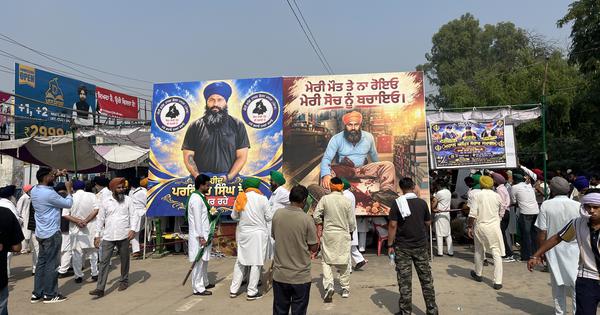
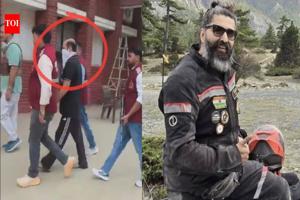
At the protest in Mansa, posters of Jhota (left) and the chemist accused of his murder.
From addict to crusaderParvinder Singh Jhota’s activism was personal.
In Mansa, Jhota’s activism involved exposing the sale of such banned drugs on camera.
Bhupinder Pal Singh (right) and Jagmohan Singh were members of Jhota's group of anti-drug crusaders.
“All of us have to die anyway,” said Bhupinder Pal Singh, Jhota’s long-time friend.
A fortnight after the public murder of anti-drug crusader Parvinder Singh Jhota, his face turns up across Mansa city in Punjab – as posters on vehicles and massive hoardings towering over the city and, most visibly, at a long-drawn highway protest against his death.
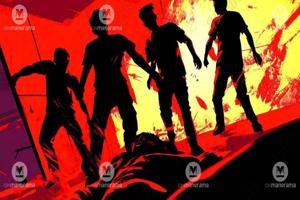
Many of the posters feature an AI-generated representation of Jhota’s last moments, when he lay bleeding from gunshot wounds of his assailant.
On October 13, Jhota, who led a self-styled group of anti-drug volunteers in Mansa district, did what he was known for – he landed up with a smartphone at the shop of a drugstore owner and accused him of selling banned drugs. The confrontation turned violent. The chemist, Ashwini Kumar, shot Jhota multiple times with his licensed pistol, then chased him down a street and shot him again.
The murder was caught on camera, as Jhota and his team typically streamed their raids live on Facebook.
Jhota’s killing has resonated beyond Mansa, quickly becoming a symbol of the impunity of drug peddlers in Punjab and putting the ruling Aam Aadmi Party government under significant pressure ahead of Assembly elections.
Jhota’s family has refused to cremate his body or even allow a post-mortem unless Chief Minister Bhagwant Mann and the state police chief resign. A protest on the Barnala-Mansa highway, led by his family and several farmer, labour and religious organisations, continues to draw crowds. On Tuesday, the police had to forcibly stop the family of a young man who had allegedly died of a drug overdose in Mansa district from joining the protest.
“Jhota’s work represented our growing frustration against the problem of drugs,” said Bhagwant Singh Samaon, the state president of Mazdoor Mukti Morcha Azad, a leftist group fighting for the rights of landless agricultural labourers and Dalits. “Many of us would speak about this menace. He was someone who chose to act without caring for his own safety.”
While there is a wave of sympathy for Jhota, many argue that his crusades, bordering on vigilanteism, were a sign of desperation, rather than a solution to a deeper problem of institutional failure. “It is a time-tested thing that when the system does not give justice, people sometimes take justice into their own hands,” said retired professor Dr Ranjit Singh Ghuman, who has studied the drug problem across five northern states, including Punjab.
At the protest in Mansa, posters of Jhota (left) and the chemist accused of his murder.
From addict to crusader
Parvinder Singh Jhota’s activism was personal. An athlete and boxer, he had started using drugs during his college days in Jalandhar after being named in a police complaint. However, around 2015, he quit drugs on his own, said Jagseer Singh, who later became part of Jhota’s crusades.
“He had come out of the tentacles of addiction. This is why he was so brazenly against it,” said Jagseer Singh, who too is a former addict.
Jhota’s wife, Manpreet Kaur, said her husband was moved by the plight of the parents of drug addicts and those who lost their children to drug overdose. “Every time he came across youth or children who had fallen prey to drugs, I could see him suffer,” Kaur said.
In 2023, frustrated by the failure of the authorities to take action, Jhota started organising bands of volunteers from the villages in Mansa into a self-styled anti-drug task force.
His focus was on chemists who sold high doses of pregabalin without prescription, despite a ban.
The drug is prescribed for pain relief and long-term conditions like epilepsy. But if consumed in high doses, it can lead to euphoric effects for the users.
In rural Punjab, however, its abuse is widespread, as it is significantly cheaper than opioids like heroin. Samaon, the state president of Mazdoor Mukti Morcha Azad, said, “Since a pregabalin tablet costs as little as Rs 10, a major section of people who consume these illegal drugs are labourers. The dependency is such that many labourers start their day only when they pop a pill in the morning.”
A recent year-long study by a group of psychiatrists from various hospitals and multiple tertiary care centers located in three different regions of Punjab and the Union Territory of Chandigarh, warned that “nearly half of the patients seeking treatment for substance use disorders” were dependent on pregabalin or used it without prescriptions. In 2024, the Punjab government banned the sale and stocking of pregabalin in doses over 75 mg.
In Mansa, Jhota’s activism involved exposing the sale of such banned drugs on camera. “We had grown tired of informing authorities about the pharmacists who sell illegal drugs,” said Bhupinder Pal Singh, who has been part of Jhota’s brand of activism since 2023 and accompanied him on the day he was killed. “We found children as young as six caught consuming and selling pregabalin tablets,” he said.
Inspired by Jhota, similar groups of volunteers organised themselves as Nasha Roko Committees across various districts of Punjab’s Malwa region.
Bhupinder Pal Singh (right) and Jagmohan Singh were members of Jhota's group of anti-drug crusaders.
In July 2023, Jhota carried out a sting operation on Ashwini Kumar, the drugstore owner who eventually killed him. Having caught him selling pregabalin in doses of 150 mg or 300 mg, Jhota and supporters allegedly paraded Kumar with a garland of footwear around his neck through the main market in Mansa before taking him to the police station.
While the police filed a case under the anti-narcotics law against Kumar, it also filed an attempt-to-murder case against Jhota. He was arrested but let go after massive protests broke out in the region.
For a while, the Nasha Roko Committees faced heightened police scrutiny and several FIRs were filed against them. Many of them backed down from further confrontation, but not Jhota or his colleagues.
They continued to carry out raids on drug stores after being tipped by addicts themselves.
But Bhupinder Singh alleged that the law enforcement agencies often colluded with the manufacturers of high-dosage pregabalin tablets and sellers.
That was also why they chose to livestream their raids. “We thought it’s better to expose these people on camera and ask people to boycott them socially,” he added. “We also felt that this may eventually nudge the police to act. But they were booked under soft charges and let go. At best, their licences would be suspended for some time.”
A day after the murder, an angry mob demolished Ashwini Kumar's shop and set it ablaze.
Nothing changes
Many of those who joined the protest pointed out that Ashwini Kumar’s refusal to change his ways was a sign of how little the law mattered.
Since 2020, Kumar had five criminal cases registered against him, including an offense under the Narcotic Drugs and Psychotropic Substances Act. Kumar’s shop was raided nearly 10 times in the past four years with authorities recovering intoxicants on three occasions, reports said. While his drug licence was suspended on three occasions, Kumar eventually managed to reopen his shop each time.
Despite such a questionable record, the licence of Kumar’s drugstore was cancelled only a week after Jhota’s murder.
Jhota’s supporters also questioned how Kumar was given an arms licence despite his criminal record. “Our demand is to probe each and every police and drug department official for selling illegal drugs,” said Bhupinder Pal Singh, Jhota’s companion. “Only then will people know how deeply entrenched this nexus is with the system.”
Bhagwant Singh Samaon, the state president of Mazdoor Mukti Morcha Azad, who is part of the protest against Jhota's murder.
‘Vigilantism won’t work’
While many share Jhota’s anxiety over Punjab’s drug crisis, not everyone agreed with his brand of activism.
One of them was Rupinder Singh.
After his 24-year-old cousin, Sukhdev Singh, died of opioid abuse in 2007, 42-year-old Rupinder Singh from Talwandi Sabo also took an aggressive approach against the drug mafia, often involving much personal risk.
Rupinder Singh, a former member of similar anti-drug vigilante group.
His groundwork and coordination with residents helped the law enforcement agencies arrest 50 drug peddlers. However, Singh eventually abandoned the confrontational approach. “Once they landed in jail, their networks expanded manifold,” said Singh. “Earlier, they had to leave their homes to procure drugs but after jail time, the nexus was so strong that drugs would be delivered to their doorsteps. So, the [vigilante] approach simply didn’t work.”
A 56-year-old college professor in Mansa admitted that Jhota’s activism bordered on taking the law into hands. “But why was he so frustrated?” he asked. “It’s because he had regularly flagged the issue before the police and authorities but had not seen any impact on the ground.”
Political fallout
At the protest site in Mansa, demonstrators held every major political party responsible for the drug crisis in the state, including the Akali Dal and the Congress.
But the greatest anger appears to be at the Aam Aadmi Party.
“One of the reasons why the people of Punjab voted for the AAP in 2022 was to give a chance to a new political force,” said Anup Singh Khalsa, a professor from Mansa who supported Jhota’s drive against drug suppliers. “But under the AAP government, Punjab’s drug crisis has worsened.”
Ghuman, the retired professor and expert, pointed out that the drugs crisis has been in the manifestos of political parties in all elections since the 2012 Assembly poll. “But political parties have been politicking over the issue rather than addressing it,” he said. “[As a consequence] the credibility of the political class, the police and other machinery is under serious question.”
In such a scenario, lone warriors like Jhota can only do so much, he said. “The crisis is embedded in the socio-economic and political system. It cannot be addressed by an individual or a group of individuals,” Ghuman said.
In private, Jhota’s companions also conceded their limited role.
But they said they had no choice but to carry on. “All of us have to die anyway,” said Bhupinder Pal Singh, Jhota’s long-time friend. “It’s better if we die after doing something against this menace.”
All photographs by Safwat Zargar.