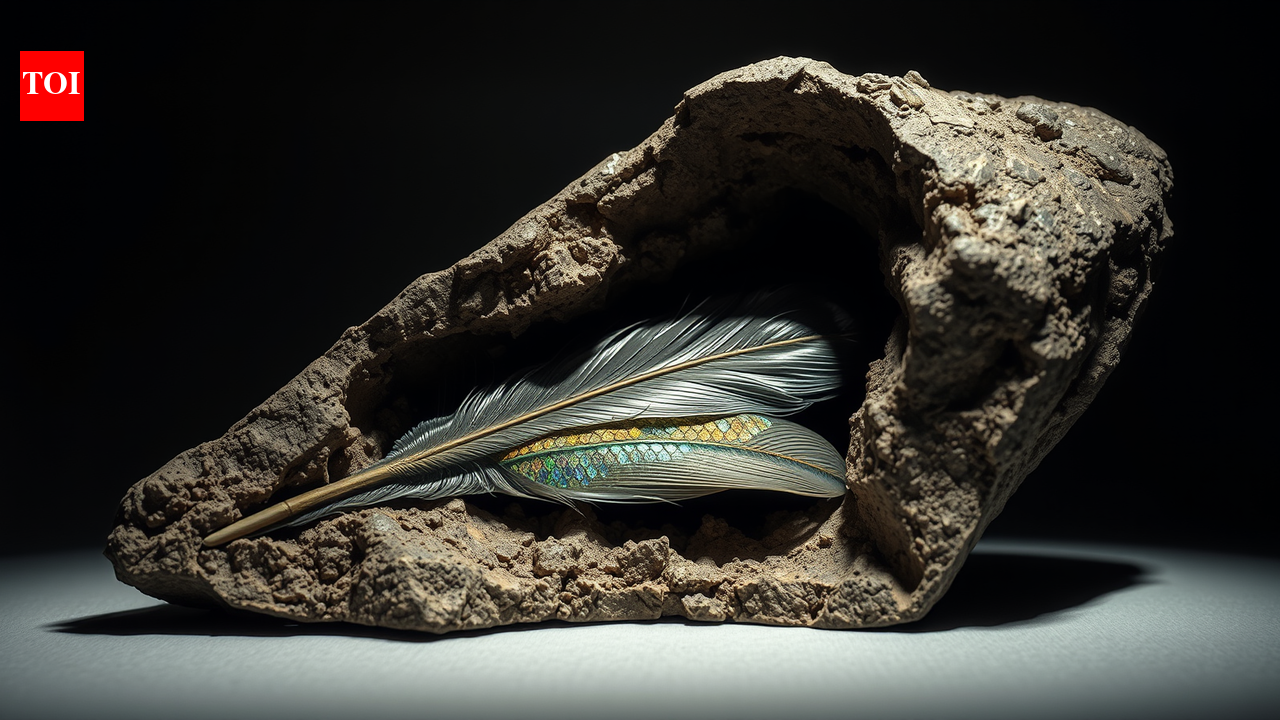
CT scans later revealed multiple feathers, fish scales and leg bones from an extinct group of diving birds called hesperornithiforms.
Its anatomy includes features associated with modern birds, while other feathers preserved in the same coprolite retain more primitive characteristics.
Researchers found multiple feathers, tiny fish scales and leg bones inside the coprolite, with the structures retained in three-dimensional detail.
The researchers concluded that the feathers preserved alongside the bones came from the same bird.
Feathers are rarely preserved in the Late Cretaceous fossil record, and most known fossil feathers from other settings are preserved as flattened impressions rather than three-dimensional structures.
Representative Image of a dinosaur coprolite revealing remarkable bird feathers and fish scales inside (AI Generated Image)
A strange nodule revealed a feather from the end of the Cretaceous
The feathers belonged to an extinct group of diving birds
Living near water did not guarantee survival
One fossil could open a new way to study ancient feathers
A chance discovery in Montana has uncovered exceptionally preserved bird feathers inside a 66 million-year-old piece of fossilised dinosaur dung, giving scientists a rare look at plumage from the final days of the dinosaur era. David DeMar Jr., a research scientist at the University of Washington and collections manager for the Hell Creek Project at the Burke Museum, found the fossil in 2016 while collecting fish fossils in the Hell Creek Formation in eastern Montana. CT scans later revealed multiple feathers, fish scales and leg bones from an extinct group of diving birds called hesperornithiforms. The principal feather is described by researchers as among the best-preserved feathers recovered from Mesozoic rock. Its anatomy includes features associated with modern birds, while other feathers preserved in the same coprolite retain more primitive characteristics. The findings, published in Current Biology on September 10, 2026, could help researchers investigate why some ancient birds survived the mass extinction 66 million years ago while hesperornithiforms and other non-modern bird lineages disappeared. This extraordinary fossil demonstrates how unconventional discoveries can reveal profound insights into evolutionary biology, offering rare glimpses into the intricate food chains that shaped prehistoric ecosystems millions of years ago.DeMar was searching a rocky outcrop in Montana in 2016 when he noticed a dark, reddish-brown nodule about half the size of a golf ball. He had been collecting fish fossils when he picked up the object and examined its surface with a hand lens. A tiny feather was exposed in the rock. The discovery was particularly striking because no feathers had previously been found in the Hell Creek Formation, despite more than a century of fossil prospecting in the region. Researchers later identified the nodule as a coprolite, or fossilised dinosaur dung, produced by a medium-sized theropod. The exact dinosaur cannot be established from the coprolite, although the study considers animals such as Nanotyrannus or Anzu as possible producers.Back in the laboratory, researchers examined the fossil's mineral composition and used micro-computed tomography to look inside it. The technique combines thousands of X-ray images to produce a three-dimensional representation of material hidden within the specimen. The scans revealed that the exposed feather was only part of what had been preserved. Researchers found multiple feathers, tiny fish scales and leg bones inside the coprolite, with the structures retained in three-dimensional detail. The discovery meant the team could examine feathers that otherwise would have been almost impossible to identify from the fossil record.The leg bones found inside the coprolite belong to a hesperornithiform, an extinct group of aquatic birds that lived during the Cretaceous and were ecologically similar to modern loons. The researchers concluded that the feathers preserved alongside the bones came from the same bird. The study describes them as the first hesperornithiform feathers ever found. The principal feather is particularly important because it preserves its three-dimensional structure. Researchers identified a square-shaped rachis, or central shaft, containing a sponge-like internal structure called a medulla. Those characteristics occur in living birds and their immediate ancestors, showing that an anatomically modern type of lightweight, stiff feather had already evolved among pennaraptoran dinosaurs before the end-Cretaceous extinction.Two of the preserved feathers, including the one visible on the outside of the coprolite, show this combination of modern-looking characteristics. The researchers say no other Mesozoic feather is known with the same combination, while the next older record of the sponge-like internal structure comes from the early Eocene of Denmark, about 10 million years later. The fish scales provide another important clue. They belonged to a gar and were interpreted by the researchers as the hesperornithiform's own last meal, eaten shortly before the bird itself was consumed by the theropod. The coprolite therefore preserves evidence of a sequence in the Late Cretaceous food chain: the aquatic bird ate the fish, and the theropod subsequently ate the bird.Hesperornithiforms were close evolutionary relatives of the bird line that includes species living today, but they disappeared during the end-Cretaceous mass extinction. This raises a question because some researchers have proposed that living near water may have helped certain birds survive the environmental upheaval associated with the extinction. Hesperornithiforms were themselves aquatic birds, yet they did not survive. That has led the researchers to consider whether their anatomy, particularly their feathers, could have contributed to their vulnerability.Lead author Jingmai O'Connor of the Field Museum said the researchers suspect that the types of feathers these birds possessed, or the way they replaced those feathers through moulting, may have influenced which bird lineages survived. The hypothesis centres partly on insulation. Some hesperornithiform feathers appear modern and waterproof, which would have been useful for diving birds, but the animals also retained smaller, fuzzy body feathers with more primitive characteristics. The researchers propose that if these body feathers were less effective at retaining heat, the birds may have struggled during the severe environmental disruption that followed the end-Cretaceous impact. This remains a proposed explanation rather than a demonstrated cause of their extinction.The discovery is unusual not only because of the quality of the feathers but because of where they survived. Feathers are rarely preserved in the Late Cretaceous fossil record, and most known fossil feathers from other settings are preserved as flattened impressions rather than three-dimensional structures. The coprolite effectively protected the feathers from being compressed flat, allowing researchers to examine their internal anatomy. The team also believes the specimen was discovered at precisely the right moment because it had naturally split open, exposing one of the feathers and prompting DeMar to investigate it more closely.O'Connor described the work as a form of detective investigation because researchers had no complete bird skeleton to study and instead had to piece together clues from the coprolite's contents. She hopes the discovery encourages researchers to CT scan more coprolites, since other fossilised dung specimens could contain biological remains that are invisible from the outside. The specimen's unusual preservation gives researchers an opportunity to study not only the anatomy of an extinct bird but also the sequence of events surrounding its death. A bird that had recently eaten a gar was itself eaten by a theropod, leaving behind feathers, bones and traces of its last meal inside the predator's fossilised dung.