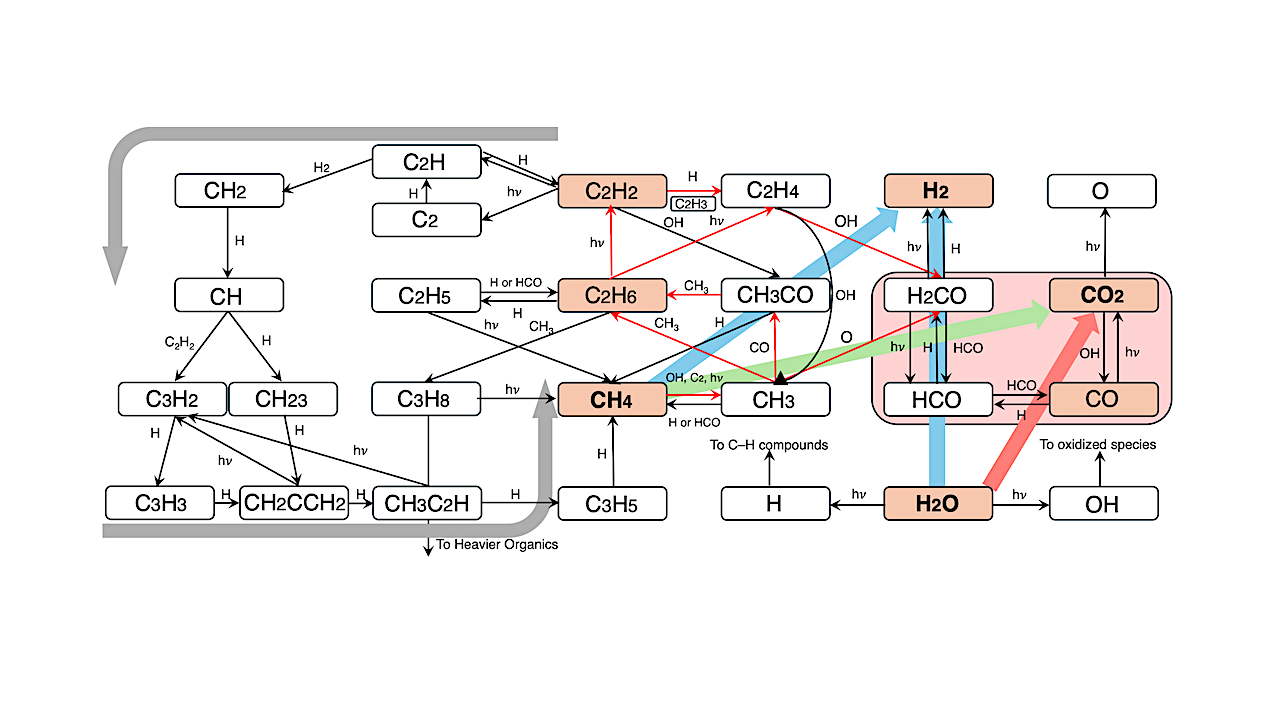
Thick colored arrows represent the net transport of atoms: blue for H, green for C, and red for O.
The thick gray curved arrow highlights the circulation loop of hydrocarbon (C–H) species.
— astro-ph.EPThe nature of the sub-Neptune K2-18b is debated between Hycean and mini-Neptune interpretations.
We test whether self-consistent Hycean atmospheres are compatible with current JWST transmission spectra by combining one-dimensional photochemical modelling, radiative–convective equilibrium calculations, and forward modelling of transmission spectra.
Our photochemical simulations show that H 2 -CH 4 -H 2 O networks generically drive CO to mixing ratios of order 1-2 %.
Diagram of the dominant chemical reaction pathways in our photochemical network. Bold text indicates the initial chemical species. Species shaded in light orange correspond to those plotted in Figure 5 and included in the absorption calculations for the transit spectrum shown in the upper panel of Figure 9. Thick colored arrows represent the net transport of atoms: blue for H, green for C, and red for O. The thick gray curved arrow highlights the circulation loop of hydrocarbon (C–H) species. The thin light-red box on the right-hand side highlights the oxygen-bearing CO/CO2 cycle into which a small fraction of carbon leaks from the hydrocarbon loop. Under the CO2-bearing reference case of this study, approximately 99% of the carbon from CH4 remains within the C–H circulation loop (thick gray arrow), while about 1% is directed towards oxidation (red arrows), leading to its consumption. Arrows extending from C3 species imply further polymerization leading to the formation of heavier organic hazes. — astro-ph.EP
The nature of the sub-Neptune K2-18b is debated between Hycean and mini-Neptune interpretations.
We test whether self-consistent Hycean atmospheres are compatible with current JWST transmission spectra by combining one-dimensional photochemical modelling, radiative–convective equilibrium calculations, and forward modelling of transmission spectra.
We assume H 2 -CH 4 -H 2 O atmospheres over a liquid ocean, compute altitude-dependent abundances with a 1D photochemical model, and couple them to P-T profiles that avoid runaway greenhouse states.
Using the CH4-dominated 2.8-4.0 μm band, we constrain wavelength-independent offsets between NIRISS SOSS and NIRSpec G395H for multiple reductions, and then scan grids of CO and CO 2 scaling factors, weighted by the CH 4 -band offset posteriors, to evaluate oxidised-carbon abundances consistent with the 4-5 μm region. Radiative–convective calculations further map pressures and albedos that yield non-runaway climates.
Over a wide range of temperatures and pressures, liquid oceans can exist, and Hycean models with a 1 bar H 2 envelope, percent-level CH 4 and CO, and CO 2 buffered at ∼10−3-10−2 reproduce the NIRISS and NIRSpec spectra from 0.8 to 5.2 μm without invoking DMS or other additional species.
Our photochemical simulations show that H 2 -CH 4 -H 2 O networks generically drive CO to mixing ratios of order 1-2 %. Mass-balance arguments imply that a ∼1 bar H 2 envelope with percent-level CH 4 requires interior replenishment on gigayear timescales, and the resulting vertical gradients naturally generate flat, CH 4 -dominated plateaux in transmission.
While mini-Neptune scenarios remain viable, our results show that Hycean configurations are likewise consistent with the data, and current CO and CO 2 constraints alone are not yet sufficient to rule out Hycean interpretations of K2-18b.
Takuya Fujisawa, Masashi Shimada, Tatsuya Yoshida, Kiyoshi Kuramoto
Comments: 28pages, 15figures
Subjects: Earth and Planetary Astrophysics (astro-ph.EP)
Cite as: arXiv:2605.17803 [astro-ph.EP] (or arXiv:2605.17803v1 [astro-ph.EP] for this version)
https://doi.org/10.48550/arXiv.2605.17803
Focus to learn more
Submission history
From: Takuya Fujisawa
[v1] Mon, 18 May 2026 03:26:08 UTC (6,401 KB)
https://arxiv.org/abs/2605.17803
Astrobiology, exoplanet,