For over two months now, we’ve all been focused on how much oil is being exported out of the Persian Gulf.
There’s been much less focus on what’s going INTO the Persian Gulf, so that’s what I’m digging into today.
But there’s an additional reason, which is that - without money from oil and gas exports - the poorer Gulf countries can’t pay for imports.
So, even if it were possible to safely ship goods into the Gulf, countries’ purchasing power is currently severely compromised.
China’s export data should net all this out, giving us a good summary perspective on what’s going on.
Thank you for subscribing to my posts. If you’re not yet a paying subscriber, please consider becoming one. That’ll allow you to DM me with questions and comments. I plan to move my posts behind a paywall in coming months. Subscribing now locks you in at a low rate. Thank you so much for your support and feedback!
For over two months now, we’ve all been focused on how much oil is being exported out of the Persian Gulf. I’ve covered this extensively, including in my posts on tanker traffic through the Strait of Hormuz, which remains severely encumbered, and in my posts on what this means for oil prices, which have risen over 80 percent so far this year and in my opinion largely price the resulting supply disruption.
There’s been much less focus on what’s going INTO the Persian Gulf, so that’s what I’m digging into today. I look at Chinese export data to countries in and around the Persian Gulf. China does a great job publishing these data quickly, which means we already have monthly data through April, giving us a great perspective on all the disruption to goods trade heading into the region.
There’s several reasons why China’s exports into the Gulf will have fallen sharply. The most obvious one is that Iran continues to blockade the Strait, so it’s impossible for China (or anyone else) to run meaningful trade volumes to countries in the Persian Gulf. But there’s an additional reason, which is that - without money from oil and gas exports - the poorer Gulf countries can’t pay for imports. So, even if it were possible to safely ship goods into the Gulf, countries’ purchasing power is currently severely compromised. That said, the story is different for the richer countries in the region, which have lots of saved-up cash and large expat communities that are clamoring for their creature comforts. Hence the stories about truck convoys taking goods from ports in Oman to the UAE. China’s export data should net all this out, giving us a good summary perspective on what’s going on.
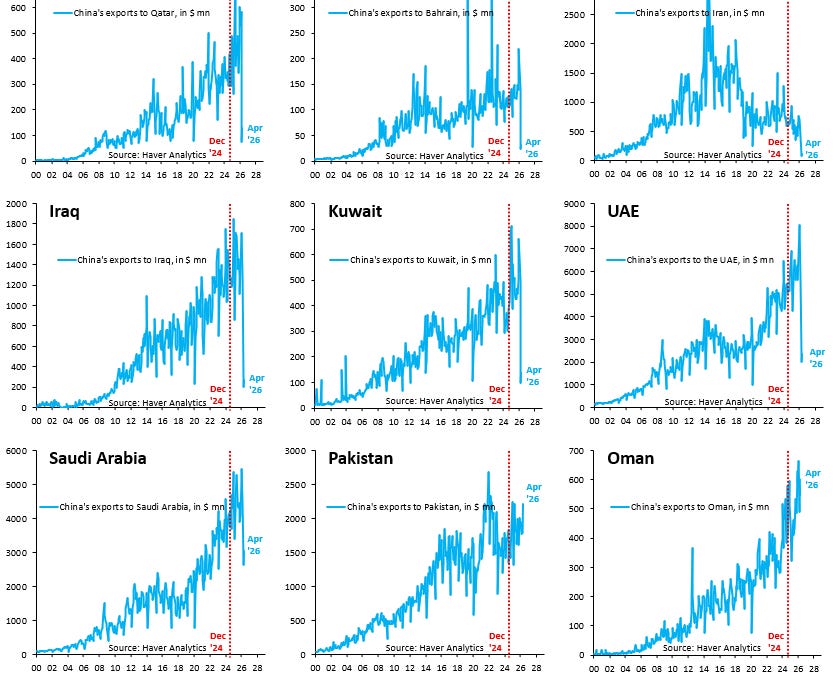
The charts above show China’s monthly export values in millions of US Dollars to Qatar (top left), Bahrain (top middle), Iran (top right), Iraq (middle left), Kuwait (dead center), the UAE (middle right), Saudi Arabia (bottom left), Pakistan (bottom middle) and Oman (bottom right). You can think of countries in the bottom row as my control variables, because they have access to shipping routes beyond the Strait of Hormuz, which means trade will be much less impacted than for countries inside the Gulf.
The chart above summarizes across the nine countries how China’s exports have fared in the year through April 2026. Countries like Oman (OM), Pakistan (PK) and Saudi Arabia (SA) don’t depend on the Strait (or to a lesser extent) and have therefore seen relatively little disruption. The disruption is largest for Iraq (IQ), Bahrain (BH), Qatar (QA) and Iran (IR), while Kuwait (KW) and the UAE (AE) occupy a middle ground.
I’m a fan of the US blockade of Iran for reasons I laid out in a series of pieces back in March. It’s reassuring to see that Iran has been hit as hard as most of its neighbors, which in no small part will be due to the US blockade. How quickly this brings Iran to the negotiating table in good faith remains an open question unfortunately.