News world 800 KMs In 5 Secs: China's Experimental Maglev Train Breaks Its Own Record800 KMs In 5 Secs: China's Experimental Maglev Train Breaks Its Own RecordPublished By :,Last Updated: August 14, 2026, 10:37 ISTChina’s experimental maglev train has reached 800 kmph in 5.3 seconds, setting a new acceleration record while testing high-speed levitation, propulsion and braking technologies.
Rapid ReadChina has, with its latest experimental Maglev train, broken its own record by reaching 800 kmph speed in just under 5 seconds.
The ultra-high-speed maglev vehicle achieved the feat on a 1-km test track at the Donghu Laboratory in Hubei province, according to media reports.
How Maglev Trains Reach Extreme SpeedsChina first tested the experimental maglev system in June 2025, when the vehicle reached 650 kmph in seven seconds.
After reaching 800 kmph, the experimental train slowed to a complete stop over a distance of nearly 200 metres.
News world 800 KMs In 5 Secs: China's Experimental Maglev Train Breaks Its Own Record
800 KMs In 5 Secs: China's Experimental Maglev Train Breaks Its Own Record
Published By :
,
Last Updated: August 14, 2026, 10:37 IST
China’s experimental maglev train has reached 800 kmph in 5.3 seconds, setting a new acceleration record while testing high-speed levitation, propulsion and braking technologies.
Rapid Read
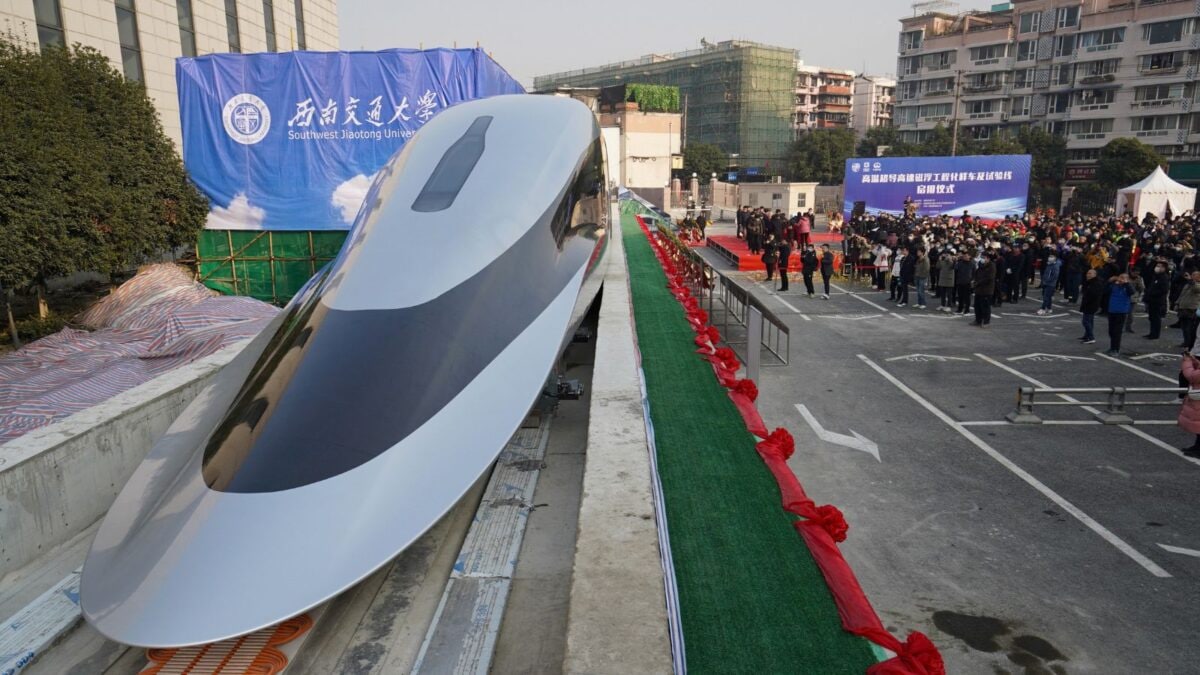
China has, with its latest experimental Maglev train, broken its own record by reaching 800 kmph speed in just under 5 seconds. (Image source: AFP)
China’s experimental maglev train has reportedly set a new acceleration record after reaching 800 kilometers per hour from a standstill in just 5.3 seconds, marking the third time in six months that the system has surpassed its previous benchmark.
The ultra-high-speed maglev vehicle achieved the feat on a 1-km test track at the Donghu Laboratory in Hubei province, according to media reports. The test focused on the train’s ability to accelerate rapidly while maintaining stability and control at extreme speeds.
The 1.1-tonne experimental vehicle had previously reached 798 kmph, surpassing its earlier record. In December 2025, the same system had accelerated to 700 kmph in just two seconds.
How Maglev Trains Reach Extreme Speeds
China first tested the experimental maglev system in June 2025, when the vehicle reached 650 kmph in seven seconds.
Maglev trains use magnetic forces to eliminate direct contact between the vehicle and the track. Magnetic fields lift the train above the rail, reducing friction, while electromagnetic forces generated through coils along the track propel it forward.
The track must maintain extremely precise alignment to allow the system to operate safely at very high speeds. According to CGTN, China’s state-owned media group, deviations are kept within 0.5 millimetres.
Maglev technology is already used for passenger services in China and Japan, although conventional operational speeds are far below those achieved in the latest experiment. China’s fastest commercial high-speed rail services can reach around 350 kmph.
Researchers Test Braking And Other Technologies
The latest test was not limited to acceleration. Researchers also demonstrated that the vehicle could decelerate rapidly while remaining under control.
After reaching 800 kmph, the experimental train slowed to a complete stop over a distance of nearly 200 metres.
The trial also tested several technologies needed for ultra-high-speed transport, including high-power energy delivery, levitation control, electromagnetic propulsion and emergency braking systems.
Chinese researchers are also exploring next-generation maglev systems that could operate inside tubes with extremely low air pressure or near-vacuum conditions. Such systems could potentially reduce air resistance and allow even higher speeds.
China’s Push For Faster Maglev
China has invested heavily in developing next-generation maglev technology. In 2020, CRRC Qingdao Sifang unveiled and tested a prototype designed to reach speeds of up to 600 kmph.
Researchers at Southwest Jiaotong University in Chengdu have also been developing high-temperature superconducting maglev systems aimed at exceeding 600 kmph, according to Xinhua.
The latest 800-kmph vehicle remains an experimental system and is not designed for passenger service at the moment. Researchers are studying whether technologies developed through such tests could eventually be applied to ultra-fast transport and other high-speed applications, including spacecraft and aircraft launch systems.
News18 Newsletter Handpicked stories, in your inbox A newsletter with the best of our journalism submit
Location : Beijing, China
First Published: August 14, 2026, 10:37 IST
Disclaimer: Comments reflect users’ views, not News18’s. Please keep discussions respectful and constructive. Abusive, defamatory, or illegal comments will be removed. News18 may disable any comment at its discretion. By posting, you agree to our Terms of Use and Privacy Policy Loading comments...